




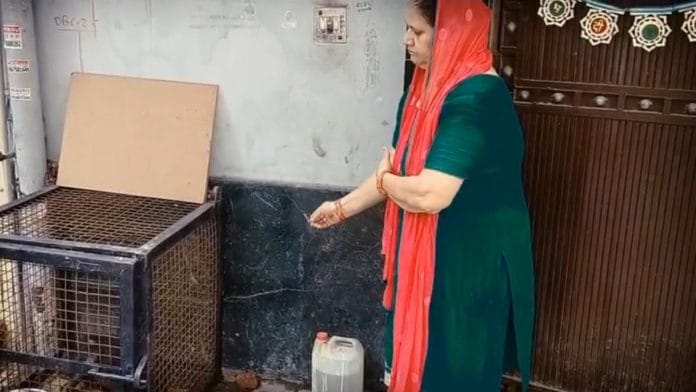

Religion, politics and pigs all came together in a Delhi neighbourhood recently, such that it would leave one scratching their head. According to the report, Hindu families in Tri Nagar—home to over 70 Muslim households—were worshipping pigs, often caged, alongside images of Varaha, the boar-headed Hindu deity.
Was it simply an act of devotion or a not-so-subtle political message to Muslim families? The debate is unfolding on social media.
Both sides, unsurprisingly, have their own accounts. The Hindu families maintain that it is an expression of belief. Residents from the Muslim community, however, allege that the act is provocative, pointing out that pigs are given Muslim names such as Sultan or Abdul.
It’s tragic that Varaha, whose story is about saving the earth and restoring cosmic order, is being turned into something ridiculously petty. A story that once spoke of saving the world is now being rewritten to draw lines within it. Religion can be a bridge based on our shared humanity, but it always ends up becoming a barrier.
Religion belongs in the spiritual domain, where it can guide one’s personal morals. When it takes a political shape, it becomes a question of how society should be organised: who fits within a space and who must be thrown out. That is the case of Delhi’s Tri Nagar.
Over a year ago, L&T chairman SN Subrahmanyan sparked controversy by suggesting a 90-hour work week.
“How long can you stare at your wife? How long can the wives stare at their husbands? Come on, get to the office and start working,” he said.
Perhaps Subrahmanyan captured an insight not understood at the time—a gruelling work week might be a better alternative to devoting this amount of time, energy, and effort into annoying your neighbours. One of the videos featured a woman sharing a plate of food with her pet pig. These scenes would make for a great Bollywood comedy, were there no darker forces at play.
Also read: Tamil Nadu’s elections are fought on delivery—ideology appears only when needed
A new symbol of hate
You may bring a pet into their life out of care, even out of devotion. But if the primary reason is to create discomfort for others, it should give you pause.
It’s a case of not being able to see the wood for the trees. When you spend so much effort on obsessing over others, it stops being about them entirely. Your decisions begin to be shaped by resentment and hostility.
Social media influencers and TV personalities who heavily generalise Muslims might find a certain comfort in the pig worship. It creates a space where they don’t have to word their hatred clearly, but can still signal it.
And that is what makes the episode more dangerous.
Openly calling for ‘genocide’ or marginalisation of a community is not acceptable anymore. But the sentiment does not disappear. It finds more socially acceptable ways to express itself. And sometimes, it begins to show up through small actions, such as caging up and worshipping an innocent animal.
Neither Delhi nor India are alone in their newfound love for pigs. Last month, MAGA supporters in New York organised a pig roast in front of Muslim mayor Zohran Mamdani’s office. But the funniest part about such incidents remains that they’re is based on a misunderstanding rooted in ignorance. Hindus and Christians can eat all the pork they want and keep pigs as pets—that does not bother Muslims. Pigs exist everywhere, including on the streets in many parts of India. Muslims see them, but they simply choose not to touch them. It is a personal religious practice.
The pig politicisation saga smuggles destructive communalism under the guise of spiritual practice. The veneer is especially thin in this particular instance, even if the provocation is not unique to Delhi or Hindus. It’s a well-practised strategy being deployed around the world. And for those of us who wish to see a harmonious, tolerant India, the four-legged pigs are not the real threat.
Amana Begam Ansari is a columnist, writer, and TV news panellist. She runs a weekly YouTube show called ‘India This Week by Amana and Khalid’. She tweets @Amana_Ansari. Views are personal.
(Edited by Prasanna Bachchhav)
Well written article. Unnecessary politicization of religion is happening. Message of Varaha is being muddled by stupidity.
Do Muslims even realize why Hindus are becoming increasingly angry? Muslims see themselves as Muslims first, Indians second (if at all). Hindus see Muslims as belonging to India only because it benefits them.
Did Iran need to collect donations from poor Shias in Kashmir? No. But it did so to remind them where their loyalties should lie. Bahrain and even Pakistan told protesting Shias to go to Iran if they loved Iran so much. India did not because of the trouble Muslims would create in the country if it did so. Hindus see instances of Muslim disloyalty every day.
Muslims are being manipulated every day by Saudi, Qatar and Iran. And creating fault lines within the countries they live in. Their countrymen, whether in Europe, India or parts of Asia, see them as disloyal and dangerous.
Muslims have taken performative religion and religious passive-aggressive actions to a fine art. Did you see so many women in burkhas and head coverings all over the world 20 years ago ? And taking over entire roads for namaz and forcing others off the roads has been a time-honored tradition in India.
When one religion makes passive-aggressive performance such a big part of itself, you should expect others to do the same. Sadly, none of this has anything to do with actual religion.
So let me get this straight.
Mandatory cow sacrifices because kuff*r worship the cow – this is personal freedom of religion.
But someone keeping a pet they worship – this is meant to target your beliefs even when 1. the said belief is pre-existing and 2. it’s literally their pet in their home.
Maybe now is the time to preach: ‘Look away if you’re offended’?
Carl Jung said that you eventually become what you worship. Let’s see where this ends up.
Putting up the picture of a woman praying to a pig is actually a subtle way of showing Hinduphobia.. which Ms. Amana may not have realized, and hence condoned
This is not politicisation at all.
Hindus are assertively stating that they are completely vexed with Islamists/musleems, and their hostility towards Muslims. There are large issues at play here that The blogger doesn’t understand and will never get it.
When extremist groups explicitly claim to act in the name of Islam (or any religion), they’re asserting themselves as representatives, and that claim shapes how outsiders perceive the broader community, fair or not.
When a community’s institutional or political leadership either enables, excuses, or fails to clearly condemn members’ actions, there’s a collective dimension. 3xample…You see muslims in JK donating Gold and cash and what not for Iran. Have you seen any of them donating or contributing or consoling the 26 Hindu Pahalgam victims’ families of Izzlamik terrorism.
Those Hindus keeping pigs as pets are openly protesting against Izzlam and it’s lack of checks and balances. Wake up and see, smell and taste the reality of Hindus lived experiences, in their own country.
Reverence for all life – including board/pigs – a concept very evidently completely foreign to Abrahamics, is not a political strategy but deeply rooted in the Dharmic ethos. We were all (including, we believe, those who deny it) incarnated as different forms of life and will be reincarnated as them. This is why we see all life as sacred.
This philosophy has existed since long before the Abrahamic faiths even entered the scene with claims of the supremacy of man over nature. It is far from a politicisation – Dharma is not so malleable as to be modified to target the beliefs and practices (no matter how rational or not) of others.
Honestly, as a Muslim, this doesn’t deter me at all, I’m not going to avoid streets just because there are pigs. The idea that this would intimidate people feels disconnected from reality.
What it does highlight, though, is a kind of growing tribalism,where actions are less about genuine belief and more about signaling identity in opposition to another group. It stops being about religion and becomes more about ‘us vs them.’
If something is being done mainly to provoke or mark territory, it reflects insecurity and polarization at a local level rather than strength or conviction. In the end, this kind of behavior just deepens divisions without actually solving anything.