






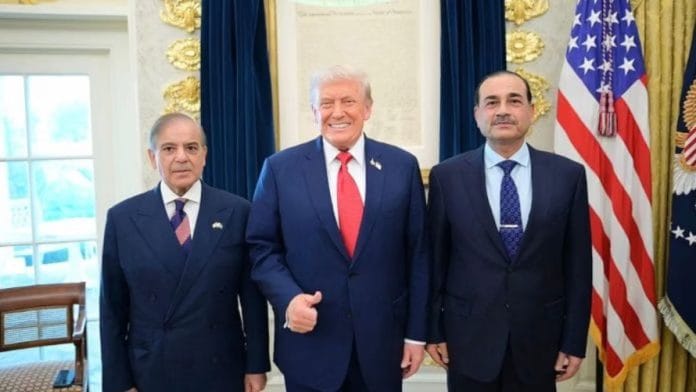


Pakistan Army chief Field Marshal Asim Munir was confident that his multiple backchannel visits to Iran would soon pay rich dividends as both Washington and Tehran were desperate to sign a long-awaited deal to formally terminate the conflict. Munir appeared determined to deliver what the US President Donald Trump expected from his “favourite field marshal”.
The wider architecture of US-Iran engagement remains driven by forces far beyond Islamabad’s direct control. But Pakistan’s military establishment was eager for the deal announcement to project it as Munir’s personalised statecraft and Pakistan’s geopolitical indispensability. However, the regional chessboard has shifted abruptly, and Pakistan might just have lost its moment to bask in the sun.
Trump’s latest desire for Pakistan and other Muslim countries to align themselves with the Abraham Accords under a bigger scheme of things has put Islamabad in an unusually fraught position. Having garnered international attention and visibility through his mediation efforts in evolving US-Iran engagement, Munir is in danger of being stuck between ultimately irreconcilable pressures of Trumpian expectations, the domestic Islamist outlook and Pakistan’s historical stance towards the Palestinian cause.
What at first seemed an opportunity for diplomatic advancement appears to be quickly coming to mirror a familiar case of use and discard, reinforcing Defence Minister Khawaja Asif’s remark that the US had treated Pakistan like “toilet paper”.
A one-sided love affair
No country can be “used” in this shabby manner by any external manipulator unless, through its own strategic choices, it has placed itself in such a position. It’s possible that even Munir himself, somewhere deep down inside, may begin to wonder whether Trump merely “used” him.
Yet this pattern is hardly new in Pakistan’s strategic experience. Pakistan’s early history makes its reliance on external patronage almost inevitable. Formed in haste, with its frontiers undefined, its political system still in infancy, and its armed forces already powerful, Pakistan needed a degree of stability which could only come from external ballast.
In the 1950s, such ballast came in the form of a partnership with the US. Joining organisations such as CENTO and SEATO meant having access to arms and support. However, this alliance was driven by short-term tactical calculations rather than a shared ideological vision or a “common destiny.”
In the anti-Soviet jihad in Afghanistan, Pakistan became indispensable. It served as a useful channel for money, weapons and backroom dealings. Its intelligence capabilities were enhanced, and its strategic value was heightened. But with the end of the war came the realisation of the provisional nature of all this inflated significance. With the withdrawal of the Soviets came the flight of the Americans — sanctions were imposed, aid was withheld, and the former ally was increasingly viewed as the problem.
The trend persisted after 9/11 with near mechanical regularity. Pakistan once again found itself being labelled indispensable. It was once again designated a “major non-NATO ally” and received huge amounts of aid. The same old dilemma of competing allegiances once again marred the relationship. When the US finally retreated from Afghanistan in 2021, Pakistan found itself dealing with the consequences of an unfinished war.
This phenomenon cannot be viewed purely in external terms. There is an internal logic to it. Pakistan’s ruling elite, especially the military and bureaucracy, has always considered alignment as a strategic asset. External patronage has reinforced internal power, offset economic weakness and offered a perception of strategic advantage against India. But affection is not the name of the game in these alignments. Only calculations are.
Anti-American sentiment among a vast segment of the populace does not preclude cooperation because the military has perfected the art of stifling the voice of the Pakistani people. In official jargon, sovereignty is loudly claimed, but quietly undermined. A state apparatus habituated to living in someone else’s strategic framework gradually loses the ability to think independently for itself.
At independence, India too had faced a series of vulnerabilities and chosen a far more difficult path. Under the then Prime Minister Jawaharlal Nehru, non-alignment was not merely a moral posture. India’s decision not to align with either of the rival blocs was to maintain autonomy in its foreign policy decisions. This approach enabled India to deal with the Cold War blocs without becoming a junior partner of either.
This was not to say that India was not weaker than the superpowers, but it was not in a state of subordination either. There were episodes of intimacy which were misinterpreted as dependence. For instance, the rapprochement with the Soviet Union in 1971 was a tactical move to cope with an immediate problem and not an abandonment of autonomy. India obtained what it wanted — a certain degree of political and strategic insurance during an existential security crisis — without sacrificing any real sovereignty.
Also read: Pakistan wants to revive Middle East alliance yet again. Terrible ideas die hard
A lesson for India
In the post-Cold War era, this instinct has evolved. India’s relations with America have been strengthened in various domains. The agreements made during the tenures of both Manmohan Singh and Narendra Modi have been a symbol of a new era in Indo-US relations. However, it has not been a classical alignment as India still maintains strong relations with Russia.
The practice of strategic autonomy requires both patience and restraint because the temptation of alignment is so strong. External assistance may provide a boost to development, give confidence and make decision-making easier. But it also creates the risk of intellectual dependence and subservience.
The result of not resisting this temptation can be seen in Pakistan’s strategic culture. Decades of being a collaborator in unnecessary conflicts initiated by others have normalised proxy warfare and tactical ambiguity as part of statecraft. These approaches make it hard to distinguish between state and non-state action. Moreover, they have entrenched a vicious cycle wherein conflicts are used as a means and a way of life.
Strategic autonomy is not a fixed position but a continuous process. There has been a growing closeness between India and the US, especially in light of strategic competition between Beijing and Washington. At the same time, the increasing proximity with Israel appears to be adding a layer of complexity to its relations with Iran. Yet these apparent contradictions reflect the very essence of autonomy.
Essentially, the difference between Pakistan and India has been one of structure and choice. One is built on seeking security from external sources and living with the limitations that come with it. The other is built on seeking to create its own capacity, engaging externally on its own terms. The first provides immediate gratification yet lacks agency. The second provides agency but lacks immediate gratification. In this model, national dignity is not some ethereal concept. It is the outcome of having the power of choice. A state that has the power of choice would maintain its dignity, even at some material costs.
The ‘toilet paper’ analogy, however distasteful, is an apt portrayal of this imbalance in motion. Once dependence sets in, it does not change just the external environment; it changes the internal dynamics as well. Pakistan’s external significance at the moment may temporarily mask its internal decay, and its current confidence emerges from precisely this phenomenon.
But the danger lies in the fact that this condition develops a self-reinforcing momentum. External use gives way to internal adaptation, which further enables external usage. Escaping this cycle requires institutional transformation, economic strength and a paradigm shift in strategic thinking. Nonetheless, its military leadership appears incapable of doing it.
What is the lesson for India? Amid intensifying domestic debate about preserving strategic autonomy at a moment when the Trump-led America is increasingly weaponising trade and alliances, the core reminder is that autonomy is never self-sustaining. It has to be constantly defended against outside pressures and inside complacency.
The temptation of closer association with powerful states will always be there, and in a world of shifting balance and alliances, this temptation will be all the stronger. For New Delhi, the real challenge is how to engage deeply without slipping into dependence. Sovereignty is not merely a statement, but a practice defined by actions. And once this practice is abandoned, it disappears with far more pernicious effects.
Vinay Kaura is Assistant Professor, Department of International Affairs and Security Studies, at the Sardar Patel University of Police, Security and Criminal Justice in Rajasthan. Views are personal.
(Edited by Saptak Datta)