






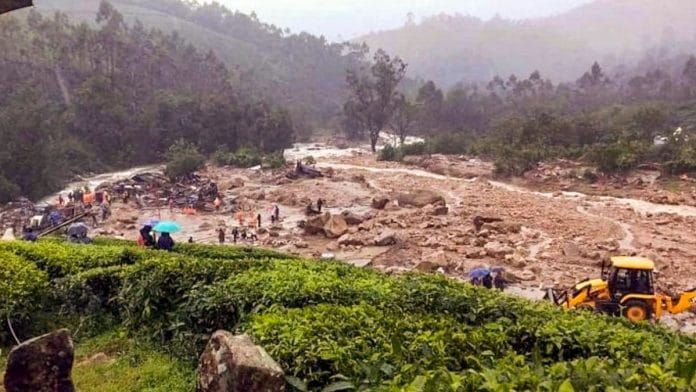



The last thing that the seven people who died in the avalanche at Zojila Pass on 27 March would have seen was the sunshine. It was the sunshine, in fact, that killed them.
Midday warmth is known to loosen the snowpack above the Srinagar-Leh highway, sending it down the slopes. It’s also well-known that March is an avalanche-prone month and that the early morning hours, up to 10 am, are generally considered safer than afternoons. The avalanche that occurred between 12.30 pm and 1 pm bore down on a mix of heavy and light vehicles, even though advisories suggest that heavy vehicles be allowed only after light ones. Among the dead is a 10-year-old child, while a search for two more missing people continues.
In about four weeks, the avalanche will be all but forgotten. The Indian summer will be upon us, and schools will break for the annual vacation. Hours will pass in the delirious search for finding a homestay at the last possible village in Uttarakhand or Himachal. The season must go on, because #TheMountainsAreCalling. What is the death of seven people, when thousands of lives have been lost in the last few years?
Strain on the mountains
For generations, India’s northern states were a salubrious escape from the hellish summer of the plains. As the tourism sector evolved over the last 25 years, and 4×4 road journeys along sleek, many-laned highways replaced sleepy train rides, access to the Himalayas exploded in an unprecedented way. But for the last several years, the mountains have been sounding the alarm bells – in the form of landslides, flash floods, waste and water-management crises. But none of the bad news seems to dent the tourist enthusiasm.
Take Uttarakhand’s Joshimath, for instance. The culturally significant historical town is the gateway to several religious and tourist sites, like Hemkund Sahib and Auli. In 2023, 700 buildings developed cracks and became unfit for residence. The town, situated on debris left by ancient landslides, also began to sink.
But this wasn’t the first time Joshimath was under the microscope. Cracks in its houses first appeared in the 1960s. In 1976, a state committee recommended that blasting of boulders be immediately stopped, a pucca drainage system be developed, and chopping trees be banned to prevent landslides.
Joshimath, however, is now filled with luxury hotels.
By 2023, the town’s slow-motion sinking had become a cautionary tale about what unscientific construction on unstable mountain terrain actually looks like. By the following summer, the cautionary tale had vaporised, and the Char Dham Yatra—whose infrastructure expansion is one of the reasons geologists have been alarmed about these valleys for years—drew more than 50 lakh pilgrims. In 2012, that number was 4.5 lakh.
Religious tourism is only one part of the immense strain on the mountains. During peak season last year, 67 per cent of Himalayan tourist destinations had to ration water for residents to ensure the hotels stayed supplied. The average tourist in the mountains consumes between 150 and 200 litres of water a day, while the average local uses between 30 and 40. In Shimla, last June, 15,000 vehicles entered the city in a single day, even though its parking infrastructure can accommodate only 5,000.
The tourist, however, is only the easiest to scapegoat, and the most visible link in this chain—not the most consequential.
Also read: Where’s climate in AI conversations? Biodiversity collapse is missing
Never-ending development
The expansion of India’s highway network into the Himalayas has been one of the more momentous infrastructure projects of the last two decades. The Himalayas are geologically young mountains, their rock masses highly fractured and prone to failure under the kind of stress that road-building introduces. Slopes are routinely excavated at near-vertical angles to save costs and space, destabilising the hillside.
The effects of this destabilisation are often seen only years later, maybe in a sinking village or a landslide following a mild shower.
The original cost of the Parwanoo-Solan four-lane project was Rs 934 crore in 2015. However, as this report clarifies, ‘by 2022 repeated landslides led to an escalation of costs by 65 per cent, to Rs 1,541 crore’. In February 2023, the NHAI had to release a tender for Rs 122 crore for “slope protection work” at 32 locations along the route. The road that was built to open up the mountains is now, at considerable public expense, being protected from the mountains it opened up.
But the uninterrupted march of development carries on. None of these calamities has prompted a rethinking of the model.
Sanjay Austa, a former journalist who runs the Meena Bagh homestays in Himachal Pradesh, describes watching Chandratal, in Spiti Valley—once only accessible by a demanding trek—get a road. “Some areas should be untouched,” Austa said during an interview. “Chandratal remains one of my best trekking adventures because I had to work hard to get to a place of beauty. How else will you value that place?”
But the operating ideology that accessibility is an unqualified good and that no peak should be beyond reach turns the mountains into something to be consumed rather than reckoned with. It is an ideology with powerful political backing. Austa, citing the example of Hatu Peak, says that we have to make peace with the fact that not all places can be accessible to all people. Austa also has to sometimes turn down visitors with mobility issues, because the property, set in a permaculture organic orchard, can be reached only via a short trek.
‘Valley cannot accommodate a lot of people’
Meena Bagh is built around a traditional kaathkuni structure, a technique of layering wood and stone, without mortar, that produced structures so well-suited to the terrain that they were naturally earthquake-resistant. For generations, a kaathkuni structure was inherently eco-friendly—but that dynamic completely changes when you expand that aesthetic into a full-scale hotel.
The problem, as Austa points out with some weariness, is that a commercial kaathkuni hotel employs enormous quantities of deodar wood. Each of those trees takes two hundred years to reach maturity. “The kaathkuni is now a brand strategy for most commercial establishments,” Austa said. “But building these at scale only encourages illegal mining and tree-felling.”
Meena Bagh, thankfully, hasn’t had to deal with cataclysmic ecological disasters, but the effects of climate change are all too visible. Austa talks about the disappearance of amphibians from the farm around Ratnari, frogs and toads that once kept the beetle and slug population in check. Without them, pest pressure has exploded, and farmers have responded with pesticides, which have further decimated the bird populations that might otherwise have helped. The Himalayan bulbul, whose beak is too small for most insects, has adapted by switching to cherries and is now considered a pest itself.
The people who live in the mountains, too, have to do their own share of adapting. Sandhya (name changed), who runs a small homestay in Himachal Pradesh, has watched her valley transform in seven years from a green riverbank into an unbroken line of structures—commercial and residential. “The valley is very narrow and cannot accommodate a lot of people,” she told me. “When we started the homestay, one car would pass by in two days. Now, trucks are carrying construction material all around and I have a layer of dust in the homestay. Growing up, this was unheard of in the hills.”
Sandhya’s village of about 40 houses now has 15 homestays, many built with the help of hefty loans, taken by people who saw the post-Covid-19 tourism boom and moved fast. But the devastating rains and landslides of 2023 and 2025 have struck hard. “One of my staff members lost her house in the 2023 floods,” Sandhya said. “She decided to construct a pucca house after that. Then, in the July 2025 floods, her new house also got washed away.”
Sandhya’s own homestay is under threat: Land surveyors in the area have recommended evacuating the hill because the slope is extremely unstable. “But nobody wants to leave their home. People want to hold on to whatever they have, despite the risk to life.”
Also read: Why shielding consumers from rising fuel prices can backfire
Responsible tourism
The conversation around solutions, when it happens at all, tends to settle on “responsible tourism”. We must travel in smaller groups, we are told, and lower our footprint. Shikha Tripathi, a mountaineer and founder of Snowfox Escapes, a small trekking company, has spent years trying to build exactly this. For years, Tripathi has written about Himalayan trails like the Hampta Pass or Markha Valley trek, being overwhelmed by trekkers.
“Snowfox was born from this idea of finding solutions to the problems that I saw in the mountains,” she said. “And one of them was this massive annoyance and impact caused by big groups of trekkers that I would come across.”
Tripathi says that there is a massive difference in learning when groups become smaller.
But she is also honest about what the model cannot do. “I don’t know if there’s any tourism model for the Himalayas that is going to be sustainable to match the kind of demand that we have,” she says.
Tripathi knows that any solution will require a hard cap on numbers. “If you want to keep small numbers and low-impact groups, the cost of operating goes up. Now, if we combine it with who really gets to enjoy the mountains — is it someone with a true love for nature or mountains, or is it someone who can afford to pay a small company that is strict on its responsible travel guidelines? I’m still a little divided on how we can get to the right audience without having price as a barrier,” she says.
Responsible tourism, in other words, is largely tourism for those who can afford to be responsible. The mountains are open to everyone, but to love them well comes at a price.
Tripathi has a lovely philosophy, she says the mountains taught her: “See everything as if for the first time, and as if for the last time.” She means it as an instruction in wonder, and a way of staying present in a precious landscape. But in the Himalayas of 2026, with its deadly slopes, the last time is no longer a metaphor. We have loved these mountains so hard and so carelessly that one final, perfect view may be all that remains.
Karanjeet Kaur is a journalist, former editor of Arré, and a partner at TWO Design. She tweets @Kaju_Katri. Views are personal.
(Edited by Saptak Datta)