







Chennai: Vijay spent decades defeating corrupt politicians, saving the poor, and dismantling broken systems on screen. On counting day in Tamil Nadu, millions of voters handed him the chance to do it in real life.
In a state where the “actor‑chief minister” model is not new, actor-politician Vijay has delivered what many believed was impossible. His party, Tamilaga Vettri Kazhagam (TVK), stormed to 108 seats in the 2026 Tamil Nadu Assembly elections, shattering the decades-long dominance of the DMK-AIADMK duopoly and emerging as the single largest party in the state. Seen initially as a “third factor”, Vijay succeeded where stars like Kamal Haasan faltered, converting fandom into votes at scale.
Vijay entered politics without the organisational machinery that backed earlier actor-politicians such as MG Ramachandran, who spent years inside the DMK before launching the AIADMK. Vijay had no political apprenticeship, no cadre base, and no family network. Yet, powered by enormous fan loyalty, anti-establishment sentiment, youth-driven social media mobilisation, and a carefully cultivated on-screen image of a saviour fighting corruption and injustice, he managed to redraw Tamil Nadu’s political map in his very first electoral outing.
For breaking Tamil Nadu’s entrenched Dravidian binary, surviving the Karur stampede fiasco and swirling personal controversies, and proving that mass stardom can still be converted into a formidable electoral machine in the social media age, Thalapathy Vijay and Tamilaga Vettri Kazhagam (TVK) are ThePrint’s Newsmaker of the Week.
Hero of the masses
Vijay never had to struggle to draw crowds to his rallies since they assembled spontaneously, driven by his star power. In fact, such is his stardom in Tamil Nadu that TVK candidate VS Babu, the giant killer who defeated ex-Chief Minister MK Stalin, campaigned with a Vijay lookalike in the Kolathur constituency.
But after his political rallies became the spectacle, TVK hit a roadblock with the Karur stampede on 27 September 2025 when 41 people died and Vijay was nowhere to be found before releasing a statement on X hours later. He then posted a video message for the victims’ families on 30 September. Despite accusations against TVK of poor handling of the incident, delayed rally and lack of organisational capabilities, the party meetings gathered momentum in a few months.
Then in February 2026, Vijay’s wife, Sangeetha Sornalingam, filed for divorce after 27 years of marriage, accusing him of infidelity with a female actor, mental cruelty, neglect, and desertion since 2021. Vijay shrugged it off and then made an appearance with Trisha at a wedding in early March.
In a deeply conservative Indian society, where adultery is considered unacceptable, Vijay, the star hero, was largely forgiven and even protected by his fans.
The delay in the release of his last film, Jana Nayagan, stuck at the censor board for months over politically sensitive content and the subsequent case at the Madras High Court, even gathered sympathy from his fans.
Everything that came Vijay’s way, he tackled with characteristic defiance.
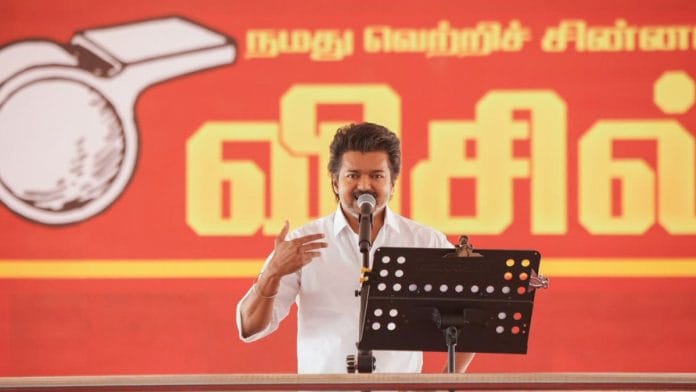
And behind this star power where everything is forgiven and forgotten is Vijay’s political campaigining that began 15 years ago through his films. Films like Mersal (2017), Sarkar (2018), Bigil (2019) and Kaththi (2014) consistently showed him as the hero of the masses fighting injustice, corruption and broken systems. The messaging was political education wrapped in mass appeal.
The movies saw the emotional investment of people across all age groups, making him the boy next door. This set the tone for the required cultural, emotional and mass infrastructure for TVK, the party he formed in 2024.
In his first state conference in Vikravandi, Vijay powerfully defended cinema’s role as a tool for political awareness when critics called him a “koothadi”, meaning a reckless actor.
“I am not the only one who was called ‘koothadi‘. Even MGR and NTR were called so. Movies are not just dance and songs. It is a tool for social change. Isn’t that how the DMK grew? ‘Koothadi’ is not a slur or an insult. ‘Koothu’ will speak values, politics, truth,” he said.
Tamil Nadu’s need for “change” and TVK’s emotive messaging
Vijay’s stance against BJP and DMK was clear, positioning TVK as the one against Hindutva forces and dynasty politics.
There was deep fatigue with the Dravidian establishment and a younger electorate increasingly disconnected from old ideologies.
Vijay’s self-made image carried huge symbolic weight in a state long dominated by family networks. People saw him as someone who sacrificed a successful cinema career to serve the public.
“I have left my career for you and I have come after overcoming a lot of struggles and I am here as your Vijay, trusting you all,” Vijay said at his Vikravandi conference.
The love for Vijay runs deep. Supporters view him as clean, uncorrupted by clan politics, and genuinely committed.
“He is like my son. He earns in crores but if he has left it all for us and to serve the public, it is only morally right for us to support him,” said Saroja, a resident of Erode, during a TVK rally.
Also read: Maach & mutton for Mission Bengal. What BJP-TMC are cooking in new poll battleground
Youth, fandom, and the social‑media machine
Both DMK and AIADMK gravely underestimated Vijay, dismissing TVK as a passing celebrity fad and even mocking supporters as “Tharkuris” or uneducated. They questioned whether fans could become voters and highlighted his limited ground presence. This very underestimation became their undoing. TVK disrupted traditional strongholds in northern and western districts, where voters backed Vijay even if they didn’t know their local candidates.
If Dravidian politics relied on traditional party cadres, TVK grew through social media that later translated into visible ground support. The internet-era youth (ages 18–35) powerfully amplified the “Vijay versus the system” narrative through memes, reels, and influencer posts in the final stretch. This casual, relatable, and highly shareable style marked a new political culture.
TVK tapped into youngsters with promises of employment, better governance, and youth-centric politics, framing old regimes as outdated while invoking Tamil pride and resistance to divisive agendas.
“We said this election would be a remarkable one that would shake Indian politics, and it has proven to be so in many ways. Among the many factors, one of the deeper reasons behind this extraordinary election has been the children who guided their families with their sense of conviction,” he said after the winning on the counting day.
Now, Vijay’s next challenge is achieving a majority in the 234-member Assembly. He is short of two seats. Tamil Nadu Governor Rajendra Vishwanath Arlekar has not invited him to form a government.
(Edited by Ratan Priya)