






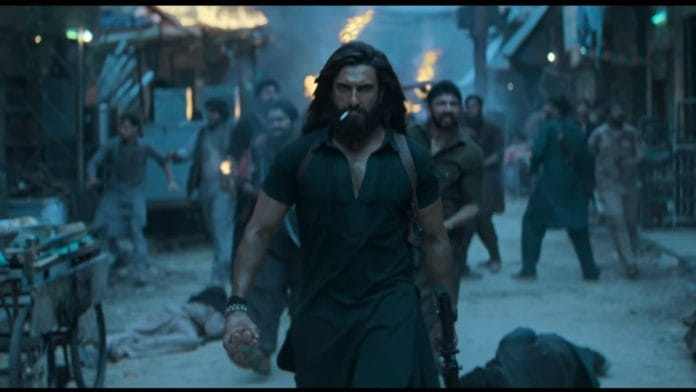



The hype around Aditya Dhar’s Dhurandhar began in November last year when the first part of the spy thriller hit theatres. Four months later, that build-up culminated this week with the release of Dhurandhar: The Revenge—a blockbuster sequel that has filled theatres, split critics, and ignited debates about contemporary politics seeping into mainstream cinema.
Within a day of paid previews, Dhurandhar 2 reportedly crossed the Rs 100-crore mark, turning the Ranveer Singh starrer into a box-office juggernaut and a cultural flashpoint that audiences are cheering, arguing over and dissecting in equal measure.
Dhurandhar’s larger-than-life characters, elaborate world-building, an A-list casting coup, and just enough gap between the two films kept audiences hooked. The social media buzz that began last November never really faded.
The film’s sustained marketing blitz, the political debates it has triggered, and the sharply divided reactions to its politics have pushed the film into the national conversation—a rarity for a Bollywood film. This is why Dhurandhar is ThePrint’s Newsmaker of the Week.
Beefed-up nationalism
If the first part of Dhurandhar was entertaining and relatively restrained, Dhurandhar: The Revenge is longer, louder and unapologetically nationalistic.
Even the trailer—which begins with a provocative line about Hinduism being perceived as a “weaker” religion—made it clear that the sequel would lean more openly into themes of identity and power. India vs Pakistan, them vs us, Hindus vs Muslims: the messaging is sharper and more explicit.
Where the first film skirted geopolitics, the sequel puts it front and centre.
Scenes referring to Prime Minister Narendra Modi, including footage from his 2014 election victory and his 2016 demonetisation speech, drew cheers, hoots and claps in packed cinema halls, with several viral videos circulating on social media.
Bollywood has fictionalised political figures before. Dhar himself did so in Uri: The Surgical Strike (2019), where an actor portrayed Modi. But Dhurandhar reflects a new shift: real political footage and speeches embedded directly into film narratives.
In the film, Modi’s surprise demonetisation announcement is portrayed as a strategic “masterstroke” that foiled Pakistan’s plans to expand fake currency networks inside India.
For supporters, such references add immediacy and invoke emotions. For critics, they raise uncomfortable questions about how closely entertainment and political messaging are beginning to overlap, especially when a film has this kind of scale and reach.
Also read: From Kerala Story 2 to Hamare Baarah—how Indian courts decide fate of ‘controversial’ films
Controversy fuels the buzz
The debate around Dhurandhar has not been limited to its politics.
From the start, the film has run into controversy and logistical hurdles. Reports that Ranveer’s character Hamza was inspired by a real-life army officer triggered a legal controversy even before the film’s release. Before the sequel, the Central Board of Film Certification cleared the film with 21 cuts a day before previews, leading to last-minute uncertainty and cancelled screenings in Tamil Nadu and prompting an apology from the director.
But in the era of viral marketing, controversy often becomes part of the campaign. Each debate pushed the film further into the spotlight.
Part of Dhurandhar’s roaring success can be attributed to its tweaked spy-thriller formula.
The franchise blends intelligence agencies, covert missions and shadowy criminal networks with just enough real-world political references to make the story feel grounded. Dramatic reveals, including the long-teased identity of the mysterious “Bade Sahab”, keep audiences invested.
Technically, the films are slick. The action sequences are stylised, the background score is rousing, and the sprawling ensemble cast ensures there are enough characters to hold the audience’s attention. The film also taps into the current appetite for spectacle: graphic violence, charged confrontations, humour, romance and dramatic plot twists.
Also read: The real D in Dhurandhar—Who is Bade Sahab in Aditya Dhar’s spy thriller
A new formula
For years, Bollywood’s spy genre leaned on spectacle while keeping politics relatively muted. Shah Rukh Khan’s Pathaan centred on a charismatic spy whose nationality and ideology were not blatantly revealed. Dhurandhar represents the opposite approach.
Its nationalism is direct, its politics explicit, and its storytelling is tied to contemporary political narratives.
Then there is the thriller paradox.
With streaming platforms, audiences have lost their patience. Long movies are not appealing, especially thrillers that are supposed to be short and crisp. Movie releases increasingly rely on scale to draw audiences back to cinemas.
Dhurandhar leans heavily into that idea. At nearly eight hours across two parts, a slow-burn thriller packed with overt political messaging might not sound like an obvious recipe for mass appeal, yet Dhurandhar has managed to flip several assumptions about what audiences want.
With the films, Dhar has achieved something Bollywood has been trying to engineer for years: an event blockbuster that dominates both the box office and the national conversation.
Some viewers see it as ambitious, technically polished entertainment. Others view it as a troubling example of politics reshaping popular culture.
Nevertheless, Dhurandhar has become the kind of film audiences feel compelled to watch, if only to have an opinion about it.
(Edited by Saptak Datta)
I’m not even a fan of the spy thriller genre but I watched this duology. It confuses me, what is fictional here except some dramatisation? It is about as fictional as one of them ‘true crime’ books that read like novels (think, ‘In the Skin of a Jihadist’) – real facts, told like a thriller.
Likewise, practically most of the ‘meat’ (a word I’m using deliberately) of Dhurandhar is picked straight from the news and well-recorded history. Where’s the alleged ‘propaganda’?