



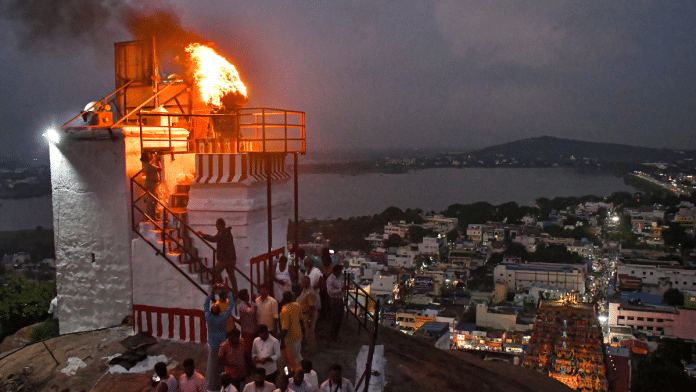
The Karthigai Deepam controversy in Tamil Nadu is not just about a temple ritual anymore. By defying a Supreme Court interim order and detaining Hindu activists and BJP leaders, the C Joseph Vijay government is testing party alliances, state authority, and political optics. On 27 November, the Supreme Court delivered a sharp judicial response and came down heavily on the Tamilaga Vettri Kazhagam government, asking it to light the lamp at Deepathoon on Saturday, using the flame from the Karthigai Deepam lit at Uchi Pillaiyar temple.
On 24 November at around 6 pm, the ceremonial Karthigai Deepam was lit at the traditional Deepa Mandapam near the Uchi Pillaiyar temple on Thiruparankundram hill near Madurai. Despite the Supreme Court granting limited interim permission on 20 November for a restricted, one-time lighting at the Deepathoon by an authorised temple team—and the Madras High Court’s Madurai Bench reminding the district administration on Karthigai Deepam day that a pending review petition does not stay the order—the lamp was not lit at the Deepathoon.
Last year, the Dravida Munnetra Kazhagham (DMK) cited law and order issues as the concern, and despite a Madras High Court order, a lamp was not lit at the Deepathoon. The Tamilaga Vettri Kazhagam (TVK) followed the playbook, though a little differently, with the district administration shifting the onus on the temple authorities.
Hindu activists and Hindu Munnani cadres gathered near the temple Tuesday, a scuffle broke out, and police forcibly removed the demonstrators, detaining around 300 people. Prohibitory orders under Section 163 of the BNSS had already been imposed across the district, backed by more than 5,600 police personnel, a temporary Red Zone, a drone ban, and barricades around the pillar. BJP leaders, including Tamilisai Soundararajan and Nainar Nagenthran, were stopped or detained while trying to reach the area.
In that operational window, the Madurai administration functioned as both the non-executor of a Supreme Court direction and the uncompromising enforcer of public order against those protesting the non-execution. That real-time contradiction and the political calculations behind it make the Thiruparankundram Deepathoon controversy ThePrint’s Newsmaker of the Week.
Supreme Court’s ‘iron hand’
The final hearing of the case is scheduled for January 2027, and a contempt petition was filed by Rama Ravikumar, the original petitioner in the Deepam case and a Hindu Munnani leader.
The contempt plea sought disclosure of any role played by Chief Minister Vijay or his ministers in the non-compliance, a complete end-to-end communication trail between the political leadership and the executive, and the release of any related intelligence report.
On 27 November, a Bench of Justices Aravind Kumar and Vipul M Pancholi heard contempt petitions and related applications in the case. The Court recorded that the first word that came to mind was “alas” and that the situation had to be dealt with an “iron hand” lest it descend into “constitutional chaos”.
Invoking Article 144 and the rule of law, the Bench declared that an order of the Supreme Court is not an invitation to negotiate and remains binding until the Court itself modifies or sets it aside. It found, prima facie, that Executive authorities and the temple board had wilfully and flagrantly disobeyed the 20 November order and had acted “according to the dictates of their political bosses”.
The Court suspended the Board of Trustees of the Arulmigu Subramania Swamy Temple and appointed former High Court judges Justice S Vaidyanathan and Justice V Parthiban as receivers to take immediate charge of the temple administration. It directed the receivers to ensure the Karthigai Deepam is lit at the Deepathoon on 28 November, using the flame from the Uchi Pillaiyar Mandapam, if it is still burning, or by other suitable arrangement, after consultation with the sthanikars.
Devotees were permitted to light lamps subject to a 50-metre cordon from the Sikandar Dargah on all sides. The security of the temple and the entire hill has been handed over to the CRPF. Show cause notices for contempt have also been issued to the Tamil Nadu Chief Secretary, the Director General of Police, the HR&CE Secretary and Commissioner, the Madurai District Collector, the Superintendent of Police, the temple Executive Officer, the Chairman of the Board of Trustees, and other trustees.
The Chief Secretary has been directed to file a detailed affidavit explaining the sequence of events, communications, and the apparent disregard of the constitutional duty to aid the Supreme Court, and to appear in person. The matter is next listed on 15 December. The Court made clear that the 28 November lighting would not create any equities in favour of any party.
Earlier, the Supreme Court order had stayed key findings of the Madras High Court’s earlier judgment that treated lighting the Deepam at the Deepathoon as an essential religious practice. At the same time, it permitted a one-time, tightly controlled ceremony by a small authorised team from the temple Devasthanam and government officials.
At the same time, the Court had stated that public processions, slogan-raising, and unrestricted access to anyone except those authorised to light the lamp were barred. The court explicitly said the permission created no customary, proprietary, or religious right and would not serve as precedent.
The Tamil Nadu government, through the HR&CE Commissioner, filed a review petition arguing an error apparent on the face of the record, but the petition was not listed for hearing on 24 November, given it was a holiday. It was only after the lighting of the lamp at the Uchchipillaiyar temple that the temple administration and trustees issued a statement confirming the lighting occurred at the traditional Uchchipillaiyar temple, citing Saiva Agama traditions and a 150-year practice at the Deepa Mandapam.
The Madurai Collector later told the Supreme Court that the temple board’s refusal left the district administration unable to proceed and tendered an apology. He also explained that while all arrangements were made to light the lamp, it could not be lit at the Deepathoon in the absence of an authorised team.
The Bench, on Friday, expressed dissatisfaction with the preliminary status report, observing that the Collector’s powers were wide enough to implement the order and that the attempt to shift blame entirely onto the Devasthanam was unconvincing.
Critics see it as the Vijay-led TVK government’s failure to implement a Supreme Court order, calling the outcome a deliberate stance. The BJP described the entire controversy as “manufactured” and accused the TVK of playing the same political game as its DMK predecessor.
BJP leader Tamilisai Soundararajan called it “deeply condemnable” for a law minister to “openly oppose an interim order of the Supreme Court”.
“The Tamil Nadu Law Minister has forfeited the moral right to continue in that office,” she wrote on X, responding to his post.
According to political analyst S Nagarajan, the move could erode public faith in the Supreme Court.
“In a constitutional democracy, fair criticism of a judgment is permissible, but imputing motives to the bench or attempting to intimidate the judiciary through populist posturing strikes at the very root of institutional authority,” Nagarajan said.
Political observers say that an administration cannot claim the moral or legal authority to arrest citizens in the name of ‘law and order’ at the exact moment it is withholding the execution of an order passed by the highest court of the land.
“Public-spirited citizens and legal practitioners must immediately bring these contumacious utterances to the formal notice of the Honourable Supreme Court. Those who seek to erode public faith in the highest court of the land must be brought squarely under contempt of court procedures and punished strictly according to the penal laws of the country,” added Nagarajan.
Also read: Thiruparankundram Deepam row shows Muslims see secularism as a one-way street
Alliance arithmetic, politics of the Thiruparankundram hill
The TVK government under Vijay held a closed-door meeting with the alliance partners a day before Karthigai Deepam. TVK depends on the legislative support of Congress, the VCK, Left parties, and the IUML. These partners had taken a firm public line against any change, framing the demand as an attempt by Hindutva groups to disturb a historically shared hill.
Currently, there are six vacant seats in the Assembly, leaving 228 sitting members. The ruling TVK holds 108 seats on its own, Congress has five, and VCK, IUML, CPI, and CPI(M) have two seats each. Similar to the previous DMK regime, the current administration maintained that the established practice is at the Deepa Mandapam, that the pillar is a British-era survey station rather than a traditional religious structure, and that altering the status quo near the Hazarath Sultan Sikkandar Badhusha Avuliya Dargah risks communal friction.
VCK Chief Thirumavalavan said the TVK government was “safeguarding both the secular fabric of Tamil Nadu and the genuine religious beliefs of the people,” by not bowing down to the Sangh Parivar. IUML had earlier taken a firm public position against changing the traditional site, framing any shift as a risk to communal harmony. Congress leader Manickam Tagore also defended the government, saying the intention was clear.
“We don’t want to disturb the communal harmony and goodwill in Tamil Nadu,” he told the media.
Political observers see a calculated trade-off with TVK’s stance since the government told the Madras High Court they would implement the order on the day but did not actually do it. The party filed a review petition to show they did not want open conflict.
“TVK do not want to be attacked by the opposition or offend their Left and minority alliance partners. They can always say that they tried on their end to oppose the lighting politically while also maintaining in the court that they facilitated the lighting,” political analyst Sunil Kumar told ThePrint.
Political commentator Mukund Padmanabhan says that since the lighting of the lamp was to be done by the temple authorities, it doesn’t constitute defiance in the strict sense. TVK knew DMK would criticise any other course while its own allies would not support pushing the temple against its wishes,” Padmanabhan said.
For a relatively new force positioning itself as neither the old Dravidian establishment nor a BJP ally, the priority was clear—protect secular credentials and minority support even at the cost of contempt accusations and BJP charges of continuity with the DMK.
“TVK might not gain much from this stance, but they don’t want to lose the minority vote bank. In Tamil Nadu, the larger political arithmetic still runs against any move that can be painted as majoritarian,” Nagarajan said.
Also read: GTA VI isn’t just for gamers anymore. Modi, MAGA, sports & startups are in on the action
The constitutional paradox
What made the lighting of the lamp at the Deepathoon a major flashpoint in the state was the simultaneous deployment of coercive power. While the permitted flame remained unlit, the same machinery imposed district-wide prohibitory orders, detained protesters demanding compliance, and restricted the movement of political leaders.
Mocking the government on National Constitution Day, BJP leaders also stated that the administration cannot easily claim the moral and legal authority to arrest citizens in the name of “law and order” at the exact moment it is withholding execution of an order from the highest court.
BJP leader Nainar Nagendran was accused the government of “betraying the Constitution of India itself”.
“The Chief Minister lacked the maturity to handle the issue,” he told the media, also demanding accountability from the District Collector and officials.
The Supreme Court’s 27 November order has now shifted the ground. The political calculations that shaped the non-implementation on 24 November are now subject to direct judicial scrutiny. The larger questions of custom, ownership of the hill, and religious rights remain for the final hearing in January 2027, but the immediate message from the apex court is unambiguous: the orders of the Supreme Court are not open to selective interpretation or political negotiation.
Meanwhile, Governor Rajendra Arlekar also formally sought a comprehensive factual report from CM Vijay on whether the state government and all concerned authorities fully complied with the Supreme Court’s 20 November order in the Thiruparankundram Deepam case.
(Edited by Prasanna Bachchhav)