





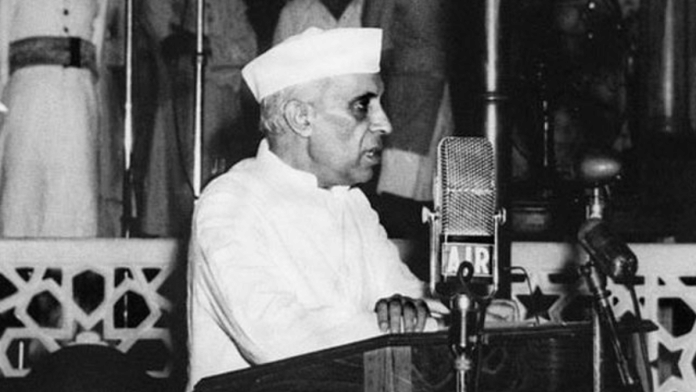



Our four-day visit to Iran is coming to an end soon and this is, I believe, the last public function that we are attending, as we are leaving early tomorrow morning. I think that it is fitting that this last function should have been organised by this Indo-Iranian Society and should lay stress on past and present contacts and friendship between Iran and India. I am glad of that because to some extent perhaps this last function, and the purpose of it, emphasises an aspect which ought to be emphasised, and one may even say, for the purpose of which I came to Iran.
I did not come to Iran to discuss any particular problem between India and Iran. I did not come here because we had any conflicts between the two countries, nor did I come here to discuss any other particular matter relating to trade or anything else. These matters are discussed from time to time by representatives of our governments. Why then did I come here?
In the final analysis, I came here because of my desire to encourage and strengthen Indo-Iranian friendship, friendship between these two countries. I hope and believe that this real purpose of my visit, to which I have referred, has been served to some extent, served partly by the occasion of my coming here, but more specially by the kindness, hospitality and friendship that the people of Iran have shown to us, who have come to them as messengers of friendship and goodwill. That is so. And we have heard many sentiments to this effect during these four days. It is good to express proper sentiments, but it is better to implement those sentiments and to think out how such sentiments can be implemented.
You, Sir, have just pointed out in your remarks about the necessity for implementing these sentiments. Among other things you have referred to the desirability of increasing the facilities for teaching the Persian language in India. May I say that I entirely agree with you that efforts to this end should be undertaken, because language is a very powerful bond between people. Of course one cannot expect the masses of any country to learn other languages. That is hardly feasible. But one can expect and try to provide for considerable numbers of people to learn other languages, and among the other languages more specially for India, the Farsi language comes uppermost in mind, because it has influenced our own languages so much that it has become a part of the texture of our language. That is so and that should be done. And even though this can only apply naturally to a limited number of persons in the country, a limited number of intellectuals, intelligentsia, those interested in literature and the like, even so that kind of thing seeps down into the consciousness of the people, more specially because it is not something new that is coming but is a continuation of something old.
There is another way in which we want to encourage. One is the direct method of learning languages, our learning, our people learning the Persian language, your people learning our languages. The other way is more indirect, that special efforts should be made for translations of books from one language to the other. This reaches, ought to reach, a much wider circle of readers, and I think this should be done. Perhaps some of you know that I have the honour to be the President of what is called the Sahitya Akademi of India that is a national literary organisation, and we are specially interested in this work of translation from languages of other countries of famous books, into our various languages. We have done this in regard to a number of well known books from Persian and we shall continue it.
While agreeing with you Mr. President, in what you have said, I should like to point out a difficulty. Perhaps difficulty is not the right word, but nevertheless something that draws attention away from such normal contacts on the literary plane. Yesterday, at the University, I was speaking about a traditional society having to face the problems of the world today and how there are various stages observable among the nations of the world, various stages of traditional societies trying to adapt themselves to the new world of science and technology.
Now I should imagine that Iran and India are two countries, which have been and to a large extent are powerfully traditional. Their roots are far past into history. Only today, a little while ago, I visited Shiraz and from there I went to Persepolis. At Shiraz, of course I was attracted by many things, and the name itself, Shiraz, had been familiar to me since I was a little child. But above all it was known to me as the home of two famous poets, Sadi and Hafiz. That brought past to me. Then I went to Persepolis and saw those magnificent ruins of the tremendous period in Iran’s past history. Such visits and such sites always fill my mind with the long perspectives of history, the ups and downs of empires and of peoples, and so my mind was full of that, and I saw, I realised, as I have realised often in India, how long is the tradition which has conditioned India and Iran, traditions rather as they affected these two countries separately. And therefore, I said that these two countries have very powerful traditions, and the more powerful the tradition, the more good it may do and the more harm it may also do.
That weight of long tradition is both good, sometimes a little bad. It is good because it gives richness to the culture of a nation, a community, an individual. It is bad if it becomes so pressing, so enveloping that it prevents change. It ties one up in a particular way and prevents change in a changing world.
There are a multitude of factors happening in the world all the time. Sometimes the pace may be greater, sometimes slower. But basically one might say that there are two factors governing human society. One is the fact of continuity, and the other is the fact of change and apparently they are opposed to each other — continuity and change. If continuity breaks completely, then much of what a human society has gathered in the past is lost. So it is very harmful. If on the other hand, change is prevented by the fact of people sticking on to tradition and not accepting change, then that society becomes out of step with the changing world, because a basic factor in the world, whether it is the individual, or a social group or a nation or the world at large, is that of continuous change. Nothing is changeless in this world.
I am not dealing with ultimates. I am dealing with human society as one sees it. One sees the individual changing, social organisms changing. And therefore a society has to fit in with the changing world, or else it falls back and there is danger of it becoming static or even decadent, because it does not change with the changing world. Therefore both are necessary, continuity and change. In fact they come whether one likes it or not. Even when great revolutions break up the continuity of a society, soon after the revolution, they try to go back to pick up the old threads of continuity of their national life, because if that continuity is broken completely a social organism becomes rootless. All its long roots in the past are dug out and there are no roots left, and the tendency would be for it to dry up, unless it recovers those roots. Therefore continuity is necessary and inevitably takes place. And equally necessary is change, because without change, gradually the life passes out of that living organism and it becomes too static.
I repeat, that India and Iran have been powerfully traditional minded, and both of these countries have to face the challenge of the present era of rapid change, and rapid change not in the political field, that is a small field, but in the basic human field of living, changes brought about by all these tremendous scientific and technological discoveries which change our life, and not only change our life, change our politics, change our economics, change our social fabric, every problem is changed. And it is not the superficial of this that count.
Europe and America represent today the highest development of technology. But, if I may be permitted to say, if we take, let us say anything of Europe, the food of Europe, the clothing of Europe, the other methods of Europe, these are superficial things. That is not which has made Europe great. It is Europe’s thoughts that have made it great. It is Europe’s or American inventiveness that has made it great, it is Europe’s technology that has made Europe great, not the superficial things which are easy to copy. So it is this great challenge that we have to face and to adopt because there can be no doubt that if we do not keep in step with modern science and technology we become static and then that very tradition which is good for us, begins to smother us and prevents us from going ahead.
Because of this challenge of modern times we in India have to function in a way which is very different from the traditional way because we want to get out of the ruts in which we have been. And so our attention today is diverted to science, to producing tens of thousands of engineers, technicians and the like, to the new technology. And so while our students in the old days studied literature, Indian literature, other literatures, European literature, while they studied, they went to Europe, law and the like, today you will find thousands and thousands of Indian students going to foreign countries to study science, engineering, technology, techniques, and all that, and from all grades, not only in the universities but in the factories, to be good foremen, to work there.
So, because India’s mind is largely directed towards capturing this new science, understanding it, these new techniques and technologies, so as to get into step with the modern world and to be able to meet others on an equal footing, because there is no equal footing if we are not advanced in science and technology, that is why I said now I come back after this long interlude, that is why I said to you, Mr. President, that there was a slight difficulty, the difficulty being people’s minds being directed towards science and technology today and not so much to literary pursuits, though of course there are plenty of people who do carry on literary studies.
I hope that Iran and India will find the proper balance in this equation of continuity and change. I hope that they will be able to keep all that is the finest in their traditions and yet imbibe, adopt fully, the great changes that have been brought about by science and technology and thus step into the present and not merely live in the past. Both are necessary. I hope that will happen. It is not for me to venture to advise anyone, or any country because I do believe that each country must think out its own problems itself. No other country can do that thinking for the other.
During the past, far too much of our thinking of Asian problems was done by Europeans, Americans and the like. It was very good of them to do that, and sometimes, no doubt, we could profit by their thinking. But basically and fundamentally I think that however able they might be, they cannot be the right persons to find the key to our problems. The key can only be found by the people themselves, by their thinking profiting, of course, by other people’s thinking. And therefore, I trust that both our countries will find the solution to these revolutionary problems that face our countries and the world today. But that will not be found by complacency, by avoiding the problems. The problems do not cease to exist because we do not think about them or talk about them and a problem that is long ignored of course remains and becomes bigger and may even become so big as to overwhelm the person who ignores that problem.
I hope you will forgive me, Mr President and friends, for my speaking to you perhaps more seriously than I should have done on such an occasion. Such occasions are meant to lay stress on friendship and good relations and contacts between our two countries. We agree about that. We can repeat those sentiments. But friendship itself demands that we should go down below the surface of things and not merely repeat superficialities, and therefore I have ventured to put before you some aspects of these problems that fill my mind. I hope you will forgive me.
I thank you, Mr President, again for your kind welcome and I wish this Society, Indo-Iranian Society, progress and success in the future, which means success in bringing our countries and our peoples ever nearer to one another. Thank you.
This is part of ThePrint’s Great Speeches series. It features speeches and debates that shaped modern India.
Neither did the people learn those languages nor did Nehru learn free-market economics.