







As the NCERT’s new syllabus textbooks reach students across the country, debate continues over the removal of the Preamble to the Constitution from the Class 9 social science textbook. The NCERT has responded by clarifying that the Preamble remains part of the new civics curriculum but has been redistributed across different classes.
This claim is factually correct—but it tells only part of the story.
Whenever school textbooks become the subject of public debate, the first responsibility is to return to the source. It is important to examine what the textbooks actually contain and then ask a deeper question: Will these changes help children become informed, thoughtful, and active citizens?
Looking beyond the headline
A comparison of the previous and the new NCERT textbooks reveals that the Preamble has indeed disappeared from the Class 9 textbook. It has found a place in the Class 7 textbook on page 225. In fact, the chapter, “Constitutional Design”, in which the Preamble appeared in the old syllabus, is no longer included in the Class 9 textbook. The Preamble is now part of a chapter in Class 7 titled “The Constitution of India – an Introduction”.
This is an important distinction.
The Constitution has not been removed from the curriculum. Along with it, the Preamble and the discussion of constitutional values and principles have been introduced two years earlier.
From the perspective of civics education, this is potentially a positive shift.
Children need not wait until adolescence to encounter ideas such as justice, liberty, equality, and fraternity. These are values they can begin to recognise in everyday life—in classrooms, playgrounds, families, and neighbourhoods. Introducing constitutional values earlier creates opportunities to nurture democratic habits and ethical reasoning from a younger age.
However, the Constitution is more than a statement of values.
The Preamble also describes the nature of the Indian State through concepts such as ‘sovereign, socialist, secular, democratic, and republic’. These are institutional design concepts. Even many adults struggle to explain them accurately. Teaching these ideas meaningfully requires careful sequencing, strong examples, and clear conceptual explanation.
This raises an important educational question: Does the new curriculum provide enough support for Class 7 students to understand these ideas in depth? To achieve this, NCERT must ensure that supplementary learning materials enable teachers to explain these concepts effectively, as they deliver the curriculum in classrooms across the country.
Also read: The Preamble won’t be changed back to the original. Here’s why
A pedagogical inconsistency
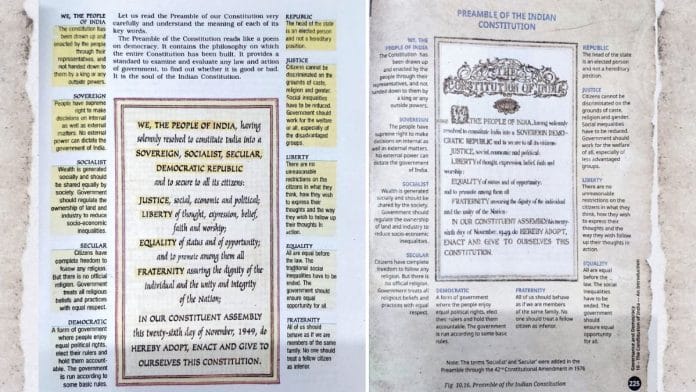
While examining the new Class 7 textbook, another interesting issue emerges. Reproduced below are the images of the Preamble and the explanations of key terms from the old Class 9 textbook and the new Class 7 textbook.
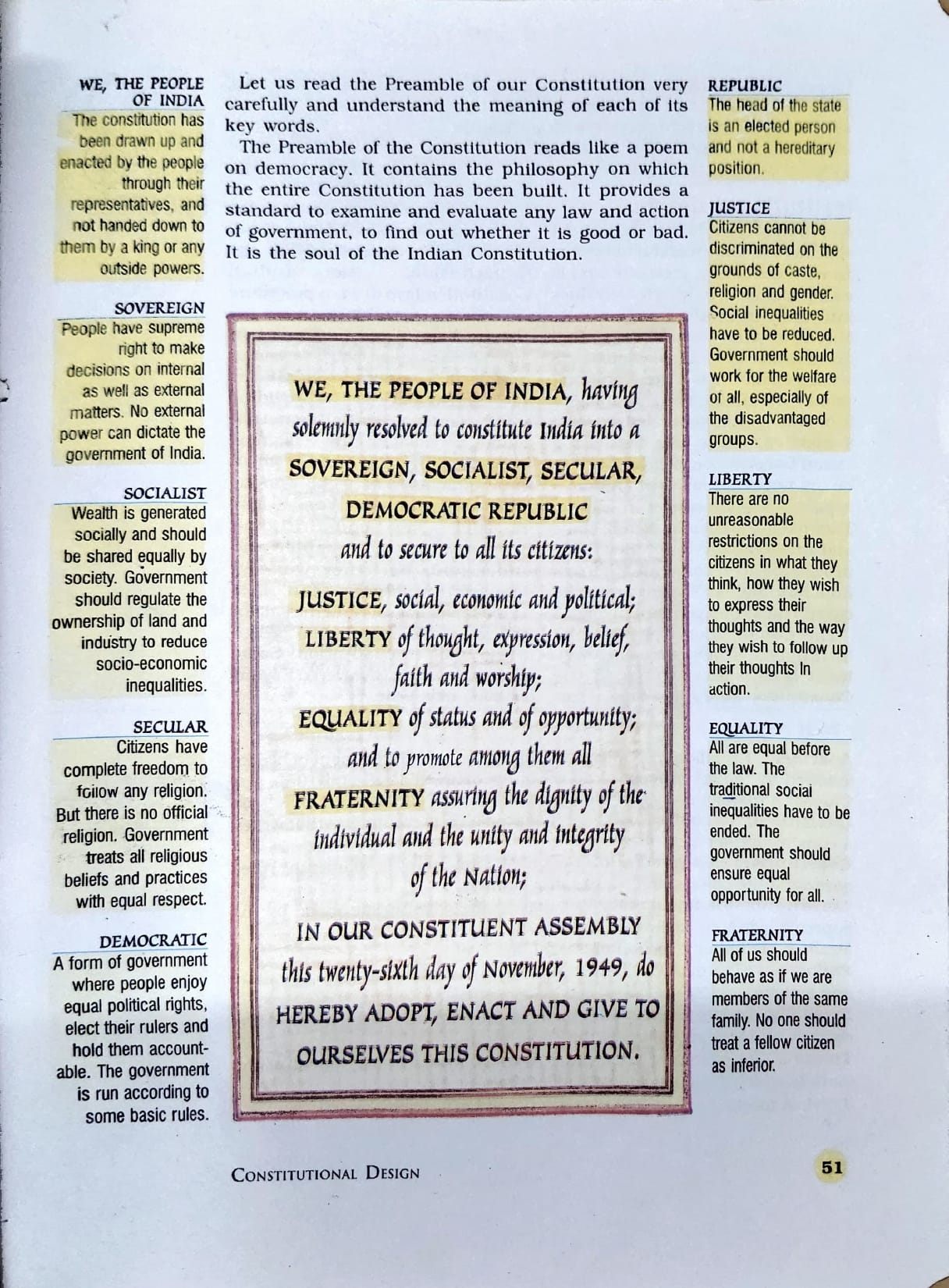
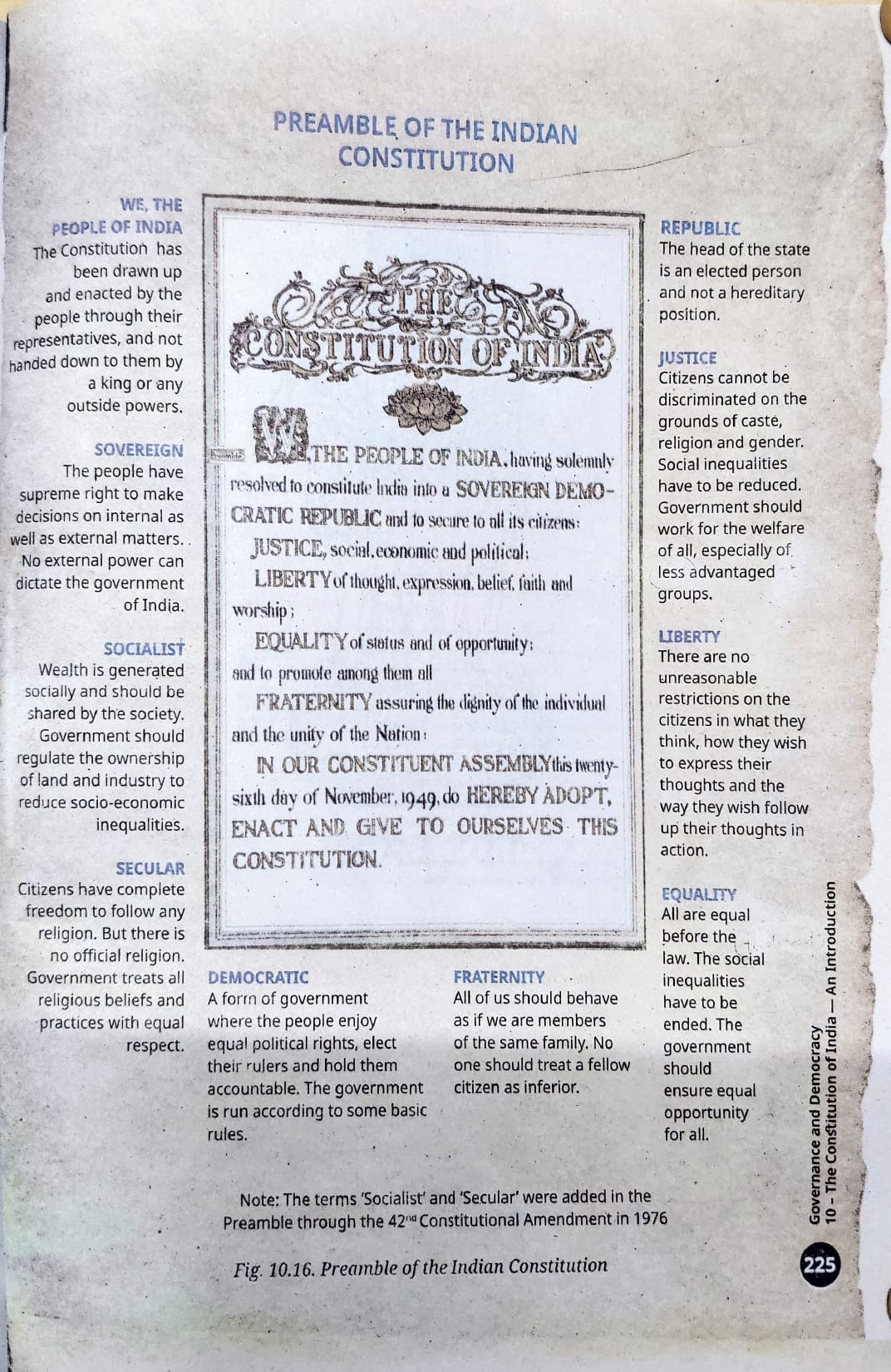
They are nearly identical, except that the Class 7 image is the original Preamble to the Constitution of India adopted in 1949, which does not contain the words ‘socialist’ and ‘secular’, or the phrase ‘unity and integrity of the Nation’. These were inserted through the 42nd Constitutional Amendment in 1976 and are part of the Preamble that is in force today.
However, alongside this reproduced image, the textbook explains the meanings of ‘socialist’ and ‘secular’ as constitutional principles. The result is a critical inconsistency.
Students are asked to understand concepts that do not appear in the document they are looking at, yet the textbook does not explain why. It does not identify the reproduced image as the original 1949 Preamble, nor does it tell students that they are reading an earlier version of the constitutional text.
Ironically, every NCERT textbook begins with the current Preamble to the Constitution, including a note explaining the amendments made in 1976. A student therefore encounters two different versions of the Preamble in the same textbook—one at the beginning and another within the chapter introducing the Constitution—without any explanation of why they differ.
From a pedagogical perspective, this is likely to create confusion.
Good civics education encourages students to engage directly with primary constitutional documents. This makes it necessary for their textbooks to contain accurate images and sources. Therefore, it is imperative to use the Preamble currently in force.
The reproduced image of the original 1949 Preamble could certainly have been included elsewhere, such as in the section on the making of the Indian Constitution, with accompanying explanations. This would have preserved both historical authenticity and conceptual clarity while helping students better understand the differences.
Also read: Caste Hindus lobbied the Constituent Assembly to defend untouchability as a ‘religious right’
Beyond the politics
Debates on school textbooks often focus on whether something has been removed or added. Those questions matter, but they are only the beginning. As parents, educators, and citizens, we must ask a different set of questions.
Are concepts introduced at the right age? Are they sequenced in ways that help children build understanding over time? Do the textbooks accurately connect primary constitutional documents with their interpretation? Above all, do they help young people become informed, thoughtful, and active citizens?
These are the questions that should guide our reading of the new curriculum.
The shift of the Constitution from Class 9 to Class 7 deserves thoughtful discussion. It offers opportunities to introduce constitutional values earlier in a child’s education. At the same time, it highlights the importance of ensuring conceptual clarity, developmental appropriateness, and the careful use of primary sources.
Ultimately, the success of any civics curriculum will not be judged by what it includes or excludes, but by whether it equips the next generation to understand, value, and uphold constitutional citizenship.
Vinita Gursahani Singh is the founder of We, The People Abhiyan, an organisation working on civics education, constitutional literacy, and active citizenship. She tweets @VinitaGS. Views are personal.
(Edited by Prashant Dixit)
42nd amendment was actually a ramrodded modification, a political crookery, and an unjust importment of a western notion.
Bharat was without those 2 words from 1950 until 1976(??) when it was modified by Cons with the aid of Coms