





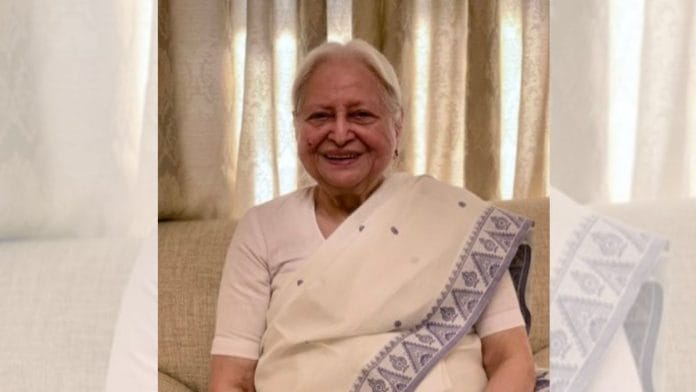



Veteran Congress leader Mohsina Kidwai passed away today at the age of 94. A former Union minister, parliamentarian, and chief of the Uttar Pradesh Congress unit, Kidwai was a close associate of Indira Gandhi. Her last notable political act was proposing and seconding Shashi Tharoor’s nomination for the Congress president’s post against Mallikarjun Kharge in October 2022.
Mohsina Kidwai, who came from a conservative, aristocratic Muslim family of Awadh, held the distinction of winning Lok Sabha elections three times—in 1978, 1980, and 1984. Her parliamentary credentials were remarkable: she won from Azamgarh in eastern Uttar Pradesh—the bypoll that marked the great comeback of Indira Gandhi—and later from Meerut in the Western side of the state. Anyone remotely familiar with the socio-economic condition of Uttar Pradesh and the caste matrix would vouch that finding acceptability in these two diverse regions is a rather insurmountable task.
A life of probity
During her tenure as an MLC and MP, Kidwai was remembered for her simplicity in public life, probity and her ability to act judiciously as a public representative. In May 2016, during her term as a member of parliament, there was a sense of fulfilment.
But it also had an element of worry. Kidwai, the former Housing Minister—despite having served the country in key portfolios—including railways, civil aviation, surface transport, health—did not have a house of her own in the national capital, or anywhere else, apart from an ancestral, joint ownership property in Badagaon in Barabanki district of Uttar Pradesh. For those wary of the political class, this offers a measure of what probity in public life can mean: here was a leader who had spent a decade as Union minister and also served as a Cabinet minister in Uttar Pradesh, yet lived a Spartan life. Neither Mohsina Kidwai nor any of her close relatives ever considered this extraordinary.
On the political front, what distinguished Mohsina Kidwai from many others in the Congress was that she was never shy of speaking her mind or sharing candid thoughts, without crossing the Lakshman Rekha (or Rubicon) of party discipline. A lot has been written about Shah Bano Begum judgment and the Rajiv Gandhi government’s move to overturn it, the Ayodhya imbroglio, Congress’ ties with the Samajwadi Party, Bahujan Samaj Party, communal riots, Mamata Banerjee, questions of probity, and other momentous events of post-Independence India. If the Congress leadership had heeded the sound advice tendered by Kidwai at those junctures, the course of the country’s politics and contemporary history might well have been far better and more fruitful.
In Indian politics, the 1970s had a certain allure—the Emergency, the defeat of Congress under Indira Gandhi. It was also a glorious chapter of Indira Gandhi’s great comeback after the 1977 Lok Sabha election loss. Kidwai had played a key role in Congress’ revival, winning the 1978 Lok Sabha by-election from Azamgarh.
On 20 December, 1978, Kidwai was president of the Uttar Pradesh Congress when Indira Gandhi was arrested and jailed for a brief duration.
At the time, Kidwai was in Lucknow with farmers, protesting against a pre-determined low price fixed for sugarcane. Their suffering was compounded by delays in payments. With most sugarcane farmers owning small holdings of land, they had little option but to sell their crop to the nearest sugar mills at low prices, without making much money on it. It was there that Kidwai received news that some of her party leaders had reportedly hijacked an Indian Airlines flight number 410.
The Boeing 737 with 126 passengers on board, carrying AK Sen and Dharam Bir Sinha, who were ministers in Indira Gandhi’s cabinet, had taken off from Lucknow for Kolkata via Delhi.
Two young men, Bhola Nath Pandey and Devendra Pandey, abruptly got up, moving toward the cockpit when the plane was barely 15 minutes from touchdown at Delhi. The Pandeys were not related, but their hijacking bid was driven by their mutual admiration for Indira Gandhi.
Captain MN Battiwala was forced to abort landing in Delhi and head for Varanasi.
The hijackers spoke about the “vindictiveness” of the Janata Party, demanding unconditional and immediate release of Indira Gandhi from jail. They had proclaimed themselves as Youth Congress members, a claim the Congress and Mohsina Kidwai denied vehemently.
The drama ended by evening when the aircraft landed in Varanasi, when the father of one of the hijackers had arrived at Varanasi airport and spoke to his son over the wireless. The father’s voice reportedly shattered the bubble of heroism. The two men [ who were actually not carrying any firearm or explosives] gently walked out of the aircraft, shouting pro-Indira Gandhi slogans, and surrendered to the police.
During the hijack, a senior government official had informed Kidwai that the two hijackers had told the authorities they would release the plane only if Mohsina Kidwai asked them to. A horrified Kidwai had told the official that she didn’t know the hijackers.
There was another twist to the tale. Since her name had come up during the hijack, some legal luminaries advised Kidwai to apply for anticipatory bail. She later said that while she did not have a law degree, common sense came to her rescue. She told her lawyers that an anticipatory bail plea would be an admission of guilt and link her to the hijackers. She remained firm in her decision. It saved her from endless rounds of court and the stigma of being associated with the hijacking.
This was Mohsina Kidwai’s brush with a major controversy. Her long and illustrious career, which spanned six decades, otherwise remained calm and dignified. She was considered the most senior and respected leader of Congress.
For her memoir My Life in Indian Politics, Sonia Gandhi observed, “Mohsina ji has a remarkable ability to establish a warm rapport with people from across the political spectrum as well as from all walks of life. These qualities, together with her integrity and gentle candour, her deep concern for the more vulnerable sections of society, her personal charm, and her abiding belief in the principles of democracy, pluralism, and social justice, are reflected in her memoirs. No wonder she is a much-loved and respected figure in our national life. She is a cherished member of the Congress Party, whose rich experience and wise counsel we value greatly, and also a cherished personal friend.”
Also read: Mohsina Kidwai book launch was all about Shashi Tharoor and Congress coterie
Memoirs, memory, and the Indira years
Kidwai’s political career began in 1960, when she won the Uttar Pradesh Legislative Council. All of 28 at the time, she went on to dedicate her life to politics and public service. She rose to serve in senior cabinet positions, first under Indira Gandhi and then under Rajiv Gandhi, gaining their trust through her tireless work at every level of the party. She continued to sit in the Rajya Sabha until well into her eighties, her age proving no barrier to her commitment and active involvement in public service.
Her memoir recounts her personal life as well as her fascinating career, from her early years in Barabanki and the scrappy battles of local politics to the corridors of power in New Delhi. Author-politician Shashi Tharoor said that throughout her memoir, he was struck by the themes that seem to consistently characterise Kidwai’s work: humility, dedication, integrity, and a fierce determination to do the right thing. Her identities, he noted, were manifold: a staunch Congresswoman; a loving mother of three daughters; a proud Muslim; and above all, an Indian, dedicated to the well-being of her country.
Remarkably, she did not use her memories of being active at the highest levels of government as a political weapon. Instead, she chose to tell several inside stories about the Congress—once the country’s most influential political party—from the standpoint of a woman in search of truth and freedom. Her reflections on the tumultuous period that marked Indira Gandhi’s defeat are especially interesting.
Kidwai shared a close and personal bond with Indira Gandhi, whom she always found to be extremely caring and attentive. While traveling, Gandhi had the habit of carrying snacks with her in a basket. Once on a very long and tiring journey, Kidwai saw her taking out some biscuits from the basket kept beneath her seat. She broke the biscuits into four pieces and asked the driver to take them one by one from her hand while driving. Extending her hand with biscuit pieces, she watched as the driver did what he was told.
According to Kidwai, Gandhi inspired such spontaneous displays of affection that it often stunned and filled her heart with admiration and pride for her leader.
On one occasion, they were traveling to a famous Gurudwara in Haridwar when their convoy was suddenly stopped by a group of Sikh devotees. Gandhi was in the Opposition then and traveling without elaborate security arrangements. The former prime minister got out to greet them. In a flash, a Sikh woman drew her kripan, slit a part of her hand, and quickly applied a tilak of blood on Gandhi’s forehead, saying, “Indiraji aap ki haar ka badla hum lenge” (We shall seek revenge for your electoral defeat). This quick display of affection and respect mesmerised Kidwai and all those who were accompanying Indira.
Rasheed Kidwai is an ORF visiting fellow, author and journalist. Views are personal.
(Edited by Ratan Priya)
The Congress should listen only to the Gandhi family. Long live Sonia mata and Rahul baba.