






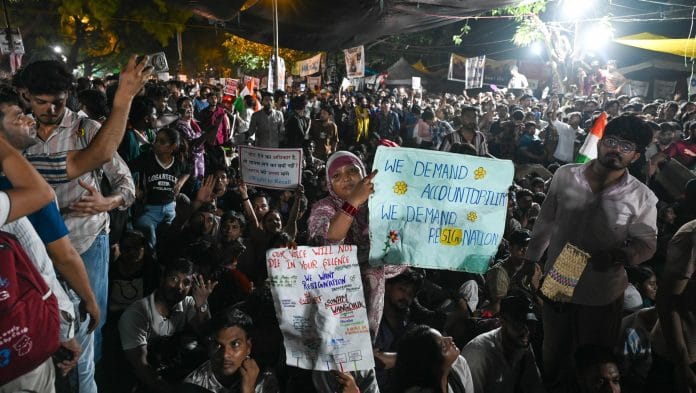


It was supposed to be a protest against the NEET paper leak: by the students, of the students, and for the students. It went grossly wrong from the day it began. The protest at Jantar Mantar, the hunger strike by an activist totally unconnected to the issue, the botched–up march to Parliament, and the gauche attempts by the Congress to steal the show and bask in borrowed glory are all indicators of how quickly things can go wrong in the current sociopolitical climate.
The protests against NEET paper leaks were spearheaded by a relatively unknown and new outfit, the satirical Cockroach Janta Party (CJP), which borrowed the name from a comment by none other than the Chief Justice of India.
Protests are not new in New Delhi or, for that matter, in capital cities across the world, including autocracies and dictatorships, like the 1989 Tiananmen Square protests in Beijing, China. Delhi has seen several of them since Independence. In 2020, farmers launched a protest march against three Farm Bills seeking agricultural reforms. The protests against the Citizenship Amendment Act (CAA) in 2019, which lasted for more than three months, prompted the Supreme Court to state that while the right to dissent is guaranteed by the Constitution, public spaces cannot be occupied indefinitely.
According to BJP spokesperson and Delhi MP Bansuri Swaraj, the permission for the protest was given for only one day, valid until 5 pm. Someone from the government must clarify why the protest was allowed to go on for more than three weeks. The government and the party heading it rightly boast of having minute details about every voter in almost all the polling booths of the country. On that basis, they have been winning all the elections from Parliament to Panchayat since 2014. It is surprising that the government did not have intelligence inputs on the extent of the damage the protesters could do.
Key questions
The students and the people leading the protest have a much greater responsibility in such situations. It is not unusual that when a protest continues for weeks, people, political parties, and vested interests take charge of the stage to air views that are completely irrelevant to the initial demands. Such forces can even hijack the movement to serve their agenda. The delay from the authorities in holding talks with the students and the lack of proper control over the protest by its organisers have both led to the situation getting out of control.
One cannot fault the students participating in such a protest, as they have genuine concerns about examinations, paper leaks, employment, and accountability. Their concerns deserve to be heard. But when some use the protest as an opportunity to attack the police or destroy public property, the anarchy and violence cannot become legitimate merely because it takes place under the banner of a popular cause. At the same time, allegations of excessive police action against peaceful protesters must also be investigated fairly. Accountability must apply to everyone.
Who exactly constituted this enormous gathering, especially on the day of the march to Parliament? How was a mobilisation of this scale organised in such a short time? How did such large numbers of people converge in Delhi at the same time? Who coordinated the logistics and mobilisation? What role, if any, did established political organisations play?
On the face of it, it appears that all those participating in the march to Parliament were not genuinely students concerned about examinations. Other anti-social elements and vested interests attached themselves to what began as a student movement three weeks back.
These are questions that deserve impartial investigation. The government should come out with clear and credible evidence at the earliest about potential foreign funding for the protest.
Also read: Dharna was sacred even in medieval India. BJP is following the path the British created
Course correction for government
The timing and political dimensions of the protest warrant examination. When a major mobilisation coincides with the Monsoon Session of Parliament and Opposition parties openly support it, citizens have every right to examine whether a genuine movement is being used to advance a wider political agenda. Political parties have the democratic right to support protests, but the public has an equal right to know where student activism ends and organised mobilisation begins.
Undoubtedly, there is an urgent need for course correction and a massive shift away from legacy administrative processes highly dependent on civil servants who have no links to academics. A total overhaul of a wrecked exam framework and the technological isolation of question paper preparation through digital systems are the need of the time. It is also essential to consider a structural decentralisation of the agencies with proper administrative mechanisms and legal accountability. The government must engage with students and their parents directly and through social media to bridge the trust deficit.
The centralised examination system requires a total overhaul, and the education ministry needs a change of guard at all levels of its functioning. A mere transfer and call for resignations will not restore confidence in the system, though they may assuage hurt feelings to some extent. There is an urgent need to understand the shortcomings of the entire higher education system. For a nation aspiring to lead the knowledge world of the future and become a strong and vibrant economy by 2047, it is important to create an atmosphere where students can trust the fairness and integrity of the systems that determine their future.
Seshadri Chari is the former editor of ‘Organiser’. Views are personal.
(Edited by Prasanna Bachchhav)