






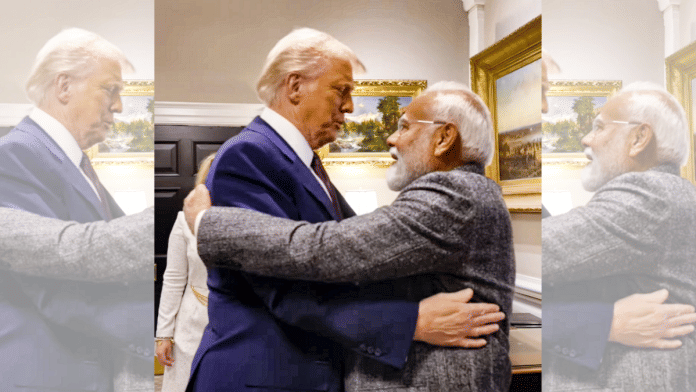



Why is nearly everyone in India who has anything to do with America in a state of permanent worry? The foreign ministry wakes up each morning hoping that the US President Donald Trump has not said anything false or insulting about India. Businessmen agonise about the levels of tariffs and whether they will be raised further. Elderly parents who are proud of the good jobs their children have secured in the US now fear that their kids will have to return to India because their visas will be revoked. Anyone who has to go to the US for work, vacation, or to see family is terrified by the immigration process, even if they are only applying for short-term visas.
There is only one explanation for the change in mood and the transformation of the environment: Trump.
To understand why the change in the US’s attitude towards India has come as such a seismic shock, you need to understand a little bit about the background.
It all started in 1971
When India became independent in 1947, the US wished us well and later offered alliances. We refused to join the alliances because of our policy of non-alignment, but Washington continued to pursue friendly relations with us. For instance, in 1962, when the Chinese attacked us, the US sent help.
But there were major stumbling blocks. We would not open up our markets to American goods because we wanted to strengthen our economy. The US did not like that. While India would not sign alliances, Pakistan was quick to seize the opportunity and became a military and trade ally of the US. American arms flowed into Pakistan, and close ties developed between the two armies.
This was also the era of the Cold War, and spies roamed the world bringing down governments and targeting politicians. India always complained about the high level of CIA operations in our country. We know now from memoirs and investigations that while we may have been hysterical in our responses, the CIA was certainly very active in India.
The low point in India-US relations probably came in November 1971 when Indira Gandhi went to the White House, asking for help to end the genocide that was then taking place in East Pakistan (now Bangladesh). She was ignored and belittled by the then US President Richard Nixon, who was then in the process of reaching out to China with Pakistan acting as a go-between. India did not feature in Nixon’s calculations, but he felt he had to help his Pakistani middlemen. And so, in 1971, when India and Pakistan went to war, America backed Pakistan.
Also read: US invasion of Venezuela is end of international order. India must focus on cold calculations
Once Nixon was disgraced and booted out, relations improved. Even US President Ronald Reagan, who had set up the world’s largest CIA station in Pakistan to defeat the Russians in Afghanistan, had warm relations with Indian leaders.
In 1991, when India liberalised and welcomed US investment, America became even friendlier. And after the Al Qaeda attack on the twin towers, America and India both began to see Pakistan as a friend of terrorists and Washington and Delhi became, in Atal Bihari Vajpayee’s term, ‘natural allies.’ This was followed by Manmohan Singh’s nuclear deal, which drew the two countries closer.
There could have been some awkwardness when Narendra Modi became Prime Minister because the US had denied him a visa after the Gujarat riots, but Modi displayed no rancour, and the then US President Barack Obama went out of his way to welcome Modi into the community of international leaders.
Given this background, the current generation of Indians had forgotten the bitterness of the Nixon years and focused on the 50 years of friendship that followed. We assumed that while Presidents would come and go, India and America would stay friends.
Our leaders offered logical reasons for the strength of our relationship. We were the two largest democracies in the world. India’s market and production capacity made it a perfect ally for US business. America needed to contain China, its only global rival, and promoting and helping India would be the best way to do this.
That’s why the events of the Trump years have come as such a shock to Indians. Trump seems to have rejected all the old assumptions. He does not care that India is the world’s largest democracy. As for the Indian market, he wants access on his own terms. Otherwise, he will make it harder for Indian exports to reach the US.
Also read: ‘Curbing China and Russia’s influence’—how the Chinese view the US invasion of Venezuela
Misreading Trump
On global issues, his approach is chaotic. Sometimes he is friends with Russia. Sometimes he isn’t. At present, he is determined to punish India for buying Russian oil. He doesn’t like the Chinese much, but he sees no role for India as a balancing factor. India’s fabled tech prowess holds no interest for him. America is more focused on AI, where India is not a global leader. He doesn’t even care about the thousands of Indian-origin Americans who loyally genuflected to him and who are now the targets of racial abuse from Trump supporters.
It’s clear that not only has this shocked Indians who see America as our friend, but it has taken our government by surprise. Nobody in a position of authority expected Trump to become such great pals with the Pakistanis. Perhaps, like many BJP loyalists, they had him pegged as some white version of a right-wing bigot who hates Muslims. In fact, his best friends (the Pakistanis, the Saudis, etc) are Muslims.
We also read Trump wrong by failing to recognise how important appearances are to him. He needs people to agree with him immediately. When he asked us to stop buying Russian oil, we hummed and hawed. Eventually, he increased the pressure so much that we had to fall in line. On his role in the ceasefire between India and Pakistan, the details are sketchy, but would Trump keep repeating the claim if there was absolutely nothing to it?
Certainly, we should have been shrewder and more careful in our public utterances.
Is there a way out? I am sure there is. Let’s accept that because of America’s clout, Trump usually gets his own way, as he has on the ceasefire and on Russian oil. So let’s manage his expectations, get him to lower his demands and to feel respected by India. It won’t be easy, given the mess the relationship is in at present. But it’s far from impossible.
Let’s also accept that we only have three more years of this. It’s unlikely that the next President will be anything like Trump, and there is certain to be a backlash against Trump’s style and policies. So the fundamental strength of the India-US relationship will show through again once Trump’s term ends.
But to live like this, in constant dread of America, is not just a major foreign policy failure for India. It is also a waste of valuable time.
Vir Sanghvi is a print and television journalist and talk show host. He tweets @virsanghvi. Views are personal.
(Edited by Saptak Datta)
Better to look at other trade opportunities than to kneel to quixotic USA
The thought that Trump will be gone soon is also misplaced. As Jeffrey Sachs puts it Trump is only a symptom and not the cause.
How nice it is to be a mere talking head so that you’re unburdened of actually running the country and acting according to geopolitical realities.
Normally I enjoy Vir’s pieces. But this one is below standard. His understanding of geopolitics lacks depth.
Its funny that the article states that because Trump has claimed a role in the May ceasefire 20 times, there must be something to it. Like everything that he says 20 times must be true…the level of journalism has gone so low that people with no understanding of foreign policy are writing advisory pieces
“living in dread of Trump” is a grossly overstatement; the author is not right. The concern that India is not in the good books of Trump is misplaced. Because Trump has been worse to its allies, worst to EU and Canada. In fact Trump’s actions are benefitting India. No world leader has been this brazen who shows off its might at the drop of a feather. He openly follows the principle “Might is right”. India hardly looses because of Trump’s such attitude.