






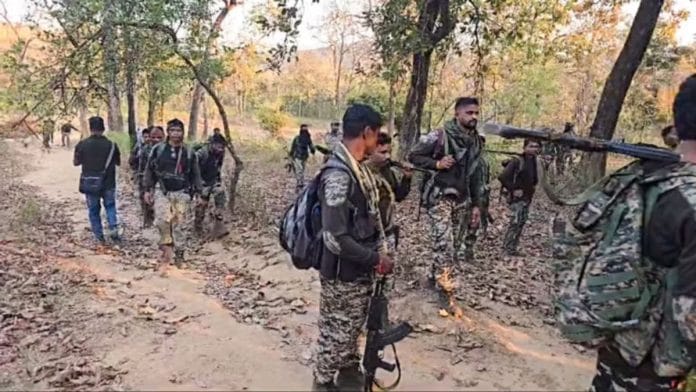



The Maoist insurgency, at one stage, posed the most formidable challenge to the internal security of India. At its peak, in 2009-10, it affected 223 districts spread across 20 states of the country. Jane’s ‘Global Terrorism and Insurgency Attack Index’, in 2013, ranked it fourth among the top ten most active non-state armed groups of the world.
The Indian government had taken a bold decision to wipe out the insurgency by the end of March 2026. Today, there is growing evidence that the armed movement, led by the Communist Party of India-Maoist (CPI-Maoist), is on the verge of collapse.
One of the most significant achievements has been the systematic neutralisation of the top brass of the Maoist leadership. Most of the members of the Politburo and Central Committee—the ideological and operational core of the movement—have been either killed, arrested, or surrendered. This has disrupted the command and control structures.
Decapitation of leadership
The death of Nambala Keshava Rao, alias Basavraju, general secretary of CPI-Maoist, along with 26 others in the Abujhmad region of Chhattisgarh in an encounter on 21 May last year, was a watershed moment. It marked the beginning of the downfall of the Maoist insurrection.
Madvi Hidma, the notorious commander of the People’s Liberation Guerrilla Army’s (PLGA) first battalion, was gunned down by the elite Greyhounds on 18 November last year in Andhra Pradesh. Ganesh Uike, a central committee member, was killed on 25 December 2025 in the Kandhamal district of Odisha. Pati Ram Manjhi, another central committee member, was killed in an engagement with the security forces in the Saranda Forest area of Jharkhand.
The “last nail in the CPI-Maoist coffin” was the surrender of Thippiri Tirupathi alias Devji, General Secretary and head of the Central Military Commission of CPI-Maoist, on 22 February before the Telangana Police. He was a staunch believer in armed struggle.
Interestingly, a central committee member and an ideologue of the party, Mallojula Venugopal Rao, released a video on 19 November 2025, urging the Maoists to surrender their weapons and join the mainstream.
“Time has changed, the country has changed, and circumstances have changed. Armed struggle is no longer possible. We must work according to the Constitution. This is the only option. Do not ignore this reality—lay down arms and return to the people,” he had said.
Simultaneously, the PLGA, the backbone of Maoist military capability, has been effectively disintegrated. Sustained counter-insurgency operations and better intelligence coordination substantially reduced the operational space available to insurgents. Drones and satellites were used to track the movement of Maoist guerrillas, and Forward Operating Bases (FOBs) were set up in remote areas, which were considered impenetrable and were the den of Maoists, to counter the armed rebellions.
Operation Black Forest, a 21-day operation in the Karregutta Hills on the Chhattisgarh-Telangana border, deserves special mention. The security forces killed 27 guerrillas and dismantled a very strong base of the Maoists. After the completion of the operation, 54 Naxalites were arrested, and 84 surrendered in Chhattisgarh, Telangana, and Maharashtra.
The result is unmistakable. The Maoist movement no longer possesses the capacity to mount large-scale, coordinated attacks as it once did. Violence has declined sharply, recruitment has dwindled, and the organisation is fragmented and demoralised.
The defeat of the insurgency is to be attributed to clear and firm political directions, comprehensive and well-coordinated operations and improved governance reflected in the construction of roads, erecting mobile towers, opening bank and post office branches and setting up industrial training institutes. In India’s battle against armed insurrections, this has been the second biggest victory after the defeat of terrorism in Punjab in the 1980s.
Also read: Maoists surrendered for family life, fatherhood. They now find it was snatched long ago
A tactical victory, not a strategic closure
While these developments justify optimism, they must not lead to complacency. Insurgencies are not merely military phenomena; they are deeply rooted in socio-economic and political contexts. The Maoist movement drew strength from long-standing grievances among tribal and marginalised communities—grievances that have not entirely disappeared.
Large sections of the tribal population continue to face displacement due to mining, infrastructure projects, and industrial expansion. In many cases, rehabilitation and compensation have been inadequate or poorly implemented. This has led to a persistent sense of alienation from the state.
Equally concerning is the uneven implementation of protective legislation such as the Forest Rights Act, 2006. The Act was intended to recognise the rights of forest-dwelling communities over land and resources. However, bureaucratic delays, procedural hurdles, and the lack of awareness have limited its impact on the ground.
Beyond specific policies, broader structural issues may yet fuel discontent. Regions affected by Left Wing Extremism have historically suffered from poor governance, lack of infrastructure, inadequate healthcare and education, and limited economic opportunities. There has been progress in recent years, but gaps remain.
Inequality—both economic and social—is a powerful driver of unrest. When development is perceived as exclusionary or extractive, it risks reinforcing the very conditions that gave rise to insurgency in the first place. The challenge, therefore, is not merely to extend the reach of the state, but to ensure that its presence is seen as legitimate, responsive, and just.
The risk of recurrence
History offers a cautionary lesson: movements suppressed through force alone often re-emerge in new forms if the underlying grievances are left unaddressed. The decline of Maoist violence should not obscure the possibility that discontent could resurface—whether as renewed insurgency, localised agitation, or any other form of resistance.
The ideological appeal of Naxalism, rooted in notions of social justice, resistance to exploitation, and resentment over inequalities, may still resonate among sections of the population.
We have a paradoxical situation: the rebellion has been crushed, but the ideology may survive, even though in a latent form.
The present moment offers a historic opportunity—not just to end an insurgency, but to build a durable peace. To achieve this, the government must adopt a calibrated and forward-looking approach.
First, development must be inclusive and participatory. Tribal communities should not merely be beneficiaries of development, but active stakeholders in decision-making processes. Their consent, rights, and cultural identity must be respected.
Second, effective implementation of laws like the Forest Rights Act is critical. Ensuring land tenure security and access to forest resources will go a long way in addressing core grievances.
Third, governance must be strengthened at the grassroots level. Delivery of basic services—healthcare, education, and livelihood—should be prioritised in previously affected areas. Administrative presence must be accompanied by sensitivity and accountability.
Fourth, security forces must not lower their guard. The transition from a conflict zone to a normalised environment requires very careful and sensitive handling.
Also read: Naxals are Indian citizens. Ruthless force is not the way to solve the problem
The real test
India appears to be on the cusp of ending one of its longest-running insurgencies. The disintegration of the Maoist movement is a testament to sustained state effort and improved counter-insurgency strategy.
The real test, however, lies ahead. The government must proceed with care, caution and sensitivity. Ending the Naxal menace is not just about eliminating armed cadres; it is about addressing the deeper fault lines in society, especially in the tribal areas. Only then will the government be able to ensure that the peace it secures today does not unravel tomorrow.
The writer, a former Police Chief, is author of The Naxalite Movement in India. Views are personal.
(Edited by Saptak Datta)