









There are elections. And there is an orchestrated assault.
The 2026 Bengal Assembly elections don’t look like a conventional democratic contest, the usual rollicking face-off between political parties.
What is unfolding is far more stark, unsettling and even chilling, bearing grim implications for the future of democracy in India. In Bengal we’re seeing a systematic alignment of institutions all ranged against a single elected leader, and a single party.
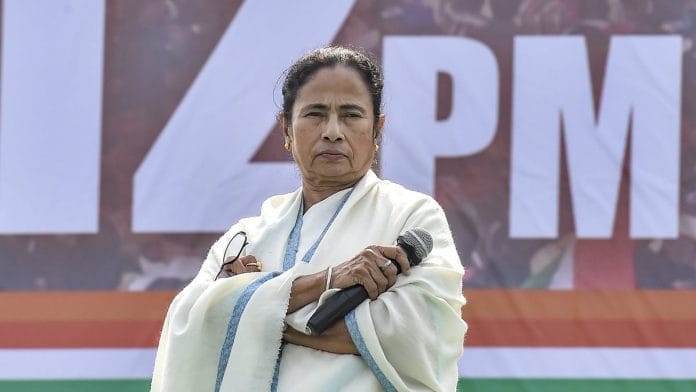
It is Mamata Banerjee versus the Establishment. Mamata Banerjee versus the System. Mamata Banerjee versus the entire Narendra Modi-Amit Shah-headed Centre.
A three-time Chief Minister stands her ground—the only woman chief minister of a state—against the full weight of the Modi-led Centre.
From the bureaucracy, to central forces, to the Election Commission, to the office of the governor, even the National Investigative Agency: A wide arc of entities is trained against Mamata Banerjee-led Bengal.
The Malda protests
If there is one arena where the Narendra Modi-led BJP excels it is narrative building—the dark art of shaping perceptions so that the lines between truth and lies blur.
On 2 April, in Malda, public anger over exclusions from the electoral roll boiled over, and an agitated crowd gathered. Judicial officers were surrounded, and according to some reports “held hostage.” There are credible reports that the Malda protests were deliberately incited by agent provocateurs, aiming to spark a conflagration.
Instantly the narrative was set. The BJP and its ecosystem quickly blamed the Mamata Banerjee government and demanded immediate central intervention. Mainstream TV media looped visuals of unrest -reinforcing a familiar “Bengal is burning,” trope.
What the BJP’s myth-making chose to ignore –and what the Honourable Supreme Court too glossed over—was crucial.
Bengal’s law and order machinery is not in the hands of the state government now. It is entirely in the hands of the Election Commission.
Almost 500 officers including District Magistrates and Superintendents of Police have been transferred out of Bengal by the Election Commission. The top official brass were transferred at 4 am on 15 March, hours after elections were announced. The number of officials transferred in Bengal is 21 times the number transferred in other poll-bound states.
So how can the blame of “breakdown of law and order” then be laid at the door of the state government? The Election Commission has imposed what the CM calls “unofficial President’s Rule” and appointed its own chosen officers across Kolkata and the districts.
The Bengal transfers are unprecedented. They will go down in India’s post-Independence history as an official pre-election purge.
A government elected in 2011, 2016 and 2021 with successively larger mandates has been totally sidelined.
Also read: Maach & mutton for Mission Bengal. What BJP-TMC are cooking in new poll battleground
A democratic injury
In a highly concerning pattern, the Supreme Court, the sentinel of constitutional balance, appears increasingly interventionist in executive domains—directing, supervising and structuring. The apex court is swift to question the state government. But it is strikingly less urgent in interrogating the Election Commission.
Article 326 guarantees the right to vote and the right to be registered as a voter. If even a fraction of disenfranchisement claims are true, why is this not a matter on which the Supreme Court must sternly demand immediate accountability from the Election Commission?
If the constitutional court moves to playing the role of an executive court, the balance of power of the Constitution is dissolved. Separation of powers ceases to exist. Power then shifts in favour of the executive, in this case the Modi government.
During the SIR hearing Supreme Court Justice Joymalya Bagchi observed: “If someone cannot vote in this election, it does not mean their right can be deprived forever.” This is highly problematic framing. Missing the right to vote is not a tolerable inconvenience. It is a fundamental democratic injury.
The Constitution does not speak the language of deferral. Under Article 326, the right to vote is not a future promise. It is a present guarantee. It is not something that can be paused, adjusted, or restored at administrative convenience.
In Parliament, repeated notices given by MPs for discussing SIR-related voter exclusions and deletions have been ignored. An unprecedented impeachment notice against the Chief Election Commissioner or ‘Motion for the Removal of the Chief Election Commissioner’ backed by 193 MPs, the first such motion in the history of independent India, has been rejected by both Rajya Sabha Chairman and Lok Sabha Speaker without giving any reasons.
Also read: Modi thinks he can win Bengal just like Bihar. Five reasons why he’s wrong
Parliament and election campaigning
Parliament proceedings are being made to coincide with electioneering. Suddenly in the thick of the Assembly election campaign, the Narendra Modi government has announced its intention to convene a Special Session of Parliament to amend and implement the Women’s Reservation Bill –or the Nari Shakti Vandan Adhiniyam—passed unanimously by all parties in 2023.
This Bill—parked for 30 months, is now being urgently implemented days before Bengal votes. Timing is never accidental. It is always political choreography. Parliament is being made to play a part in the election campaign.
Yet the Mamata Banerjee-led All India Trinamool Congress has never required legislation to send women into positions of power and agency. Led by a woman chairperson, the TMC already sends 38 per cent women to the Lok Sabha and 40 per cent women to the Rajya Sabha. Yes, we are visible. Yes, the colours of our saris are vibrant, and yes, we make ourselves heard.
The Bengal Raj Bhavan too has been brought into the battle against Mamata Banerjee. On 12 March, Bengal governor CV Ananda Bose was abruptly removed, along with other gubernatorial changes. No cogent explanation was provided for the abrupt removal of Bose.
The Modi government replaced Bose with RN Ravi, former IB officer and Tamil Nadu governor. The choice was telling. Ravi has a long history in Tamil Nadu of repeatedly blocking the MK-Stalin led DMK government. The Supreme Court described Ravi’s actions as “illegal and erroneous” when he withheld his assent to 10 bills passed by the Tamil Nadu government. It is no coincidence that the intractable Ravi—well known for his friction with elected governments—was brought to Bengal ahead of the polls.
The role of the Election Commission in Bengal has been decidedly partisan, opaque and arbitrary, as I have already explained in a previous column.
Recent videos revealed sacks of Form 6 applications (to register new voters) submitted to the EC office in Kolkata. The EC has remained silent. Repeated letters to the EC and CEC from the Bengal CM have gone unanswered.
The Malda violence saw an escalated response from the Election Commission. None other than the National Investigation Agency—the central counter-terrorism body, designed to investigate attacks on the sovereignty of the nation —has been brought in to probe the Malda incident. A civic public grievance is being viewed through a national security lens, raising questions about proportionality.
Also read: 10 examples of the BJP’s ‘Bengal Virodhi’ mindset—mispronunciations to unpaid dues
A fight for Bengal
A relentless, almost monolithic narrative plays out in the mainstream media: Bengal as “lawless,” Bengal as “violent,” Bengal as “unstable.” Every incident is amplified. An entire state is reduced to a fantasy spectacle of “anarchy” and “darkness.”
But step into Bengal and Kolkata to see the reality: Structured and targeted welfare delivery over decades, infrastructure expansion, urban transformation, and a Kolkata that continues to rank among India’s safer cities for women according to NCRB.
An industry leader recently posted about sports facilities created by the Kolkata Municipal Corporation. Kolkata hosts massive Rainbow Pride Walk parades, lively literature fests and film festivals.
The city’s café and restaurant life is buzzing. A range of new retail outlets thrive. The Kolkata Durga Puja was named on UNESCO’s Intangible Heritage list in 2021, Bengal’s new Jagannath temple has already seen a footfall of over 10 million (or over 50,000 pilgrims per day) and Bengal gets the second highest number of international tourists. Chaotic unstable Bengal is a mainstream media myth.
Vast numbers of central forces have been sent to Bengal before the elections. As many as 2,400 companies of Central Armed Police Forces (CAPF) or about 3 lakh personnel have been sent to Bengal. It’s the largest such deployment in India’s electoral history and the EC has stated that 500 companies will remain deployed for post poll control. Home Minister Amit Shah plans to spend the bulk of his time campaigning in Bengal for the next few weeks, virtually shifting his office from New Delhi to Bengal.
The Modi government has denied Bengal its dues amounting to Rs 1.7 lakh crore. Bengal’s eminent citizens like Amartya Sen and cricketer Richa Ghosh have been placed on “adjudication” lists. The Bangla language—the language of the national anthem—was referred to as “Bangladeshi” language in a Delhi Police letter. So intense were the pressures that in a first for post-1947 India, a sitting Chief Minister appeared in person before the Supreme Court to plead for democratic rights.
The pattern is unmistakable: Courts moving swiftly to question the state government. Hundreds of officers transferred. Central agencies stepping in. An Election Commission asserting sweeping control and imposing Micro Observers and Adjudication Lists which it has not done in any other state. A saturation of central forces. The governor changed. Parliament reconvened. Suspicion and targeting from New Delhi. The media amplifying one side and muting the other.
All against one state and one leader.
Bengal Assembly Polls 2026 is not BJP versus TMC, it is Mamata Banerjee against the Modi-led system.
Sagarika Ghose is a Rajya Sabha MP, All India Trinamool Congress. She tweets @sagarikaghose. Views are personal.
(Edited by Theres Sudeep)