



When a goal wins a football match, how much of the victory belongs to the player who scores it, and how much to the one who makes it happen?
Oddly enough, the question came to me while watching Tenzing on Apple TV. Going into a film about Tenzing Norgay and Edmund Hillary, you know where the story will end. What caught my attention happened well below the summit.
In the scene, Hillary falls into a crevasse. He tries to climb out. Above him, Tenzing crawls forward. Your eye goes first to Hillary, his life hanging by the rope. Then you begin watching Tenzing just as closely. Every bit of progress Hillary makes depends on what Tenzing is doing above him. And Tenzing, for all his strength and presence of mind, needs Hillary to keep climbing. For those few moments, getting one man back onto the snow seems quite enough of an achievement.
It made me think of a relay. Who wins the race? The runner who crosses the line? The one who gives the team a good start? The one who makes up the ground or the one who holds the lead?
In the women’s 4×400 metres relay at the 2026 Asian Games in Nagoya, Vithya Ramraj held off Bahrain’s Salwa Eid Naser to win gold for India. Go back to the first handover. Kiran Pahal came in third, close enough for MR Poovamma to go after the two runners ahead. She passed them both. Prachi Choudhary took the baton in front and was still in front when she handed it to Vithya. Kiran had given Poovamma a race to chase. Poovamma and Prachi had given Vithya a lead to defend. She brought it home by just over half a second.
The more interesting case may be a race in which only one man could set the record. On my bookshelf is a signed copy of Roger Bannister’s The First Four Minutes (1954). Ask who first ran a mile in under four minutes and most sports followers will give you his name. Ask who led for the first two laps at Oxford that afternoon, and there might be a pause. It was Chris Brasher. Chris Chataway then took over the pace before Bannister went ahead. Consider what Brasher had agreed to do. His job was to reach halfway with another man in precisely the right position to make history. How do you judge his afternoon? By where he finished, or by where Bannister finished?
Also read: 35 years after liberalisation, India’s youth still prefer a sarkari naukri
Distributing credit
Football, at least, has a word for the man who makes the goal. He gets the assist. But take Argentina’s second goal against France in the 2022 World Cup final. Lionel Messi flicks the ball round the corner to Julián Álvarez, who immediately sends Alexis Mac Allister clear on the right. As the French defenders turn to chase him, Ángel Di María is coming in from the far side. Mac Allister rolls the ball across and Di María meets it in stride. The goal goes to Di María, the assist to Mac Allister. Where in that account are Messi’s flick and the pass from Álvarez?
Sport tends to give the most credit to the person whose contribution we can see most clearly. The goal, the catch, the winning run, the final leg. We know whose name to put beside each of those moments. Dividing up the credit for the victory is harder. Each person’s effort changes what the next one can do.
Cricket has its own curious way of distributing credit. What do we call the dismissal of Viv Richards in the 1983 World Cup final? Kapil’s catch. Quite right, too. Anyone who saw Kapil Dev running back at Lord’s with his eyes on that ball will remember it. But whose wicket was it? Madan Lal’s. He bowled the ball that Richards tried to pull. The scorebook has kept the two men together all these years. Caught Kapil Dev, bowled Madan Lal. In conversation, one of them tends to disappear.
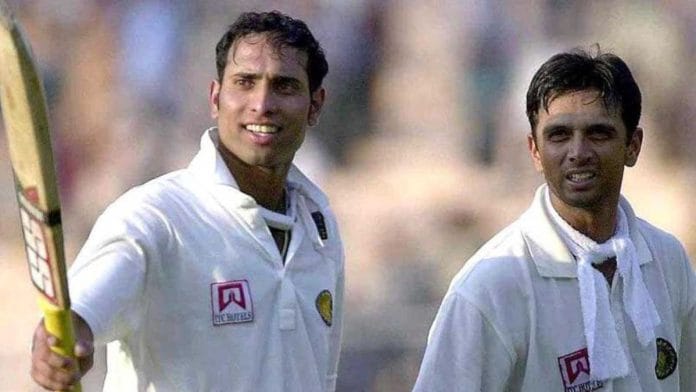
And then there is Eden Gardens in 2001. Say “281” to an Indian cricket follower and you scarcely need to name the batsman or the opposition. VVS Laxman’s innings against Australia deserves every bit of that veneration. Yet imagine watching the fourth day from Rahul Dravid’s end. Laxman had gone up to No 3. Dravid, accustomed to that position, had come in at six. A move down the order can sting. Dravid’s chance to answer came in the peculiar form of a partnership with the very man promoted ahead of him. They batted together all day. Dravid made 180.
Even then, India had only earned the opportunity to win. Somebody still had to bowl Australia out. Harbhajan Singh, who had already taken a hat-trick in the first innings, took six wickets in the second. Ask who won that Test and your answer might depend on which afternoon you spent at Eden Gardens.
Perhaps that is what held my attention in Tenzing. At the summit, somebody can always ask which man set foot there first. Down at the crevasse, it seems a peculiar question. Hillary is climbing. Tenzing is crawling forward. You can see what each man makes possible for the other.
And there hangs the tale, by the rope.
Lokesh Sharma is the founder and managing director of TCM Sports. Views are personal.
(Edited by Prasanna Bachchhav)