





The latest proceedings before the Supreme Court of India offer an opportunity to move the Katchatheevu island debate beyond the familiar question of sovereignty. While hearing petitions challenging the 1974 and 1976 India-Sri Lanka maritime agreements, the court urged the central and Tamil Nadu governments to sensitise fishermen about the consequences of crossing the international maritime boundary and entering Sri Lankan waters. The Indian government, meanwhile, has made clear that it does not intend to reopen the agreements and is pursuing concerns relating to Indian fishermen through diplomatic channels.
More significantly, the Attorney General pointed to the depletion of fish stocks in Indian waters as one reason fishermen venture into Sri Lankan waters. The court also raised questions about fishing practices and the condition of Indian coastal waters during the hearing.
These observations point towards a more fundamental question: is the continuing focus on Katchatheevu distracting both India and Sri Lanka from the real crisis—the depletion of the Palk Bay’s marine resources and the persistence of destructive fishing practices?
A problem larger than an island
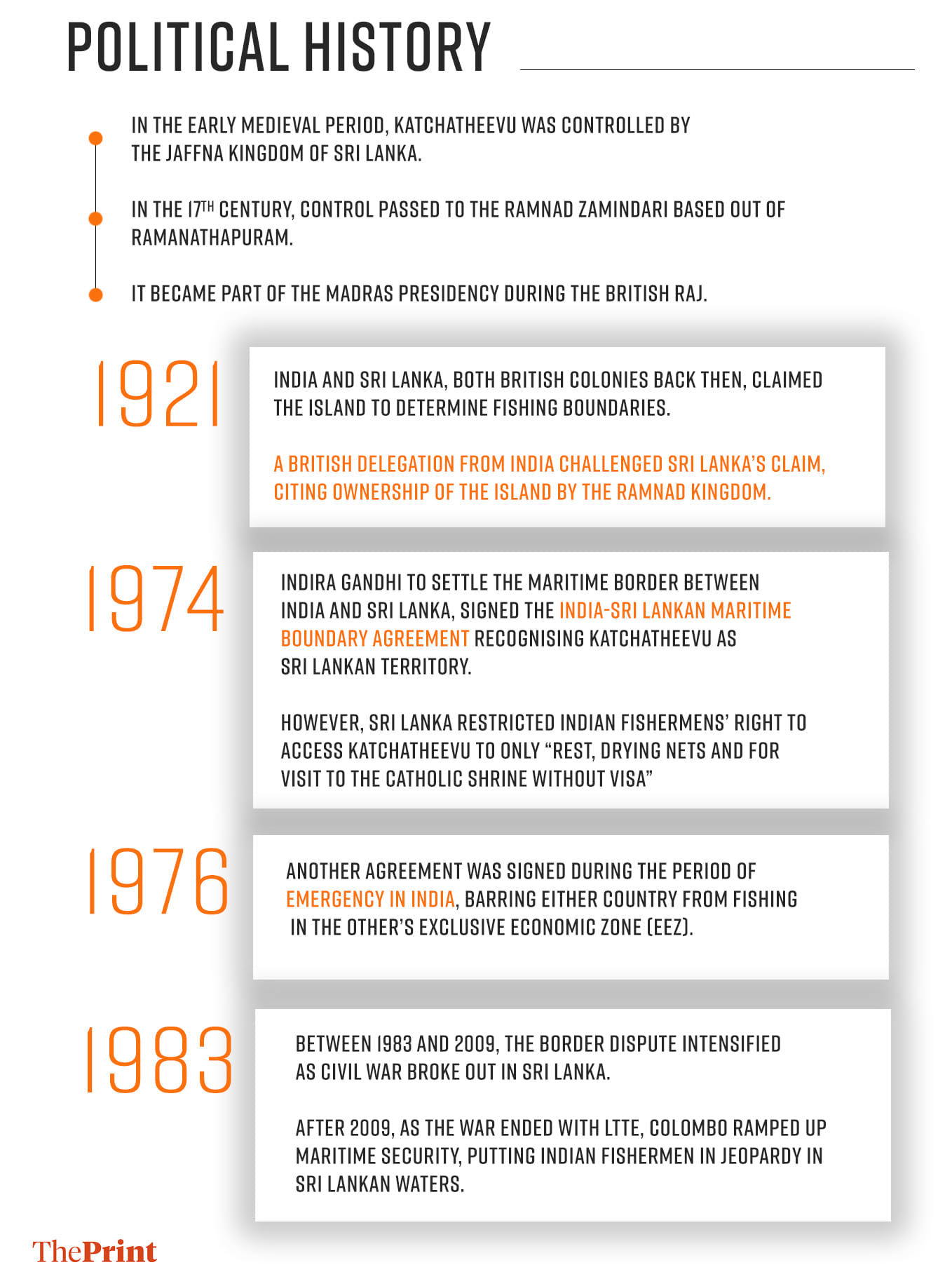
Over fifty years ago, Sri Lanka and India signed two maritime boundary agreements—one in 1974 and the other in 1976—defining the International Maritime Boundary Line and establishing the respective maritime jurisdictions of the two countries, including Sri Lanka’s sovereignty over Katchatheevu. The agreements did not grant Indian fishermen traditional fishing rights in Sri Lankan waters, nor did they provide reciprocal rights to Sri Lankan fishermen in Indian waters.
The constitutional and legal challenges to those agreements remain before the Indian Supreme Court. The court has not adjudicated their constitutional validity, and the matter remains pending. At the bilateral level, however, successive governments have treated the maritime boundary established by the agreements as the basis for managing relations between the two countries.
The concerns of Tamil Nadu’s fishing communities are genuine. Indian fishermen and their families face economic hardship when boats are detained and fishermen are arrested after crossing the maritime boundary. Tamil Nadu Chief Minister C Joseph Vijay has recently urged the Indian government to intervene to secure the release of detained fishermen and seized boats and called for renewed dialogue.
But these immediate concerns point towards a larger question: why are fish stocks being depleted, and what can be done to restore them?
The problem cannot be addressed simply through repeated diplomatic representations, arrests, releases and demands for the return of fishing boats. Nor can it be resolved by continually reopening the political debate over Katchatheevu.
The Palk Bay is a shared ecological system whose resources are finite. Its health ultimately determines whether fishing communities on either side of the maritime boundary can continue to make a living from it.
Also read: Rameswaram’s fisherfolk furious with Katchatheevu politics. ‘Don’t want island, just fishing rights’
The ecological toll
Bottom trawling is at the heart of the problem. Dragging heavy nets across the seabed destroys marine habitats, captures juvenile fish and generates substantial bycatch. Its effects are cumulative and potentially long-lasting.
The issue is therefore not simply whether fishermen cross an international maritime boundary. It is also the impact on the marine ecosystem of continued large-scale, destructive fishing.
Sri Lanka’s Northern Province, once home to a thriving fishing industry, has experienced a sharp decline in fish catches, from 35,000 metric tonnes in 1995 to 17,000 metric tonnes in 2023. Multiple factors have contributed to this decline, including the legacy of decades of conflict and displacement. But pressure from large-scale trawling in the Palk Bay has added to the difficulties faced by northern fishing communities.
For fishermen on both sides, the long-term interest should therefore be the same: preserving the marine resource on which their livelihoods depend.
A consistent but passive response
Sri Lanka has maintained a consistent and restrained position on Katchatheevu for five decades, working within established legal and diplomatic frameworks. The island has also remained a symbol of the longstanding links between the two countries, particularly through St Anthony’s Church and the annual pilgrimage attended by devotees from both sides.
But Sri Lanka has done little to give Katchatheevu a constructive contemporary role. That should change.
Years ago, the Pathfinder Foundation proposed the establishment of a marine research station on Katchatheevu, led by the Department of Fisheries, the National Aquatic Resources Agency (NARA), and Sri Lankan universities.
The proposal deserves renewed consideration.
Turning Katchatheevu into a platform for science
A marine research station would give Sri Lanka a practical means of exercising responsible stewardship while contributing to the preservation of the wider Palk Bay ecosystem.
It could monitor marine biodiversity and ecological degradation, assess the long-term impact of bottom trawling, track migratory patterns and spawning cycles, and provide scientific data for fisheries policy. It could also serve as a platform for marine diplomacy and dialogue between India and Sri Lanka.
India already possesses substantial marine research capabilities. Sri Lanka should develop a complementary capability on its side of the maritime boundary.
Advances in solar power, desalination and modular construction have also reduced the logistical obstacles that might once have made such a facility difficult to establish. A low-impact, high-value research station is now a feasible proposition.
From dispute to cooperation
The current debate offers an opportunity to change the nature of the conversation.
Tamil Nadu’s concern for its fishermen is legitimate. Sri Lanka’s concern about illegal fishing and the degradation of its marine resources is equally legitimate. Treating one concern as valid and the other as an obstacle will not produce a durable solution.
Nor will repeatedly returning to the sovereignty question.
Instead, India and Sri Lanka should focus on the management of the Palk Bay as a shared ecological system. Joint scientific monitoring, conservation programmes and discussions on regulated and sustainable fishing could provide the basis for practical arrangements that protect livelihoods while phasing out destructive practices such as bottom trawling.
Such cooperation would not require either country to compromise its sovereignty or its legal position.
It would require both to recognise that marine ecosystems do not respect political boundaries.
Science over sentiment
The Katchatheevu debate has continued for decades. The immediate concerns of detained fishermen and fishing communities must be addressed through established diplomatic and legal channels. But those measures cannot substitute for a long-term solution.
The real challenge is not simply who possesses Katchatheevu. It is whether the waters surrounding the island will continue to support the communities that depend on them.
For Sri Lanka, the answer should be neither rhetorical confrontation nor passive diplomacy. It should be science, responsible stewardship and constructive regional cooperation.
Katchatheevu need not remain a symbol of contention. Properly used, it could become a platform for marine research, environmental stewardship and sustainable cooperation between India and Sri Lanka.
Milinda Moragoda is a former Sri Lankan Cabinet minister, diplomat, and founder of the Pathfinder Foundation, a strategic affairs think tank. He served as the High Commissioner of Sri Lanka to India from September 2021 until September 2023. He tweets @MilindaMoragoda. Views are personal.
(Edited by Prashant Dixit)