









When the 7th State Pay Commission in Karnataka was constituted in November 2022, we were tasked with a seemingly technical exercise: recommend a fair minimum pay for more than 5.7 lakh state government employees. What emerged was something far more significant: A small but transformative correction to a 70-year-old formula that had subtly embedded gender bias into the very foundation of public service compensation.
The determination of remuneration for government employees rests on the fundamental premise that pay for any post must attract individuals of requisite qualifications and calibre while motivating sincere performance without any unfair treatment. Pay structures must also uphold the universal principle of equal remuneration for work of equal value.
These structures are shaped by multiple factors that evolve with changing organisational, socio-economic, and policy environments. In the public sector, employees serve multifaceted roles—social navigators, stewards of scarce resources, guardians of democratic principles and the rule of law, and agents of change—exerting wide-ranging influence on society and the environment. Consequently, Pay Commissions are responsible for recommending prudent, fair, and equitable compensation aligned with ground realities, merit, and justice.
The 7th State Pay Commission of Karnataka arrived at the minimum pay, the foundational building block of the entire pay structure. It highlighted a path-breaking innovation: the explicit incorporation of gender parity into the calculation methodology.
While previous commissions in Karnataka, the central government, and other states relied on established norms, the 7th Karnataka Pay Commission identified a subtle yet systemic gender bias rooted in normative assumptions dating back seven decades. Through microscopic examination and a reforms-linked governance approach, it revised the criteria to achieve genuine equity and equitable distribution.
Systematically undervaluing women’s needs
Minimum pay represents the entry-level remuneration at the lowest cadre and is intended to meet the basic needs of an employee and their family for a dignified standard of living. No single universally accepted formula exists; instead, two principal approaches have guided Pay Commissions.
First, the “constant relative income approach,” which ensures real minimum pay grows in tandem with real per capita income. The second, increasingly favoured in recent years, calculates the minimum expenditure required for dignified living. This latter method draws on the Aykroyd formula, named after nutritionist Wallace Ruddell Aykroyd and endorsed by the 1957 Indian Labour Conference, which assumed a normative family of four: a male employee, his wife, and two children below 14.
It assigned consumption units as follows: husband = 1 unit, wife = 0.8 units, and each child = 0.6 units, for a total of 3 units. Each unit was pegged at 2,700 calories daily. This determined not just food costs but the entire basket of minimum needs—clothing, housing, fuel, education, transport, and more.
The logic was understandable in its time. But seven decades later, with women’s participation in government service rising sharply (Karnataka now has nearly 1.85 lakh women employees), continuing to treat adult women as 20 per cent “less” in consumption needs had become indefensible. It was not merely symbolic. Because minimum pay is the base, this differential cascaded through every head of expenditure — non-food items, housing, digital access — systematically undervaluing women’s needs in the calculation of a “dignified” living standard.
The Commission reviewed methodologies from prior Karnataka Pay Commissions (including the 6th), the Central Pay Commission (including the 7th, which referenced 1957 Indian Labour Conference norms), and the 2019 Expert Committee report chaired by Dr Anoop Satpathy on national minimum wage fixation. The Satpathy Committee updated the framework using Indian Council of Medical Research nutritional norms, advocating a balanced diet (plus or minus 10 per cent of 2,400 calories, with proteins equal to or greater than 50g and fats equal to or greater than 30g per person daily) and reasonable non-food expenditures drawn from median and sixth-fractile household data (NSSO-CES 2011/12).
It recommended a need-based national minimum wage of Rs 375 per day (Rs 9,750 per month as of July 2018) for a 3.6-unit family, with regional variations.
Building on these, the 7th Karnataka Pay Commission determined that a slight but deliberate modification to the ILC/Aykroyd norms was essential for gender parity. It revised the female adult consumption unit from 0.8 to 1.0, increasing the total for the representative family from 3 to 3.2 consumption units specifically for food expenditure calculations.
This adjustment was not arbitrary. Detailed in the Commission’s report (as of 1 July 2022), the Commission itemised daily per consumption unit requirements for a balanced diet, including rice/wheat (475g), pulses (80g), vegetables, fruits, milk (200ml), sugar/jaggery, edible oil, fish, meat, eggs, detergents, and clothing (5.5 metres per month)—then scaled them for three persons (three units) and further for 3.2 units. Prices prevailing in Karnataka were applied to derive monthly costs.
Also read: India’s tax and trade policies are not aligned. It creates inefficiencies
A step-wise calculation
The calculation proceeded stepwise:
- Total food and related items for 3.2 units reached Rs 12,207.73.
- Adding fuel, electricity, and water (scaled), marriage/recreation/festivals, housing (7.5 per cent norm adjusted), and new items (transport, education, mobile/internet, household accessories) involved successive divisions by factors (0.80 for non-food, 0.85 for miscellaneous, 0.90 for housing and new items) to account for the full basket.
- A 20 per cent weightage for a decent standard of living and life skills (aligned with the 7th Central Pay Commission) was applied.
- After rounding, the minimum pay was fixed at Rs 27,000 per month.
This revision, which embeds an approximate 7 per cent increase through the 3.2-unit adjustment, appears modest in arithmetic but is profoundly significant. A comparative analysis of six scenarios (A-F) of consumption unit allocation is as follows:
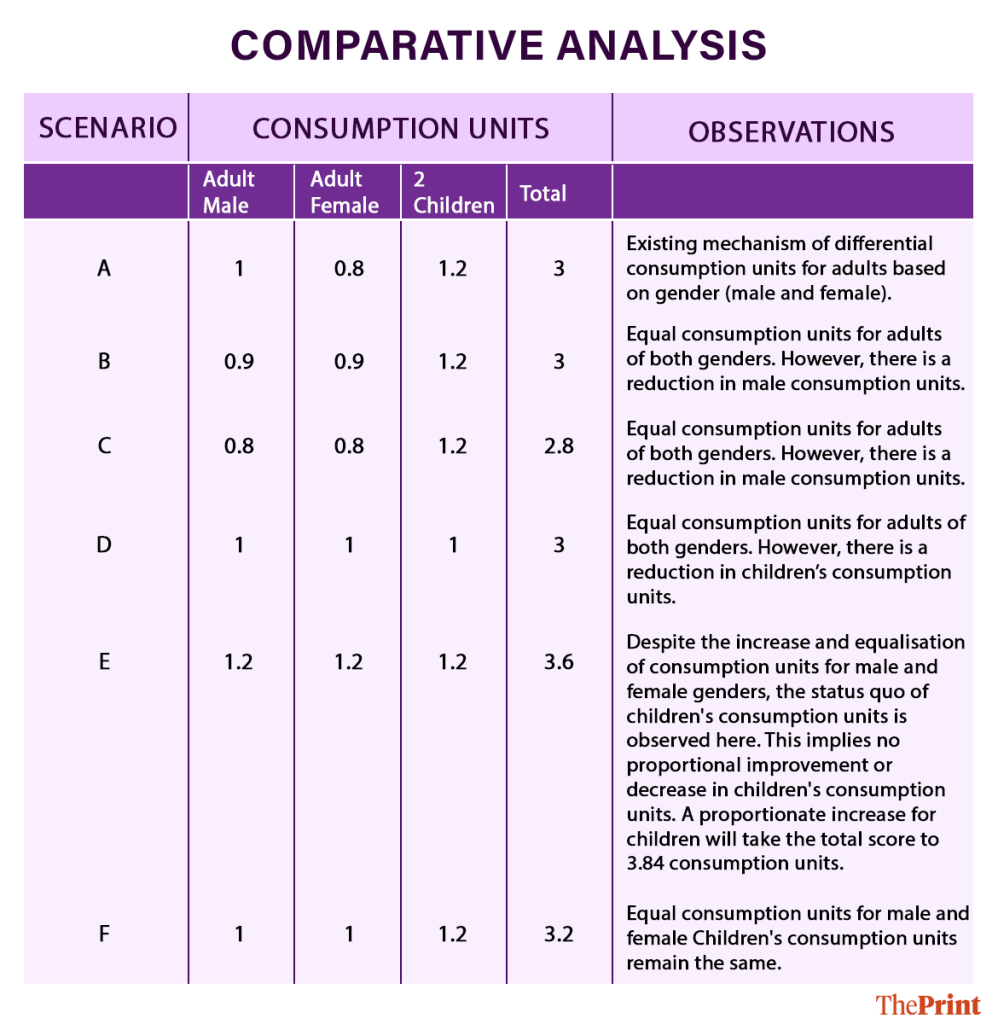
Scenario A (existing): Male 1 + Female 0.8 + Children 1.2 = 3 units (gender-differentiated).
- Scenarios B–D: Equal adult units (0.9 or 0.8 each) but with reductions in male or child units to stay within 3 total—deemed unacceptable as they lower established nutritional standards.
- Scenario E: 1.2 units each for adults and children = 3.6 units (full equalisation without child adjustment).
- Scenario F (adopted): Male 1 + Female 1 + Children 1.2 = 3.2 units (equal adult treatment while preserving child norms and maintaining proportional improvement).
Also read: India’s new wage code could raise pay without hurting jobs. Here’s how
A powerful signal
Reallocation within the rigid third-unit ceiling would merely redistribute rather than enhance consumption, contradicting governmental mandates to promote higher nutritional standards, health, and living conditions amid socio-economic progress. The Commission rejected crude rounding-off methods as insufficient for equity goals, arguing that social parameters demand precise, evidence-based apportionment rather than pre-fixed limits.
The gender adjustment has cascading effects beyond food: non-food expenditures (clothing, housing, education, transport, digital access) are also scaled upward, eliminating systemic disparity. Continuing 70-year-old assumptions that women’s needs are 20 per cent lower perpetuates inequity across all expenditure heads. This “equity principle” functions like an escalation factor in fiscal policy, which is a non-negotiable for addressing inflation, market realities, and normative biases.
The measure is highly relevant and was not an act of tokenism. As a model employer, the state must foster inclusivity. Karnataka’s workforce (5,71,271 employees as of 1 October 2023) includes 1,84,688 women; the Commission urged enhanced representation, creches, leave provisions (especially for mothers and caregivers), and enabling environments. It was prudent fiscal policy. By treating adult men and women as equal consumption units, Karnataka’s 7th Pay Commission broke a stereotype that had lingered in policy arithmetic for too long. It affirmed that women in government service are not merely “wives” in a normative family model but equal stakeholders in the functioning of the modern state.
It also sent a powerful signal: the government as a model employer must lead by example in creating enabling environments that encourage greater participation of women.
Drawing on Joseph E Stiglitz’s The Price of Inequality, it underscores discrimination as a stubborn source of inequity. Chief Justice DY Chandrachud’s observations on institutional apathy toward women, Claudia Goldin’s research on persistent wage gaps despite equal starting opportunities, and UN Sustainable Development Goals Reports (2023–2024) reinforce the urgency. SDG 5 highlights women’s disproportionate unpaid care burden (2.5 times that of men) and calls for shared responsibility, policy reform, and investments in gender equality. The Commission aligns minimum pay revision with these global imperatives, shifting from male-default benchmarks to equal treatment of all adults as stakeholders in the modern state.
Critics may argue that such changes add to the fiscal burden. The state government has absorbed an additional annual commitment of more than Rs 20,000 crore. And the long-term returns—better recruitment, higher retention, improved morale, and a more representative bureaucracy—far outweigh the cost. True fiscal prudence lies in investing in human capital and equity, not in perpetuating outdated assumptions.
A small adjustment in the foundational formula can produce structural change. As the Commission noted in its report: “The Aykroyd Formula used for the calculation of minimum consumption expenditure of an employee family has been modified slightly by providing equal weightage of ‘1’ to both adult male and female members of the representative family instead of the prevailing weightage of ‘1’ and ‘0.8’, thus treating the two genders equally.”
In an era when governments speak of inclusive growth and sustainable development, this is equity made operational and a reminder that institutions can, and must, evolve their mindsets. Policy reform is not just about increasing salaries; it is about ensuring that the very method of determining those salaries reflects the values we claim to uphold.
Thus, the 7th Karnataka Pay Commission’s recommendation—accepted by the state government modifies the Aykroyd formula by granting equal 1-unit weightage to both adult male and female members, treating genders equitably. This small yet transformative step establishes a foundation for future pay revisions, pension matters, and prudent fiscal policy.
It challenges stereotypes, promotes inter-generational nutritional equity, and positions the government as an agent of genuine systemic change. By embedding gender parity into the basic arithmetic of compensation, the Commission demonstrates that equity is not an afterthought but a core, evidence-driven principle essential for just governance and human development. Karnataka has shown that making equity happen is possible – one carefully reasoned decimal point at a time.
Hephsiba Rani Korlapati is a serving IAS officer of the 2011 batch, Karnataka cadre. She is currently posted as Additional Resident Commissioner at Karnataka Bhavan, New Delhi, and served earlier as Secretary, 7th State Pay Commission of Karnataka.
Views are personal.
(Edited by Saptak Datta)