










I dedicate this small book to the good people of the United States… as a token of admiration for their noble, disinterested, and self-sacrificing devotion in the cause of Negro slavery.”
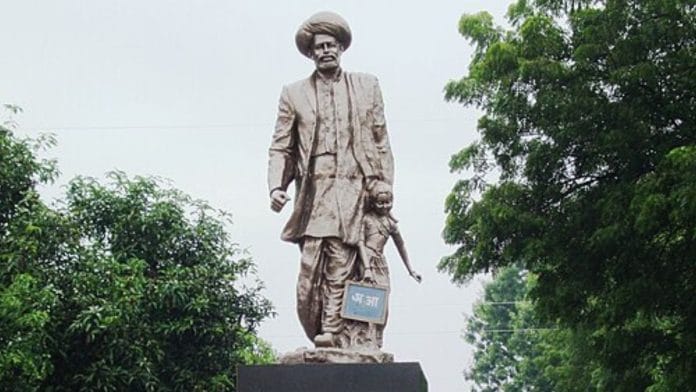
The above quote is taken from Jyotiba Phule’s book, Gulamgiri (1873), which foregrounds him as a person and connects the issues of inequality in his habitus across the ocean. He is a globalist and an organic intellectual in the truest sense and the pioneer of a Satayashodhak Modernity standpoint. But along with his global aptitude and attitude, Phule’s writings and words aspired to carve a ‘Third Eye.’
It was a powerful agency for cultivating minds to critically question the events around them. This third eye is the enhancement of people’s ability to understand, analyse, and see the ‘Truth’, and to understand the dynamics of power and knowledge. It was envisioned to democratise the power and share it among the Shudra-Atishudras.
We here try to craft a portrait of Phule and his interventions, using the idea of the third eye in the context of water, making it a tool of political and social democracy in light of his unending quest to reclaim humanity.
Ecological visionary
His water vision can be read from his text, Shetkaryacha Asud. The idea of water as a resource that should be universally accessible. A staunch critic of big dams, Phule’s ideas were ecocentric, clubbing them with justice, which focuses on building check dams and bunds. For him, this approach was water as a legal right for all, rather than based on social status.
For him, the big dams, which reeked of colonial modernity, perpetuated inequality and benefited only a few. So, water is economic capital that must be democratic and accessible to all people. This was also implemented by Phule when, as a contractor, he supplied stone and labour for the construction of the Khadakwasla dam. Not just in the construction of the dam, but he also gave a tough fight to the very British administration, so that the water of this dam reached the poor farmers and the masses.
Phule walked his talk. He didn’t stop at giving sermons; he also practised direct action. He opened his private well for the untouchables in Pune in 1868. It wasn’t a charity but a socio-biological action that centred on challenging the dynamics of caste power enmeshed in material access to the basic natural resources like water.
Phule and his partner, Savitribai Phule, protected the untouchables from the local mafia, who often attacked them when they came to fetch water, creating a safe space and demonstrating a neo-modernity that was not just preaching modern ideas but implementing them in the local conditions. This was the very thread that BR Ambedkar picked up when he undertook the Mahad Satyagraha 60 years later, on 20 March 1927.
“Do not the employees who swallow thousands of rupees as salary have enough sense to calculate how many gallons of water are available… and supply those whose lands need it?”
He asks the above question in his book Shetkaryacha Asud, where he questions the injustices that were perpetuating urban water inequality. He asks that the municipal corporation of Poona collect taxes from everyone, but the money is used to build fancy fountains and to provide access to clean water only to a few.
Also read: Casteism didn’t disappear in Indian cities. It just learned English
A journey to Viksit Bharat
As a member of the corporation, in the cause of justice, he submitted for the construction of a water filtration plant to provide the marginalised people of the city, especially the labourers who were dying due to cholera, as they lacked access to clean drinking water. Thus, Phule makes sanitation and water a public question, placing them within the economic and social justice paradigms.
Phule’s modernity, albeit a unique strand in pre-post-colonial thinking, wasn’t about taking sides. His quest to dismantle slavery, reclaim humanity, and empower the marginalised encompassed various metanarratives, among which the democratic access to water was the most important and instrumental part of his protracted struggle.
He went beyond parochial constructs to empower the masses to reclaim their sovereignty by seeking and rejecting mental and cultural slavery. This discourse was later taken up by Ambedkar, who used Phule’s Satyashodhak software in drafting the Constitution of India.
Thus, Phule’s vision and legacy today are the blueprint of India, the world’s largest democracy. And, the recent declaration by the Union government to celebrate the legacy of Phule on the occasion of his 200th birthday is remarkable in two senses.
It is an attempt to honour the legacy of Phule and Savitribai, the two organic intellectuals and activists, and to use their thoughts and standpoints to craft the envisioned journey of Viksit Bharat.
Aditi Narayani is an associate professor at the Dr Ambedkar International Centre. She tweets @AditiNarayani. Nikhil Sanjay-Rekha Adsule, is a Senior Research Scholar at IIT-Delhi & John Dewey Emerging Scholar, USA. He tweets @beingkhilji. Views are personal.
(Edited by Saptak Datta)