








The National Medical Commission’s decision to withdraw permission for the Shri Mata Vaishno Devi Institute of Medical Excellence at Kakryal in Reasi district, Jammu and Kashmir, has produced a spectacle both surreal and revealing—fireworks, dhols and sweets in parts of Jammu to celebrate the closure of a medical college.
Chief Minister Omar Abdullah has reacted with visible anger, asking how anyone could celebrate the destruction of hard-won medical seats. He accused the BJP and allied Hindu groups of ruining children’s future in the name of religion. Beneath the noise, this episode tests whether India can keep faith, merit and constitutional discipline in the same room.
Formally, the National Medical Commission’s (NMC) Medical Assessment and Rating Board withdrew the Letter of Permission for the MBBS course after a surprise inspection reportedly found non-compliance with minimum standards—faculty strength, infrastructure and clinical load. These are not ornamental requirements.
Medicine cannot be taught safely in an institution that falls short on teachers, facilities and a functioning teaching hospital. Once permission is withdrawn, the sanctioned intake of 50 seats collapses, and the state must shift the existing students to recognised colleges for their protection. Omar has assured that his government will accommodate the selected students in other medical colleges, reportedly by creating supernumerary seats.
NEET became a problem
The controversy began with the first merit list. Admissions were conducted through the National Eligibility-cum-Entrance Test (NEET), restricted to J&K students and allotted through centralised counselling. The reported outcome was stark: 44 Muslims in a batch of 50. There was no religious quota, no relaxation, no discretion—only rank, choices and counselling.
That is precisely what triggered the backlash. Protesting Hindu groups argued it was “unjust” that a shrine-run institution—funded by devotees’ offerings—should produce a predominantly Muslim cohort. The initial demand was blunt: cancel admissions and reserve seats for Hindus. When it became evident that retrospective religious engineering collides with NEET’s structure and the equality principle, the demand escalated to something more extreme: shut the institution itself.
The inversion is the story. These were not protests for more faculty, faster construction, better hospital load or greater capacity. There were celebrations of closure because merit produced an “unacceptable” demographic outcome.
India’s Constitution offers two relevant ideas that are often kept apart in political debate. One is non-discrimination in public education: you do not get to deny admission in a state-run or state-aided setting because of religion. The other is minority autonomy: religious and linguistic minorities may establish and administer educational institutions of their choice. The design is a balance—equal civic membership on one hand, protected institutional space on the other.
Courts have also supplied two guardrails that matter here. First, minority rights are not a licence to maladminister—medical education standards apply to everyone. Second, whatever the seat distribution, the gateway for admissions is merit-linked and transparent—through NEET and lawful counselling. A minority label may shape the pool for a subset of seats; it does not abolish merit.
Also read: Hindu leaders have been backward-looking. It started with Gandhi
Hindus can be a minority too
The Vaishno Devi episode forces an uncomfortable but constitutionally routine point into the open: Hindus are the national majority, but in J&K, they are a minority whose protection is territorial, not “civilisational”. In effect, the category “minority” is determined state-wise or UT-wise, not by all-India arithmetic. Jammu already has a working precedent: Acharya Shri Chander College of Medical Sciences (ASCOMS), Jammu, admits MBBS candidates under a BOPEE-notified Hindu Minority quota through NEET-based counselling.
This principle was authoritatively laid down by the Supreme Court of India in the landmark TMA Pai Foundation vs State of Karnataka judgment delivered on 31 October 2002 by an 11-judge Constitutional Bench.
Once that reality is accepted, a lawful pathway appears—far more sensible than demanding cancellations or closures. A Hindu-run institution in J&K can, in principle, seek minority-institution recognition and frame a seat model that gives a defined preference to the Hindu minority within the UT—without abandoning NEET merit and without excluding non-Hindus altogether.
There is, however, a definitional wrinkle that deserves sobriety. Explanation II of Article 25 states that, for the limited purpose of laws throwing open Hindu religious institutions of a public character, “Hindus” shall be construed as including persons professing the Sikh, Jains or Buddhist religions. Whether an admissions category framed as “Hindu minority” under an Article 30-style design in J&K should mirror that inclusive understanding is an open question here—one for careful drafting and, if contested, judicial clarity.
Also read: Jammu and Kashmir offers a model for NEP-led success. It’s called ‘Design Your Degree’
The Shrine Board’s test
Minority status is not triggered by emotion, funding streams or political pressure. The jurisprudence requires that a minority institution be both established and administered by the minority community, and that its minority character be substantive rather than cosmetic. A shrine board may be Hindu in identity; yet a medical college run as a general public institution, incidentally funded by a religious endowment, could find it harder to sustain a minority claim.
That is why the sequence matters. Seeking minority status only after an admissions list produces an unwelcome result risks looking like a retrofit—constitutional vocabulary deployed to sanctify a communal demand. If the Shrine Board believes devotees’ expectations must be expressed lawfully, it should do so through transparent institutional decisions: recognition, governance and compliance—not agitation against a counselling list.
A workable framework existed from the start: A mixed model in which a reasonable minority share is filled strictly by NEET merit among eligible Hindu-minority candidates in the UT, and the remainder is filled on open merit through the same counselling. That would have aligned donor sentiment with constitutional discipline, while ensuring meritorious Muslim candidates are not turned into outcasts.
Instead, the story has run backwards: open-merit admissions produced a Muslim-majority cohort; protests demanded retrospective cancellation and then closure; derecognition arrived on deficiency grounds; and now everyone claims vindication while the UT loses capacity and students lose certainty.
A fair way forward is straightforward:
- Compliance first. Fix deficiencies—or challenge the process transparently.
- Decide the institution’s character in law, not on the street. If the Shrine Board genuinely wants minority status, pursue it formally and meet the “established and administered” test.
- Restart admissions on a clean constitutional slate. Once permission is restored and standards are met, conduct admissions through NEET, with any minority share filled strictly by merit and the rest on open merit.
And one obligation remains immediate and non-negotiable: protect the students already selected, as the chief minister has publicly committed.
The real tragedy is not that a shrine-run college admitted Muslim students on merit. It is that some chose to celebrate the burning of public capacity because merit produced an outcome they disliked. If J&K is to gain anything from this episode, it should be a renewed insistence on the only formula that can hold a diverse society together: faith respected, merit protected, and constitutional pathways preferred over fireworks—with equal regard for the minority rights of Hindus in those States and Union Territories where they are, in fact, a minority.
KBS Sidhu is a former IAS officer who retired as Special Chief Secretary, Punjab. He tweets @kbssidhu1961. Views are personal.
(Edited by Saptak Datta)
The J&K Hindu community isn’t asking for sympathy. They’re demanding their space, and saying enough with the silent suffering.
If Shaheenbagh is democracy in your view, then this incidemt too is emphatically an identical aspect of democracy and community power.
This isn’t about political theatrics or emotional outbursts. This is about strategic community building and forward-thinking resilience.
Demography amd Performance are destiny indeed. Hindus are not asking for reservations. In this matter l. They just reclaimed the space that always belonged to them.
The central government must recognize J&K’s complex demographic landscape and proactively design policies that protect Hindu minority interests.
Home Opinion J&K medical college was shut over ‘unacceptable’ demography. Hindus can be a minority too
Opinion
J&K medical college was shut over ‘unacceptable’ demography. Hindus can be a minority too
The episode forces an uncomfortable but constitutionally routine point into the open: Hindus are a minority in J&K. Their protection is territorial, not “civilisational”.
K.B.S Sidhu K.B.S Sidhu 10 January, 2026 12:45 pm IST
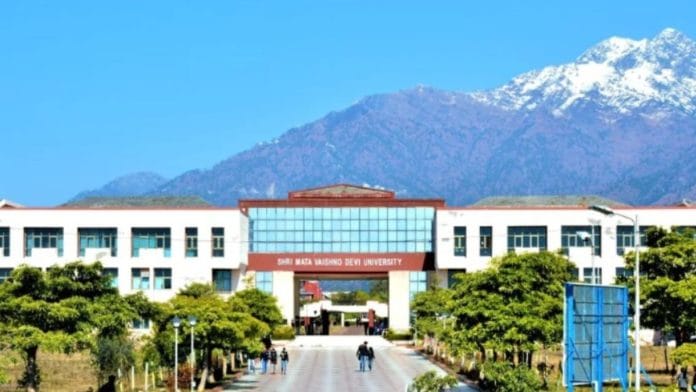
The National Medical Commission has withdrawn the Letter of Permission granted to the Shri Mata Vaishno Devi Institute of Medical Excellence in J&K’s Reasi district to start an MBBS course | Credit: SMVDIME
The National Medical Commission has withdrawn the Letter of Permission granted to the Shri Mata Vaishno Devi Institute of Medical Excellence in J&K’s Reasi district to start an MBBS course | Credit: SMVDIME
The National Medical Commission’s decision to withdraw permission for the Shri Mata Vaishno Devi Institute of Medical Excellence at Kakryal in Reasi district, Jammu and Kashmir, has produced a spectacle both surreal and revealing—fireworks, dhols and sweets in parts of Jammu to celebrate the closure of a medical college.
Chief Minister Omar Abdullah has reacted with visible anger, asking how anyone could celebrate the destruction of hard-won medical seats. He accused the BJP and allied Hindu groups of ruining children’s future in the name of religion. Beneath the noise, this episode tests whether India can keep faith, merit and constitutional discipline in the same room.
Formally, the National Medical Commission’s (NMC) Medical Assessment and Rating Board withdrew the Letter of Permission for the MBBS course after a surprise inspection reportedly found non-compliance with minimum standards—faculty strength, infrastructure and clinical load. These are not ornamental requirements.
Medicine cannot be taught safely in an institution that falls short on teachers, facilities and a functioning teaching hospital. Once permission is withdrawn, the sanctioned intake of 50 seats collapses, and the state must shift the existing students to recognised colleges for their protection. Omar has assured that his government will accommodate the selected students in other medical colleges, reportedly by creating supernumerary seats.
NEET became a problem
The controversy began with the first merit list. Admissions were conducted through the National Eligibility-cum-Entrance Test (NEET), restricted to J&K students and allotted through centralised counselling. The reported outcome was stark: 44 Muslims in a batch of 50. There was no religious quota, no relaxation, no discretion—only rank, choices and counselling.
That is precisely what triggered the backlash. Protesting Hindu groups argued it was “unjust” that a shrine-run institution—funded by devotees’ offerings—should produce a predominantly Muslim cohort. The initial demand was blunt: cancel admissions and reserve seats for Hindus. When it became evident that retrospective religious engineering collides with NEET’s structure and the equality principle, the demand escalated to something more extreme: shut the institution itself.
The inversion is the story. These were not protests for more faculty, faster construction, better hospital load or greater capacity. There were celebrations of closure because merit produced an “unacceptable” demographic outcome.
India’s Constitution offers two relevant ideas that are often kept apart in political debate. One is non-discrimination in public education: you do not get to deny admission in a state-run or state-aided setting because of religion. The other is minority autonomy: religious and linguistic minorities may establish and administer educational institutions of their choice. The design is a balance—equal civic membership on one hand, protected institutional space on the other.
Courts have also supplied two guardrails that matter here. First, minority rights are not a licence to maladminister—medical education standards apply to everyone. Second, whatever the seat distribution, the gateway for admissions is merit-linked and transparent—through NEET and lawful counselling. A minority label may shape the pool for a subset of seats; it does not abolish merit.
Also read: Hindu leaders have been backward-looking. It started with Gandhi
Hindus can be a minority too
The Vaishno Devi episode forces an uncomfortable but constitutionally routine point into the open: Hindus are the national majority, but in J&K, they are a minority whose protection is territorial, not “civilisational”. In effect, the category “minority” is determined state-wise or UT-wise, not by all-India arithmetic. Jammu already has a working precedent: Acharya Shri Chander College of Medical Sciences (ASCOMS), Jammu, admits MBBS candidates under a BOPEE-notified Hindu Minority quota through NEET-based counselling.
This principle was authoritatively laid down by the Supreme Court of India in the landmark TMA Pai Foundation vs State of Karnataka judgment delivered on 31 October 2002 by an 11-judge Constitutional Bench.
Once that reality is accepted, a lawful pathway appears—far more sensible than demanding cancellations or closures. A Hindu-run institution in J&K can, in principle, seek minority-institution recognition and frame a seat model that gives a defined preference to the Hindu minority within the UT—without abandoning NEET merit and without excluding non-Hindus altogether.
There is, however, a definitional wrinkle that deserves sobriety. Explanation II of Article 25 states that, for the limited purpose of laws throwing open Hindu religious institutions of a public character, “Hindus” shall be construed as including persons professing the Sikh, Jains or Buddhist religions. Whether an admissions category framed as “Hindu minority” under an Article 30-style design in J&K should mirror that inclusive understanding is an open question here—one for careful drafting and, if contested, judicial clarity.
Also read: Jammu and Kashmir offers a model for NEP-led success. It’s called ‘Design Your Degree’
The Shrine Board’s test
Minority status is not triggered by emotion, funding streams or political pressure. The jurisprudence requires that a minority institution be both established and administered by the minority community, and that its minority character be substantive rather than cosmetic. A shrine board may be Hindu in identity; yet a medical college run as a general public institution, incidentally funded by a religious endowment, could find it harder to sustain a minority claim.
That is why the sequence matters. Seeking minority status only after an admissions list produces an unwelcome result risks looking like a retrofit—constitutional vocabulary deployed to sanctify a communal demand. If the Shrine Board believes devotees’ expectations must be expressed lawfully, it should do so through transparent institutional decisions: recognition, governance and compliance—not agitation against a counselling list.
A workable framework existed from the start: A mixed model in which a reasonable minority share is filled strictly by NEET merit among eligible Hindu-minority candidates in the UT, and the remainder is filled on open merit through the same counselling. That would have aligned donor sentiment with constitutional discipline, while ensuring meritorious Muslim candidates are not turned into outcasts.
Instead, the story has run backwards: open-merit admissions produced a Muslim-majority cohort; protests demanded retrospective cancellation and then closure; derecognition arrived on deficiency grounds; and now everyone claims vindication while the UT loses capacity and students lose certainty.
A fair way forward is straightforward:
Compliance first. Fix deficiencies—or challenge the process transparently.
Decide the institution’s character in law, not on the street. If the Shrine Board genuinely wants minority status, pursue it formally and meet the “established and administered” test.
Restart admissions on a clean constitutional slate. Once permission is restored and standards are met, conduct admissions through NEET, with any minority share filled strictly by merit and the rest on open merit.
And one obligation remains immediate and non-negotiable: protect the students already selected, as the chief minister has publicly committed.
The real tragedy is not that a shrine-run college admitted Muslim students on merit. It is that some chose to celebrate the burning of public capacity because merit produced an outcome they disliked. If J&K is to gain anything from this episode, it should be a renewed insistence on the only formula that can hold a diverse society together: faith respected, merit protected, and constitutional pathways preferred over fireworks—with equal regard for the minority rights of Hindus in those States and Union Territories where they are, in fact, a minority.
KBS Sidhu is a former IAS officer who retired as Special Chief Secretary, Punjab. He tweets @kbssidhu1961. Views are personal.
(Edited by Saptak Datta)
Tags
NEET
Omar Abdullah
Vaishno Devi Institute
Categories: Opinion
Tags: NEET, Omar Abdullah, Vaishno Devi Institute
ThePrint
Back to