






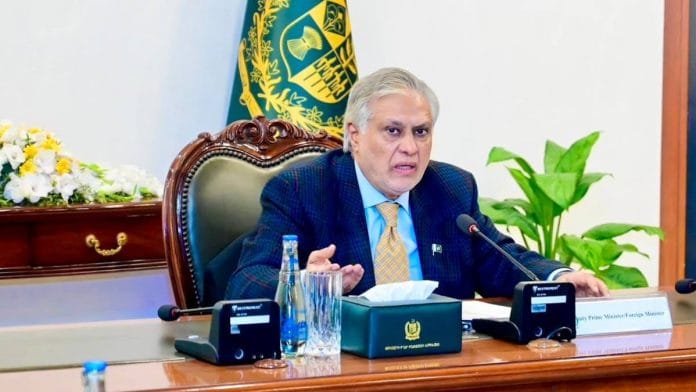



As much as I had hoped to write about a different subject for my final column for the year, Pakistan’s Foreign Minister Ishaq Dar delivered a rather interesting remark at the dusk of 2025 bringing attention back to our western neighbour.
He claimed that India has lost its image as the region’s net security provider after Operation Sindoor. The revelation was allegedly conveyed to him by ‘big’ powers, and relayed by Dar to a domestic audience at a year-end presser— picked up by foreign-policy watchers across the border, compelling our lot to clarify a few fundamentals in public interest.
Dar’s one-line statement has three dimensions that make it interesting to analyse: The conceptual confusion on the meaning of a ‘net security provider’; the context of Op. Sindoor; and the purpose of it all.
What is a net security provider?
Dar either misunderstands the concept or has deliberately used it to suggest a meaning it does not quite contain. Just a quick overview of the term, its usage and its application will convey New Delhi’s success at providing security in the larger Indian Ocean Region (IOR) and building collaborative frameworks for the same.
The term “net security provider” in the Indian context originated in Washington. Then US Secretary of Defense Robert Gates remarked that the United States “looks to India to be a partner and net provider of security in the Indian Ocean and beyond”, at the Shangri-La Dialogue in 2009.
The term resurfaced in the US 2010 Quadrennial Defense Review, which was readily welcomed in New Delhi, as it aligned with how India had long envisioned its maritime security role.
Qualitative differences, however, began to arrive only by 2015. In October, during the Naval Commanders’ Conference in New Delhi, then Defence Minister Manohar Parrikar released India’s revised maritime-military doctrine, Ensuring Secure Seas: Indian Maritime Security Strategy (IMSS-2015). This was the Navy’s first major strategy document since the 26/11 Mumbai attacks, which exposed India’s vulnerability to seaborne, state-sponsored terrorism. It prioritised preventing similar maritime threats and addressing a wider set of non-traditional security risks originating at and from the sea. It also expanded India’s maritime areas of interest to include the South-West Indian Ocean and the Red Sea as primary zones. It identified the western coast of Africa, the Mediterranean Sea and other regions strategically relevant to India’s broader maritime vision.
What it then means is that even sans a universally accepted definition, the term ‘net security provider’ is usually meant as enhancing mutual security of more than one country by addressing common security concerns, including dealing with transnational piracy or responding to disasters.
More specifically, it encompasses four different activities: (i) capacity building; (ii) military diplomacy; (iii) military assistance; and (iv) direct deployment of military forces to aid or stabilise a situation.
India’s maritime vision is best reflected in frameworks such as SAGAR (launched in 2015 and now recalibrated to MAHASAGAR in 2025), the Indo-Pacific Oceans Initiative (2018), the revival of the security vector within Indian Ocean Naval Symposium (IONS), the establishment of the Information Fusion Centre – Indian Ocean Region (IFC–IOR), and a range of maritime domain awareness arrangements with Quad partners and the European Union. The Indian Navy’s role as a ‘first responder’ is well documented—from anti-piracy operations to evacuation and protection missions during the Houthi crisis in the Red Sea. India’s commitment to humanitarian assistance and disaster relief (HADR) has been widely acknowledged by international partners, including the United States, with whom India conducted a major joint HADR exercise as recently as April 2025.
From India’s perspective, the Pakistani navy pursuing its own framework of providing disaster relief is a welcome step—as it helps global commons and upholds a freedom of navigation in the sea.
India believes in building collaborative frameworks, best expressed in the latest iteration of being a ‘net security partner’, upholding a rules based order at sea. India’s vision of the Indo Pacific remains free, open and inclusive.
So far I haven’t even gotten into the numerical comparisons between the Pakistani and Indian Navy, where the latter, on every possible metric outdoes Pakistan—whether its capabilities, collaborations or power projection.
Therefore, Dar’s correlation between India’s net security provider role and a counter-terror operation like Operation Sindoor is non sequitur.
Also read: Indo-Pacific security demands a strong India-Japan relationship
The context itself
Dar’s misplaced statement comes on the heels of what his nation deludes as victory. So much has already been written about the divergence between the Pakistani version and Indian position that there is little new to add. And that is why I will keep this part as brief as possible.
The Pakistani narrative amplifies the first day’s BVR face-off and the loss of a few Indian aircraft, while the Indian side correctly highlights the fulfilment of its broader military objectives and the damage inflicted on Pakistani bases and casualties.
Globally, stakeholders followed the details of the first ever BVR battle between two peers with great interest. Pakistan did display a network-centric, multi-domain capability—largely enabled by China. Beijing, for its part, was eager to see its PL-15 missile tested in real combat against a capable air force like India’s. Military aviation analysts watched closely to assess the missile’s performance under optimally networked conditions. On 12 May, India displayed debris of what was likely a PL-15 missile—something that Western militaries are studying just as closely.
For India, the takeaway is the need to identify and close gaps in its own network-centric warfare capabilities, which is evident from two major cabinet approvals for India’s defence modernisation.
With due respect to Dar, the cost of just these two approvals—$12 billion in July followed by $8 billion in December—approx $20 billion—far exceeds Pakistan’s entire 2025 defence budget, which stands at roughly $9 billion.
Dar’s statement, however, also comes in the context of President Trump warming up to Pakistan which has other reasons, timed optimally when India-US trade talks and tariff issues are persisting—not the subject of today’s piece.
But there is a third dimension to this debate, one that concerns the larger purpose of why we are revisiting this operation seven months after it took place. This is where the Indian side needs to contemplate.
Also read: Why India and Oman remain among the oldest strategic partners of the Indian Ocean world
Re-think the 3Ds
India did achieve its military objectives, but whether it met its broader strategic aims remains debatable. These aims could be framed around 3Ds: Destroy, Deter, and Deny.
Destroy: India demonstrated precision strikes on 23 terror-linked sites across nine locations, intending to impose lasting costs. Yet within months, much of this infrastructure has begun to reappear. This limits the long-term effect.
Deter: The government declared that a “new normal” had been established and any terror attack would invite a punitive response. But this claim was questioned when, after the Red Fort attack, India avoided naming Pakistan despite evidence of Jaish-e-Mohammed links. To many observers, this suggested that deterrence could not be established.
Deny: India’s diplomatic push to shape global perceptions through delegations of MPs and retired officials did not achieve desired outcomes either. Pakistan secured an IMF tranche and saw renewed diplomatic engagement, even a defence agreement giving Pakistan’s nuclear umbrella to Saudi Arabia. Alongside General Asim Munir’s self-Field Marshalisation and Trump’s praise that gave Islamabad added leverage.
New Delhi must not miss the woods for the trees. Securing the nation against a state-sponsored “terror factory” propped up by a bigger power such as China, requires not only enhanced capabilities and larger budgets, but also their optimal utilisation. And here the role of robust intel, internal rectifications and timely deliveries is key.
While Dar’s comments reflect a lack of understanding, New Delhi must continue to cultivate a self-reflective strategic culture and outcome-oriented strategy—building on strengths, addressing gaps, modernising where needed and building lasting cooperation frameworks with partners. Deterrence works when power is perceived by the adversary, not merely propagated. The end is long term military and economic security, the rest is means.
Swasti Rao is a Consulting Editor (International and Strategic Affairs) at ThePrint. She tweets @swasrao. Views are personal.
(Edited by Theres Sudeep)
The author seems really ignorant of what really Operation Sindoor achieved. The military operation revealed that Pakistan was directly helped by the Chinese, but when Pakistan realized how much destruction India brought on them, it immediately asked for help from USA. So it gave a rude shock to China as well as USA and left Pakistan terrified. It was revealed that USA does control many military assets in Pakistan and China can never actively support Pakistan again. India proved that it can strike any place inside Pakistan whenever it deems fit.