






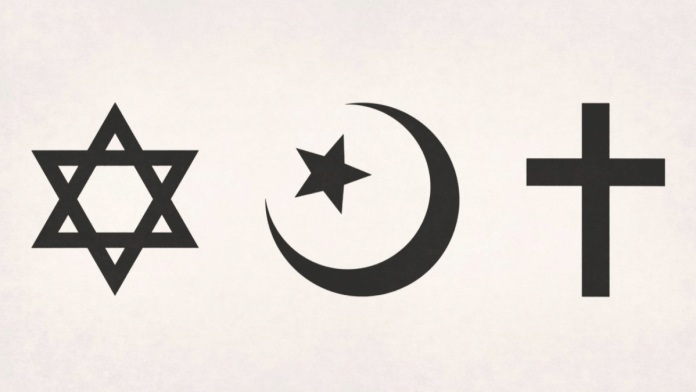


Over millennia, men, social groups, and countries have fought over land, resources, women, even honour, but the arrival of Abrahamic monotheism brought in a new edge to these usual causes of conflict. When God becomes the primary or additional cause of conflict, there are no easy off-ramps available. The ongoing war in West Asia, where three Abrahamic nations (Israel, US and Iran) are in conflict, and several other Abrahamic ones face collateral damage, should force us to examine the nature of monotheistic animosity.
The problem is not monotheism itself, for many people accept that there is a higher order or universal God who oversees the world that was created. The advent of science has not modified this belief in any way, except to the extent of acknowledging that both science and God can coexist, for the latter’s existence cannot be disproved. Belief in God is an unfalsifiable proposition.
So, regardless whether your belief system is polytheistic, henotheistic, pantheistic or monotheistic, the problem is not the belief per se. It is the super irrational monotheistic belief that there is one God, and he (always a he) happens to be the one I worship. Worse, this belief in My-God-The-Only-God comes with a binary vision and negative corollary: if you do not believe My God, you are worshipping false gods, the devil or shaitan. Abrahamic monotheism is thus a perversion of a more universal idea of monotheism, and specifically comes with the intolerance of rubbishing other gods and other faiths.
Worse, even God’s powers get limited here. If you believe in Allah, you must also believe that he has sent his last prophet, and that there will be no more prophets. If you believe in Christ as the Son of God, the possibility of other sons being sent to give mankind a new message is gone.
Monotheism thus comes with a computer binary: you are either one or zero. If My God is One, yours is Zero, Zilch, Nothing. This is a false binary, and excludes other more rational definitions of monotheism.
This idea of monotheism comes from the idea of the divine rights of kings, who needed to be granted solo powers in their domains. God did not create a single belief system for all of mankind, kings did.
Sigmund Freud, the world’s most famous psychologist, many of whose theories have now been discarded as too narrow (for they reduce almost everything to the sex drive), wrote an interesting book titled Moses and Monotheism, first published in 1939. This book, however, is not about psychoanalysis, but a speculative work on the origins of Moses in Egypt, which many scholars still argue about, and where he got his ideas of monotheism from.
The earliest votaries of monotheism date back to two eras: the era of Amenhotep IV, of the 18th Egyptian dynasty, who ruled from 1353-1336 BC, give or take a year or two. Then we had Zoroaster (or Zarathustra), who is dated anywhere from 1500 BC to 500 BC. He was the man who created a new monotheistic religion, whose practising descendants are now known as Parsis.
As Freud tells the story, when Amenhotep ascended the throne of Egypt, the state was becoming a world power. The people worshipped Amon but another god, the Sun God Aton, was in the ascendent. As the Egyptian empire started expanding to places in Syria, Nubia, Palestine and Mesopotamia, he needed a new and more abstract god who could be acceptable to the many peoples in the growing empire. Amenhotep changed his name to Akhenaten (with Aton, the Sun God, now added to his name), and chose to follow a rigid sort of monotheism. It was not popular, and the priesthood abandoned this monotheism once his dynasty ended.
Says Freud: the growth of the Egyptian empire led to a new imperialism, and “this imperialism was reflected in religion as universality and monotheism”. He adds: “Religious intolerance, which was foreign to antiquity before this and for long after, was inevitably born with the belief in one God.”
Akhenaten added “something new that turned into monotheism the doctrine of a universal god – the quality of exclusiveness.” One of the Pharoah’s hymns runs thus: “O thou only God, there is no other God than Thou.” This is eerily similar to what Islam preaches today. Freud says that to understand the core of this new Egyptian monotheism, it is important to not only know its positive content, but what it repudiates”. Freud’s book is, of course, on Moses and whether he was an Egyptian who crossed the seas to become the law-giver of the Jews. He surmises that Moses may have got his initial ideas on monotheism from Akhenaten’s brief experiments with monotheism, but we shall not get into that. Just Freud’s ideas on the underlying basis on which Abrahamic monotheism is built.
In Persia, Zoroaster was creating another monotheism, possibly in a reaction to the polytheistic peoples to the east in India, who believed in worshipping many gods. The new monotheism had a dualistic approach, separating good and evil, with Ahura Mazda representing the good and eternal, and Angra Mainyu the evil and destructive force. In the Zoroastrian world, Ahura (Asura to Hindus) represents important divinities, while Devas (Hindu divinities) are to be rejected. Clearly, the Indo-Iranian peoples split into two separate groups and theological disputes could have been one reason. The net result, though, is that when a stronger monotheism emerged from Arabia in the seventh century, the Zoroastrian one started losing ground and its last adherents had to flee to India to nurture what was left of their faith and heritage.
The point I would like to underscore is that the monotheism that has endured has two attributes: one good, and the other bad. The good part is that belief in the same God can enable people to work for a common goal even if they are from different cultures. The downside though is greater. Since Abrahamic monotheism creates a very negative “other” to emphasises its own exclusivity and greatness, ultimately all monotheisms may be destined to fight one another. We can see this even within Islam, where Shia fights Sunni, and both often fight to isolate the Ahmaddiyas or Bahais. Any religion that believes in one idea of God or Truth has, by definition, to negate other beliefs, other truths. The path to peace and coexistence lies in abandoning this narrow form of monotheism.
The war of the Abrahamics cannot end easily and well. They should be seeking a more universalised, diverse and tolerant definition of the One-God hypothesis. A God defined too precisely will inevitably add to conflicts.
To repeat: What we call monotheism is a limited and narrow monotheism that cannot bring peace.
R Jagannathan is an editor and the former editorial director at Swarajya magazine. He tweets @TheJaggi. Views are personal.
This article has been republished from the author’s personal blog. Read the original article here.
The author’s core point is worth stating plainly: in the Abrahamic world, theology and war are not separate but causally linked through the My-God complex. When God becomes a party to conflict, resolution becomes structurally impossible because you cannot negotiate what has been divinely ordained. It is against this backdrop that the Hindu framework deserves a closer look.
ParaBrahma Tatva is the singular undivided ultimate reality from which all existence emerges and into which it dissolves. Everything else flows from this. From this foundation Hinduism is simultaneously many things:
Monism: all apparent multiplicity resolves into one undivided consciousness, most deeply explored in Advaita Vedanta.
Panentheistic Monism: the universe exists within the divine yet the divine simultaneously reaches beyond it.
Acosmism: the world we see is ultimately appearance, with ParaBrahma alone being absolutely real.
Polymorphic Monotheism: one singular divine reality expresses itself through infinite forms and manifestations, none cancelling or contradicting the others.
Henotheism: one deity is worshipped fully and completely without dismissing others.
Kathenotheism: each deity is experienced as supreme in its own moment of worship.
Ishta-devata: your personally chosen relationship with the divine is completely valid on its own terms.
Nastika: rejection of Vedic authority is fully accommodated within the tradition itself.
Transtheism: the ultimate reality moves beyond God as a limiting idea.
Autotheism: divinity resides within oneself, as expressed in Aham Brahmasmi.
Polytheism and Monotheism simultaneously: what appears to Western eyes as contradictory is in Hinduism not a paradox to be resolved but a reality to be lived… the many and the one are not in opposition but the same truth seen from different distances.
Hylozoism: matter itself is alive and ensouled.
Eco-Theism: rivers, mountains and forests are divine beings rather than resources, something the West is only beginning to grasp.
Totemism: the relationships between deities and their Vahanas carry deep cosmic meaning, operating far beyond simple symbol.
Sacramentalism: sixteen Samskaras turn ordinary life transitions into sacred acts.
Nirguna and Saguna: ParaBrahma Tatva itself is beyond gender entirely… the divine manifests equally as fierce sovereign Goddesses and male deities, a philosophical position the Abrahamic world, with its eternally and exclusively male God, has never once entertained.
The Hindu pantheon is not a random gathering of deities. It is a carefully structured cosmic order with precise roles, relationships and responsibilities. Brahma creates, Vishnu sustains, Shiva transforms and dissolves… the Trimurti holding the complete cycle of existence within itself. Saraswati, Lakshmi and Parvati stand not as supporting characters but as sovereign cosmic forces of knowledge, abundance and energy without which creation, sustenance and transformation cannot function.
Beyond the Trimurti the structure runs deeper still. Indra guards the heavens while Yama oversees death and justice. Varuna holds dominion over cosmic order and waters. Agni, Vayu and Prithvi govern the elemental forces.
The precision of these roles is not incidental. It points directly to what holds the entire architecture together: Dharma… cosmic order, ethical conduct, natural law and personal responsibility all woven into one inseparable idea. Every deity, every relationship, every hierarchy exists within Dharma and upholds it. When Dharma weakens, the system moves to correct itself.
And because Dharma is structural rather than imposed, the checks and balances it produces are real and self-sustaining. Here good and evil are not relativised but contextualised… the notes are fixed and absolute, but the right song depends entirely on who is playing, for whom, and when. Through it all, one thing holds without exception: Satyameva Jayate… Truth (and Dharma) alone triumph.
This framework is remarkable because it holds centralization and decentralization together without contradiction, something no other theological or political system has achieved.
At the center, everything returns to ParaBrahma Tatva… one reality, one truth, one consciousness beneath all of existence. Yet the paths leading there are countless and all valid. Your Ishta-devata is as real as mine. The Shaiva path carries as much truth as the Vaishnava. Doubters and believers coexist without judgment or condemnation.
No single prophet, no single book, no single correct path, no declaration that my God cancels yours, no figure of absolute evil onto whom all darkness must be projected, and no division of humanity into the saved and the damned.
God is not a person on a throne handing down rules. The divine is the Truth of Being—the field in which we exist. You don’t ‘obey’ it; you either align with its natural laws (Dharma) or you suffer the friction of your own ignorance.
This is what a truly universal understanding of the divine looks like, standing in direct contrast to a framework that has kept the world burning by collapsing the infinite spectrum of reality into a brittle binary of one God and one Devil, and one road that everyone must walk or be destroyed
Well written