






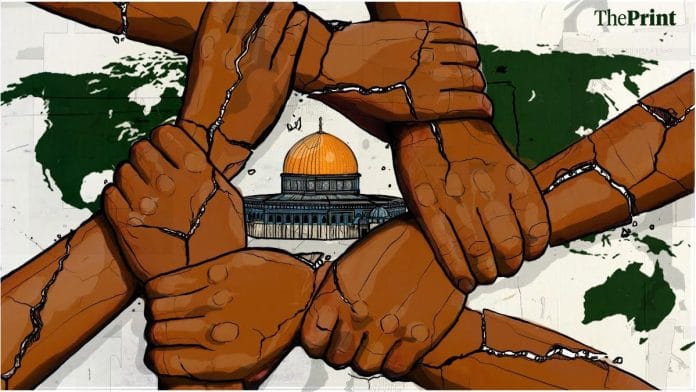



Muslim unity is a dream — and a nightmare, too. It’s as much desired by many Muslims as feared by non-Muslims. Desired, not because it promises universal brotherhood, but because it imagines a united army to fight the kufr. Non-Muslims fear it for the same reason.
So, whenever a Muslim country goes to war with a non-Muslim one, many ordinary Muslims hope that all other Muslim countries would jump into the fray. When events don’t turn out as desired, there is a palpable despair in the Muslim camp, and a sigh of relief in the opposition. There is a rush to theorise that Muslim unity is a chimera; and, thank God, there will never be a united Ummah army to turn a routine geopolitical conflict into an apocalyptic war.
Muslim thought-leaders, particularly in India, have trained the Muslim mind to regard the realpolitik decisions of Muslim countries as betrayal of the grand Islamic ideal. Though such unity never materialises, the ideal is not abandoned, and the hope is kept alive. Every unity has a counterpoint — that against which it’s organised. Clearly, the idea of Muslim unity is a confrontational concept, underlining a war mentality.
Theologically speaking, the most famous hadith about Islamic unity is actually about its opposite. The Prophet is reported to have said: “The Jews split into seventy-one sects, and the Christians split into seventy-two sects. My Ummah will split into seventy-three sects; all of them will be in the Fire except one.”
And thus it has been since the inception of Islam. The pristine Muslim community — the ideal exemplars for all ages — split into two the day the Prophet died, as the partisans of Ali contested the selection of Abu Bakr as the caliph. The dissension that began with the question of the rightful inheritance of political authority from the Prophet went on to develop into full-fledged theological schools destined to spawn scores of sects throughout history. In religion, every dispute becomes religious; nothing remains just political.
In an article titled ‘Against Muslim unity’, Oxford historian Faisal Devji calls the idea of unifying Islam a recent invention—and a bad one.
“Posturing about an illusory ‘Muslim unity’ tends only to alienate Muslims from the political world of nation-states that govern their societies. From this perspective, Muslim militancy, too, is actually a consequence of de-politicisation and not, as is commonly presumed, the reverse,” he writes.
Devji places the blame for Muslim militancy on the deracination of Muslim societies from their respective national cultures — which, in turn, follows from self-alienation from the nation-states to which they belong.
Nowhere has this process been more stark than in India.
Also Read: Indian Muslims must face the truth—Muslim countries don’t care about them
Muslim unity as a political weapon
Pan-Islamism, the utopian vision of worldwide Muslim unity, took shape as the decline of Muslim power accelerated toward total dissolution in the late 19th century. While the Mughals reigned, Indian Muslims showed scant regard for the Ottoman caliphate. It was only with the termination of Mughal rule — actually, only after the death of Bahadur Shah Zafar, in 1862, at Rangoon — that they started swearing fealty to the Khalifa in Turkey even as they lived under British sovereignty.
While their heads bowed to the British throne, their hearts belonged to the Sublime Porte. In the division between head and heart, they forgot that their entire existence — body and soul — belonged here in India. This division led to many more on the ground — the line often drawn in blood. But more on that later.
During the classical age of Islam, as the Crusades raged for two hundred years (1095–1291) for control over Jerusalem, there were as many as three caliphates in the Muslim world: the Abbasids in Baghdad, the Fatimids in Cairo, and the Almoravids and Almohads in Spain. All three treated the conflict as an insignificant war on a remote periphery. It did not even occur to them to unite to defend a site they all considered sacred.
Historical narratives of Islam are mostly about sectarian wars — betrayal and treachery being their running threads. During its age of supremacy, it is hard to come across any discourse for unity. One hears of it only in post-Islamic times.
In the book The Struggle Within Islam (1989), scholar-politician Rafiq Zakaria surveyed the length and breadth of Islamic history to postulate that Islam has had a dialectic of its own — the struggle between the pragmatic forces of secularism and the idealistic forces of religion, and more often than not, it has been resolved in favour of the former. He argues that while the concept of a single, unified Ummah (community) is a powerful spiritual ideal, the historical reality has been defined more by internal tension and political division than by monolithic cohesion.
One of Zakaria’s primary arguments is that Western observers and many Muslims alike often fall into the trap of viewing the Muslim world as a monolith. He asserts that nationalism and ethnicity (Persian, Arab, Turkic, etc.) have historically proven to be stronger drivers of political action than shared religious identity. On top of this, the fundamental split between Sunni and Shia Islam, along with various sub-sects, created internal borders that religious sentiment alone could not bridge.
Zakaria highlights that “Islamic unity” has frequently been invoked by political leaders not for spiritual reasons, but to consolidate power or oppose external threats (such as Western colonialism). He argues that when religion is used to enforce political unity, it often leads to the suppression of intellectual pluralism (as seen in most Islamic societies today), and increased conflict with “the other” (non-Muslims or “heretical” Muslim sects).
Drawing on Zakaria’s insight, it can be argued that the call for Islamic unity — the core tenet of Islamism — is actually a clarion call for war. It is a pretext for power rather than a path to piety. Its objective is not the spiritual or economic elevation of the community, but the consolidation of power for an ideological elite. This pursuit of Ghalba-e Islam (Islamic dominance) frequently becomes a catalyst for misogyny, supremacism, and systemic violence. That is what they call jihad, which is distinct from the self-purifying religiosity of ordinary, non-political Islam. There is no way that Islamic unity could ever be for a peaceful purpose. It’s an inherently belligerent idea. Externally it places a country at war, and internally into oppression. The “Islamic republics” bear testimony to it — Iran and Pakistan foremost among them.
Also Read: Vande Mataram was anti-British. Here’s how it became ‘anti-Muslim’
The Arab core of ‘Global Islam’
Pan-Islamism, which began in the late 19th century as a reactive movement and matured into the proactive ideology of political Islam (Islamism) by the mid-20th century, spread across the globe in the coming decades as a full-fledged worldview of Islamic domination and Sharia imposition. This was fuelled by massive funding from Saudi Arabia’s Wahhabi regime and the success of the Islamic Revolution in Iran, their internal sectarian animosity notwithstanding. Scholars have named this phenomenon “Global Islam”.
According to historian Nile Green, “the term Global Islam refers to the versions of Islam propagated across geographical, political, and ethnolinguistic boundaries by Muslim religious activists, organizations, and states that emerged in the era of modern globalization. By contrast, the term World Islam refers to the older versions of Islam that developed and adapted to different local and regional environments during the millennium before the onset of modern globalization.”
In light of this definition, it would be pertinent to recall Faisal Devji’s perceptive point mentioned in the supra: “Global Islam” is what happens when Muslims are disconnected from their local “national cultures” and instead adopt a standardised, militant identity.
Global Islam is transnational, but not really. It is a de-nationalised ideology of cultural rootlessness — but only for non-Arab Muslims. Islam has its own nationalism: it is Arab.
The 20th-century Arab nationalists — both strands of Pan-Arabism, Nasserist and Ba’athist — regarded Islam not merely as a religion, but as the essential cultural and historical ideology of Arab nationalism. They posited Islam as the “genius” of the Arabs and the vehicle through which they achieved their historical greatness. Michel Aflaq (1910-89), the co-founder of the Ba’ath Party, though a Christian himself, considered Islam the “soul” of Arabism and the Prophet Muhammad the ultimate Arab hero.
In his book The Great Theft: Wrestling Islam from the Extremists (2005), Islamic scholar Khaled Abou El Fadl examines the historical intersection of Islam and Arab nationalism to explain how their fusion produced the primitive cult of Wahhabism. The organic unity of Arab culture and Islam transformed 7th-century Arab tribal customs into eternal and immutable laws of Sharia. The Wahhabi insistence on “pristine” Islam is effectively the sacralisation of 7th-century Arab tribal culture.
Islam is a product of Arab culture. The two are so inextricably interwoven that it is impossible to distinguish one from the other. Therefore, a non-Arab Muslim, in his aspiration toward authentic Muslimness, mimics the Arab and ends up a cultural counterfeit.
In his travelogues Among the Believers (1981) and Beyond Belief (1998), Nobel laureate VS Naipaul explores this complex, often turbulent intersection of faith, identity, and history in non-Arab Muslim nations. He diagnoses a “neurosis” afflicting the converts — the psychological struggle to reconcile an acquired faith with their indigenous cultural histories.
The Indian Muslim’s dilemma
Nowhere has this struggle been more obvious than among Indian Muslims. The single most contentious debate within the community — between Deobandis, Barelvis, and Salafi-Wahhabis — revolves around the permissible degree of “Indianness” in Islamic religiosity. The less Indian one becomes, the more Islamic he appears. As Naipaul said, “The convert has to turn away from everything that is his. The disturbance for societies is immense… it can never be truly settled.”
Perhaps, if Islam had ceased to be an alien implant, the converted Muslims would not have become a separate community, and history might have taken a different trajectory. At present, the contest between puritanism and syncretism seems heavily loaded in favour of the former.
However, in his book Waning Crescent: The Rise and Fall of Global Islam (2025), Faisal Devji prognosticates the End of Islam (the title of his article summarising the book) as a subject of history and an actor on the global stage. “Islam became a protagonist in history which, in the 19th century, took the form of a civilisation, conceptualised as an abstract agent whose rise and fall played out on a global stage. In the 20th century it came to be understood by Muslim liberals and Islamists as an ideology on the pattern of communism.”
Islamism — the highly politicised version of the faith — has run its course and is being replaced by local, “small-p” politics or humanitarian concerns.
“None of the great Muslim mobilisations of recent years has invoked Islam as a subject or even cause. From the Arab uprisings of 2010 to the 2020 protests over citizenship laws in India, and from the Green movement of 2009 to the 2022 women’s uprising in Iran, none opted for Muslim liberalism, Islamism or militancy. Islam is no longer a subject in these events, including protests over the Gaza war which have been remarkably muted in the Muslim world,” Devji writes.
During the Shaheen Bagh movement, though they began with Islamic sloganeering — tera mera rishta kya, la ilaha illallah — they soon made a strategic shift to constitutional discourse.
The illusion of Ummah
The recent events in Gaza and Iran, and the response to them, have exposed the hollowness of the idea of Global Islam, and its personification, the Global Ummah.
Under its Vision 2030, Saudi Arabia has effectively retired its role as the global exporter of religious ideology. By prioritising “Saudi-first” nationalism and economic modernisation over pan-Islamic leadership, Riyadh has signalled that it is no longer the “bank” for global Islamic movements.
The Iranian model — ideological, revolutionary, and confrontational — has become a cautionary tale.
A global Ummah that could fight (what else?) unitedly against a common enemy has been nothing but an illusion created by the ideology of political Islam. It is time that Muslims stop hallucinating about a unity that they have never had, nor can ever have. If there is no enemy at hand, they inevitably fight among themselves along sectarian lines.
It is time that Muslims return to their respective national roots and, instead of Arabising themselves, indigenise Islam. Indian Muslims, in particular, should stop being delusional about the Global Ummah. If their sentiments for Arabs or Iranians are not reciprocated in equal measure, there is something perverse about the Indian Muslim’s sense of self.
Ibn Khaldun Bharati is a student of Islam, and looks at Islamic history from an Indian perspective. He tweets @IbnKhaldunIndic. He can be reached by email at ibn.khaldun.bharati@gmail.com. Views are personal.
Editor’s note: We know the writer well and only allow pseudonyms when we do so.
(Edited by Asavari Singh)
Keep a close watch on commenters like UA…who would use anything in their book to commit STSJ and justify Zeehadism. These are precisely the closeted Ghadists that Bharat doesn’t need. We need Hinduised Muslims…Muslims who may practice the truly peaceful aspects of their mazhab while rooted in the exceptional and quintessential cultural ethos of Bharat’s Hindus ala true tolerance, true pluralism, true secularism and true live and let live philosophy. Until then keep your guard high, eyes wide and defend.
Another first-rate essay on another contentious subject by Mr. Ibn Khaldun Bharati. He is unremitting in his effort to impress upon the faithful that it is high time they started listening to reason. Despite being fully awake to the fact that Muslims have the utmost respect for each and every word of the foundational texts of Islam, he refuses to let up. He also knows that his arguments would raise the hackles of the majority of the believers. Yet he seems unstoppable. His intellectual pugnacity is such that one cannot but bow down to it. Mr. Bharati, I love to partake of your knowledge and wisdom. Thank you.
It is one thing to lament the poor realisation of the concept in the world, but to ask a Muslim to abandon belief in the أمّة ummah – the transnational, supra-ethnic community of believers – is to ask them to deny something enshrined in the Qur’ān itself with a force perhaps second only to the أركان الإسلام (pillars of Islam). Far from a modern de-nationalising invention that should be abandoned in favour of a ‘return’ to ‘national roots’, Islam essentially commands transcending national roots from its earliest sources (I am including Arabic quotes for anyone who might wish to dig into the primary sources). Allāh declares: ﴿ وَٱعْتَصِمُوا۟ بِحَبْلِ ٱللَّهِ جَمِيعًۭا وَلَا تَفَرَّقُوا۟ ۚ ﴾ – ‘And hold firmly together to the rope of Allāh and do not be divided’ (Āl ʿImrān 3:103), and ﴿ إِنَّمَا ٱلْمُؤْمِنُونَ إِخْوَةٌۭ ﴾ – ‘Without doubt the believers are brothers of one another’ (al-Ḥujurāt 49:10), and ﴿ إِنَّ هَـٰذِهِۦٓ أُمَّتُكُمْ أُمَّةًۭ وَٰحِدَةًۭ وَأَنَا۠ رَبُّكُمْ فَٱعْبُدُونِ ﴾ – ‘Indeed this, your religion (ummah), is one religion (ummah), and I am your Lord, so worship Me’ (al-Anbiyāʾ 21:92).
The تفاسير tafāsīr (exegeses) reinforce this unequivocally: al-Qurṭubī records from Ibn Masʿūd that حبل الله is الجماعة, and concludes that the meaning is convergent – «فإن الله تعالى يأمر بالألفة وينهى عن الفرقة فإن الفرقة هلكة والجماعة نجاة» (Allāh commands unity and forbids division, for division is destruction and collective solidarity is salvation). Ibn ʿAbbās admonished Simāk al-Ḥanafī: «يا حنفي، الجماعة الجماعة! فإنما هلكت الأمم الخالية لتفرقها» (O Ḥanafī – the Jamāʿah! The Jamāʿah! For verily the nations before you perished only through their fragmentation). Meanwhile, the doctrine of الولاء والبراء al-walāʾ wa-l-barāʾ – loyalty and disavowal – is not an optional extra but a corollary of إيمان iman (faith) itself. The Prophet ﷺ asked Abū Dharr: «أيّ عرى الإيمان أوثق؟» – Which bond of faith is the strongest? – and answered: «الموالاة في الله والمعاداة في الله والحب في الله والبغض في الله» (Loyalty for Allāh’s sake, enmity for Allāh’s sake, love for Allāh’s sake, and hatred for Allāh’s sake). الولاء والبراء al-walāʾ wa-l-barāʾ thus obligates Muslims to confer exclusive allegiance to Allāh, His Prophet, and the أمّة ummah of believers who uphold توحيد tawhid (divine unicity). To sever this bond is not to modernise the Muslim – it is to ask him to amputate a limb of his عقيدة aqeedah (creed).
Looking at more modern scholars and thinkers, both Dr. Isrār Aḥmad and Maulānā Mawdūdī understood this with crystalline clarity, despite their different emphases. Dr. Isrār wrote that ‘according to strict Islamic spirit and principles, the term “Muslim nation” is a self-contradiction,’ since ‘the Qur’ān and Ḥadīth state clearly that all Muslims from any part of the world form one Ummah or Ḥizb, community or party, not various geographical entities or nations,’ and that ‘they are unified in an indivisible religious communion with no possibility of internal divisiveness or of multiplicity of identity.’ He traced the present fracture to Western colonialism, which ‘completely smashed the unity of the Muslim Ummah’ by planting ‘such seeds of racial and regional prejudices as are still yielding bitter fruits.’
Mawdūdī, for his part, strongly opposed the concept of nationalism, believing it to be شرك shirk (polytheism) and declared that the principles of nationalism are totally contradictory to the principles of Islam. He taught that the common bonds uniting all Muslims are ‘common beliefs and thought, common culture, common moral system, civilisational relationship, vitality of the concept of one Ummah, universal brotherhood and geographical location of the Muslim world.’ Nasr summarises Mawdūdī’s overarching aim as putting forth ‘a view of Islam whose invigorated, pristine, and uncompromising outlook would galvanise Muslims into an ideologically uniform and hence politically indivisible community.’
Thus, to reiterate, expecting Muslims to simply shed this consciousness treats the أمّة ummah as a geopolitical club one may resign from, when in truth it is a theological reality woven into the very fabric of لا إله إلا الله Lā ilāha illā llāhu – a reality that Qur’ān, سنّة sunnah, تفسير tafsīr, and the foremost thinkers of the twentieth century all affirm with one voice.
References:
– Ahmad, Dr Israr, مسلم امت: عروج و زوال Muslim Ummah: Urooj o Zawal (The Rise and Fall of the Muslim Ummah)
– Amanullah, Muhammad and Tazul Islam, ‘Understanding the Problems and Prospects of the Muslim Unity: An Analysis of Mawdūdī’s Views’
– Al-Qurtubi, Abu ‘Abdullah, Tafsir al-Qurtubi
– Nasr, Seyyed Vali Reza, ‘Mawdudi and the Making of Islamic Revivalism’
– The Qur’an (Translations synthesised from Saheeh International and Mustafa Khattab’s The Clear Qur’an)
– Subhani, Ayatullah Ja’far, The Islamic Moral System: Commentary of Surah Al-Hujurat, trans. Saleem Bhimji
It’s a good article and what differentiates Christians from Muslims in general. Don’t get me wrong I still don’t like the proselytizing aspect of both religions but no one accuses Christians of “lack of patriotism” or “loyalty”.
Do I see this changing ? No. People like you are far few and less. I mean the amount of Indian Muslims who brag about “golden age of Islam” or should I say “golden age of Arab-Islam” is just outright pathetic. I don’t see many of them bragging about their Indic discoveries like Hindus or others do.
The concept of global ummah exists because there is a propaganda around Indian Muslims about who they are and where their roots are from. Like I said I don’t see it changing unless Muslim leaders (some do) start talking about it.
Nice piece of moral panic, neat package, thin argument.
Quoting a few respected names and calling the global ummah a threat does not magically turn a social diagnosis into a policy plan. It just makes fear sound scholarly.
You collapse five different things into one: violent politics, foreign state interests, theological reform movements, diaspora solidarity, and private piety. Treating all of them as a single malign force is lazy thinking, not insight. If you want to spot a threat, name the threat. Do not throw a net over everything and then declare the catch proof of a conspiracy.
There is a double standard here. Transnational networks exist for Christians, Hindus, Jews, secular activists and corporations too. Money, ideas and loyalties flow across borders in every direction. Singling out Muslims as uniquely prone to deracination reads like bias with footnotes, not careful analysis.
Labeling solidarity as inherently militant has a policy consequence. Once you call a community existentially dangerous the default response becomes surveillance, policing and exclusion. Those tools rarely fix the problems that produce alienation. They tend to amplify them. If your priority is national cohesion, stop prescribing the blunt instruments that make cohesion impossible.
The rhetoric you use is familiar. It mirrors the exact majoritarian playbook it claims to critique: identify a group, mark them as foreign, stoke panic, then justify legal and administrative measures. You diagnose deracination while practicing it. That is hypocrisy, not scholarship.
If you want serious outcomes instead of rhetorical victory, try this simple rule: distinguish violent actors from peaceful solidarities, and then treat grievances as grievances rather than as proof of treason. Equality under the law, targeted social investment where exclusion is real, and restraint from securitizing everyday religious life would do far more to reduce alienation than another op-ed sermon.
Final note: alarm sells, nuance does not. But if your goal is a safer, more stable society, try solving insecurities instead writing half-assed shit pieces that create more of it.
It’s giving icono-anankist Hindutva core.
But that’s a global Hindutva dream you’d rather not talk about.
The same non-assimilationist, racinated, ‘foreign-fealty’ arguments can be made of many communities very easily.
I expect nothing more from this toilet paper of a news outlet that platforms people like Seshadri Chari and Amana who Shekhar sees as kindred spirits while co-opting liberal vernacular as a veneer.
Laughable op-ed rooted in icono-anankist imagination, with securitization of ANYTHING that doesn’t conform to it.
That is TRUE intellectual suppression.
All your tired tropes unravel really easily for any half-decent, discerning person.
I’m not even muslim btw, and even I see through your crap. The same bigoted “Hindutva-core” arguments are used by your rw contributing authors for all faiths, including Shekhar himself.
Of course, the Print would know you personally. And of course, you need to be anonymous — who’d want to own such shit writing and pass it off as an op-ed?
It’s OpIndia in liberal lip-gloss. No that people don’t see through it.
Why do we worry so much about these tangential issues. Let Indian Muslims be treated with fairness and dignity, like normal Indian citizens. Neither more ( recall “ Appeasement “ ) nor less. One would commend the columnist to observe the high level messaging coming from Assam.