





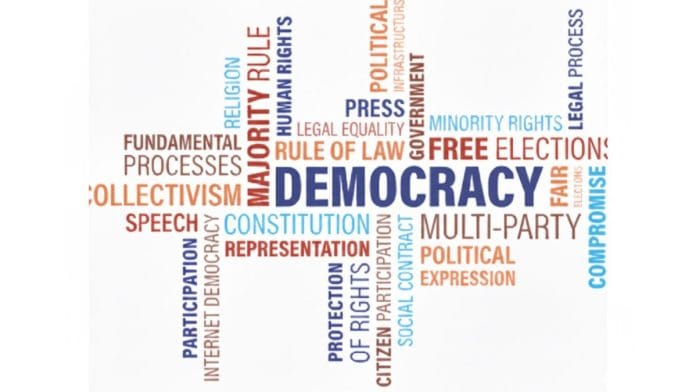



Some people would reply that democracy means majority rule. How wrong they are! Stalin and Hitler, after coming to power, repeatedly won elections by huge majorities which were presumably bogus, and then carried on a ruthlessly oppressive and tyrannical regime. The dictators of the Black African countries, who are often ferocious autocrats, also claim to have been elected by a majority. As the anthropologist, Elspeth Huxley, has put it : “One man one vote, once”.
Mr. R. Venkataraman, President of our Republic, mentioned this in his Inaugural Address as President on July 25, 1987 that ‘most of the newly independent countries which adopted a democratic form of government have lapsed into dictatorships’. There are countries covered by Mr. Venkataraman’s statement in Asia and Latin America which also qualify along with Africa.
The concept of majority rule is a particularly pernicious one in countries which are not of a homogenous nature ethnically, linguistically or by religion. Examples of such countries are the Union of South Africa, Fiji, Sri Lanka, and, of course, our own country. In these countries there is a built-in permanent majority based on race, language or religion. Majority rule in such cases would mean the tyranny of the majority community over the minority community or communities. In South Africa the result of “one man one vote” majority rule would be the domination of the Blacks over the Whites and the coloured peoples including Indians who are all minorities. In Fiji it would mean the domination of the Indian immigrants over the original inhabitants there. In Sri Lanka it would mean the domination of Sinhalese over Tamils and in India it would mean the domination of the Hindus over the Muslims, Sikhs, Christians and other minorities. It is quite obvious, therefore, that majority rule is not democracy and can often be undemocratic.
Having disposed of this myth, let us now turn to the various factors that make a real democracy.
Also read: Liberal methods reach social justice faster than socialism: Minoo Masani
Limited government
It is quite clear that a government which is not limited to essential purposes but dominates [the] economic, educational, literary and artistic life of the country cannot be a democratic one. Where this happens, an effective opposition ceases to be possible, and Mr. Durbin’s test cannot be fulfilled.
This has been proved by the case of the Soviet Union, Communist China and others in our time.
Italian theorist Benedetto Croce was able to foresee this when he wrote in the last quarter of the 19th century that where the Government or the State tends to become the only employer and the only landlord, that society ceases to be democratic, because there would be no one left to oppose except at great peril. That is why he argued that in a free society there have to be “autonomous social forces” such as the farmer owning his land, the industrialist owning his factory or business, the shopkeeper owning his shop and the professional man like the lawyer or doctor or consultant who works for himself. Later developments have proved how right Croce was.
In my opinion, India is in the border line between a limited government and a total one because of excessive controls, destruction of the balance of the mixed economy, control of the dominating heights of the economy, as Jawaharlal Nehru grandiloquently described it, through giant industrial units, the control of the State over universities, the absence of economic freedom, the institution of Sahitya Academies and other government institutions which have undermined the independence of writers, artists and other members of the intelligentsia. Writing on 5th January 1969 in the Times of India, Mr. Nirad Choudhary asked:
“Where do contemporary Indian writers stand in the light of these ideals? I cannot say they are not involved in current affairs. On the contrary, I would assert they are only too much involved in them, which means that they are wrongly involved. Most of them are doing their best to have a share of the loot of public money that has become the vocation of the upper middle class since Independence. All of them are enlisting or trying to enlist in the horde of Pindaris that the present ruling order of India is. The writers in this army will not indeed be Amir Khans or Chittus but they aspire to become quite prosperous thugs.”
There have been repeated attempts to destroy the freedom of the press. All these have brought India to the position where it is possible to say that the so-called ‘socialist pattern’ and democracy cannot co-exist for long. This already happened for a brief period of two years after 1975, and could easily happen again for a longer duration. Therefore it is that the liberal insists that unless [the] Government is limited and kept in its proper boundaries, it cannot be called a democratic one. Mahatma Gandhi said: “That Government is best which governs the least.”
Also read: Prices, like water, will find their own level. Controls breed vested interests: Minoo Masani
Sharing of power
Democracy has been defined as [the] government of the people, for the people, and by the people, the last of these being the most important of the three. The sharing of power has to be both horizontal and vertical. It should be horizontal in the sense that minority groups have a right to participate in the government of the day along with the majority. It is not enough for members of the minority to be condescendingly included in the cabinet as are Muslims, Sikhs and others in India, and, Tamils and Muslims in Sri Lanka, at the ‘meherbari’ of the majority or of the White ‘Uncle Toms’ whom the Communist-dominated African National Congress would perhaps include in their new government, if ever they are allowed to come to power. What is necessary is for the Tamils and Muslims in Sri Lanka to be represented by those chosen by them. That Muslims and Sikhs in India should similarly have the right to choose their own members of the cabinet and that the Whites in a Black dominated country should have ministers of their own choice. This has been ensured only by the Swiss Constitution to which I shall refer later.
Vertical participation is equally important. The infrastructure of a democracy lies with grassroots vigilance and initiative which keeps political parties and governments on the straight and narrow path. Where such grassroots vigilance and initiative are weak as in India today, political parties float on top without any infrastructure, without internal democracy, and with “Kangaroo courts” which ‘expel’ members without even asking them to show cause.
The element of grassroots vigilance is not one that can be created by law. It is primarily one that is dependent on home and school education and training of the young in the right to think for themselves, training in the right to stand up to authority—whether domestic, industrial or political, when the conscience demands it. Gandhiji defined a real satyagrahi as one who defies a law which he thinks is immoral even if he is in a minority of one, provided he is prepared to pay the price for his act. In other words, democracy is contingent on the existence of independent, aware and courageous citizens who are prepared to speak up for their rights and do not always count the cost. As the poet said:
“They are slaves who dare not be
In the right with two or three”.
The main enemies of such initiative are the cult of personality, misguided loyalty to party “high command”, sycophancy which abounds in the capital and other parts of India and the presence of a controlled economy where the permit-licence or quota is a pre-condition to economic survival.
Here we are on very weak ground. The concept of good and active citizenship is not well understood in India. The result is “too much politics, too little citizenship”. We need much more grassroots vigilance and action. It is not periodic five-year elections that determine the quality of democracy but the day-to-day intervention of the ordinary citizen in the affairs of the State. Here we are very weak, and unless the quality and activity of our citizenship improve and become much more democratic, our political parties will continue to float on top and be utterly irresponsible as they are today. It is important that the people of India be educated on this subject. It is important that the people of India be educated on this subject.
This essay is part of a series from the Indian Liberals archive, a project of the Centre for Civil Society. This essay was published by the Harold Laski Institute of Political Science, Ahmedabad on 24 March 1989. The original version can be accessed here.