


The new education policy has evoked much interest in academic and non-academic circles. It is surprising that this much-talked-about document is as yet unavailable to the general public. But, for information gleaned from newspapers, one is in the dark about what the new education policy is all about.
Article 45 of the Constitution directs the State to “endeavour to provide within a period of 10 years from the commencement of (this) Constitution free and compulsory education for all children until they complete the age of fourteen years.” This was in the year 1950. Against this background of national commitment, it would be instructive to take a look at the progress of women’s education.
There is no denying the fact that India has made considerable progress since independence in terms of enrolment figures and development of diverse educational programmes. It has, however, been unable to meet the nation’s requirements in terms of overall coverage and equitable distribution. This is particularly true of women’s education. In 1881, for every 1,000 boys in school, the number of girls receiving instruction was a mere 46. A hundred years later, there were 55 girls for every 100 boys receiving education. The overall literacy figures climbed from 16.67 per cent in 1951 to 36.23 per cent in 1981. The corresponding male literacy figures stood at 46.9 per cent while female literacy figures stagnated at 24.8 per cent.
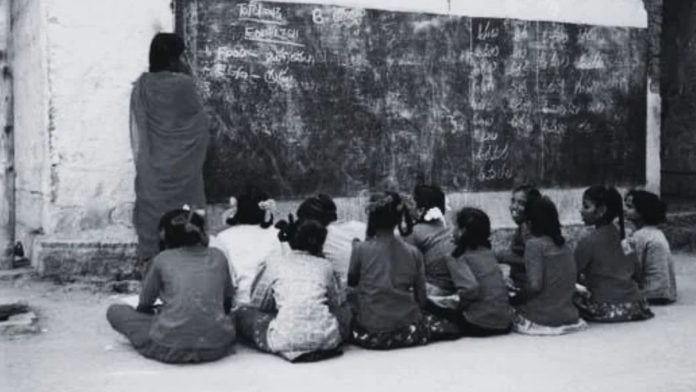
Elementary education is the most crucial stage of education, spanning the first eight years of schooling. Yet studies reveal that in classes I-V (6-11 years), one out of every three girls is still out of school. The drop-out rate for girls is very high. Of every 100 girls enrolled in Class I, only 30 reach Class V. In classes VI to VIII (11 – 14 years), only two of five girls are in school.
At the secondary stage (14-17 years), 12 of 100 girls are in school. Educational opportunities at this stage are confined to middle and upper-middle classes in urban areas and, to some extent, rural middle-class sections. Higher education (17-23 years) is mainly the preserve of the urban middle and upper middle class. Even here, women constitute less than a quarter of the total enrolment. The faculty-wise enrolment of women in university education shows a large number of them opting for arts, general science, education and medicine. In 1981-82, of every 100 girls enrolled, 56 were in arts, 21 in science, 13 in commerce, 3.6 in medicine and 0.7 in engineering.
Choice dictated by men
The phenomenon of women taking courses in arts and humanities limits their occupational choices and chances. There is no denying that these choices are dictated by the actual or expected adult role of women in our society as mothers and wives. Thus, the gender-based division of labour is recreated in the labour market, and even the modern sectors of our economy display the characteristics of patriarchal societies. A 1980 study sponsored by the ICSSR noted that industrial training institutes cater to men primarily.
The number of women trainees in the engineering section formed only one per cent of the total number of students. Women, however, formed a large segment of the trainees in the tailoring and stenography categories. Professional women have tended to concentrate in teaching and medicine. Even here, the overwhelming number are concentrated in primary schools. In medicine, women constitute the majority of nursing staff, and as doctors, they specialise in gynaecology, obstetrics and paediatrics.
Interstate comparison of female enrolment in education indicates the uneven rate of progress. Bihar and Rajasthan have maintained uniformly low performance at all levels. Kerala leads in primary school enrolment. Tamil Nadu and Delhi lead at the secondary level. In higher education, most states have made progress, with Delhi and Kerala leading.
These statistics reveal that despite the constitutional directive and provision for free education, the number of girls seeking education increased to any appreciable extent. The drop-out rate is very high. Three-fourths of the girls in India who enrol at the primary stage leave before attaining functional literacy. The high drop-out rate cuts across state boundaries and is a cause of much concern.
Also read: Can the state take your property in the name of equality? This 1971 essay had an answer
Erroneous notions
Socio-economic reasons have been primarily responsible for why girls have not been persuaded to come to school and stay there until the completion of fourteen years. The subordinate status of a daughter in comparison to the son leads to disparity in the education of boys and girls. Female children, by custom, are expected to look after their brothers and sisters and manage domestic chores while their mothers earn for their families in the fields or elsewhere. During a family crisis such as the mother’s illness, the entire burden of housework falls on the daughter, and she is compelled to discontinue her education.
It is evident that although educational opportunities have widened, the large majority of women have not been able to take advantage of them. It is time we realised that identical strategies devised for promoting literacy among men and women do not yield similar results. The reasons for this are not far to seek.
In popular imagination, women look after the home and raise children, while men till the land or earn a livelihood through other means. Nothing could be further from the truth. The women’s traditional role of looking after the home, bearing and caring for the children is only half the picture.
Throughout the Third World, women are responsible for half of all agricultural produce, putting in as many or more hours in the fields as men and still managing to wash, mend clothes, carry wood and water, tend to animals, clean the home and look after the old, the sick and the children. The rural woman spends hours each day collecting fuel and fodder from the forests. Deforestation has resulted in women having to go further and further in search of fuel and fodder. For millions of women in India, the day begins and ends with the search for water.
Also read: UPA’s Left allies are holding back India’s privatisation drive, this economist argued in 2007
The plight of rural women
A study conducted by the Indian Institute of Rural Workers reports that three-fourths of women are engaged in farming and non-farming activities in the village. Three-fourths of women are engaged in farming and non-farming activities in the village. A large proportion of marginal farmers having one hectare of land, who constitute 50 per cent of peasantry, do not cultivate their land because an average annual income of Rs 1,000 does not make cultivation economically viable. These marginal farmers lease out their land to rich farmers, idle away their time and hardly lend a helping hand to women in their domestic work.
Others migrate to cities in search of employment. Available data indicates that three of every ten rural households in many developing countries are headed by women. Where remittances from migrant men are low or cannot be relied upon, the women are forced to become family providers. To be rural and poor is a heavy cross for a woman to carry. Another is having to bring up children while doing all sorts of domestic and farm-related chores at the same time. To assume the role of the family provider means adding yet another burden on her weary back.
Also read: Nehru’s India had a youth problem. This 1958 essay explained why
A national investment
Education, in order to make an impact, has to bear in mind the distinctive role of women as mothers, nutritionists, healthcare workers, home-makers and economic providers. The education of women has an important effect on the well-being of the family. It has rightly been said, educate a man you educate a person, educate a woman you educate a family. Education must assist women in devising appropriate technology to lighten their drudgery, help in providing low-cost sources of nutritive food for infants and adults.
It must make her aware of the Importance of nutrition for herself, especially during pregnancy and lactation. It is ironic that those who provide life and continuity give themselves less and less. Education should equip women to fight inequality within the home and exploitation outside. It must enlighten women about their legal rights relating to inheritance, marriage and minimum wages.
Education must provide women with information about their biological and sexual roles, and encourage questioning the prevailing idea that, in traditional societies, men take the decisions and women the consequences. Social attitudes and religious customs that have taken a firm hold over the mind have to be re-examined in the light of the prevailing times; the meaningless have to be discarded and the meaningful preserved. Education should help women in understanding their own contribution to society and enable them to take their rightful place in it.
Any programme for improving female literacy must bear in mind that a general plan for education which does not take into account the specific needs of women will fail to yield any result. Socioeconomic conditions in the countryside call for flexible hours and curriculum relevant to the needs of women.
This essay is part of a series from the Indian Liberals archive, a project of the Centre for Civil Society. This piece is excerpted from the booklet Freedom First, titled “Women’s Education – A Perspective”, published in July 1986. The original version can be accessed here.