






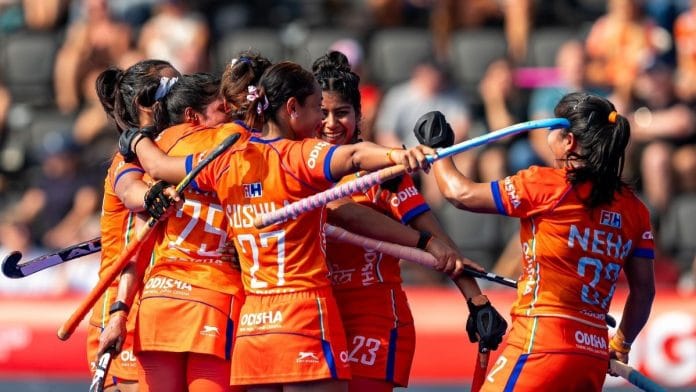

India’s fifth place at the FIH Women’s World Cup is not the story. With the kind of skill, grassroots talent, and game intelligence we possess, that story should be a recurring theme. In the villages of Punjab, Haryana, Odisha, Manipur, Mizoram, and Jharkhand, the potential talent pool is at least 150 elite strong. But only 5 per cent of that talent surfaces. To work at the ground level requires extraordinary dedication, far more than what is visible at the top. Talent spotting is an art that redefines itself every other year. It is also a vocation with few perks, no TV appearances, no headlines, and no digital spotlight. Your reward is simple: seeing the player you once discovered on a dusty pitch now under the television lights, knowing you spotted her first.
Two of India’s greatest coaches—Balkrishan Singh and Baldev Singh—understood this intimately. Balkrishan achieved the rare distinction of Olympic gold as both player (Melbourne, 1956) and coach (Moscow, 1980). On the other hand, Dronacharya awardee Baldev single-handedly produced over 150 players out of his stable in Shahbad. Of these, half played for India and 10 per cent rose to be elite players, with Rani Rampal becoming Olympic captain. At his residence in Ludhiana, over sugar-laced tea and a bowl filled with almonds, Baldev once said: “There is too much emphasis on the League. Put the national players in different tournaments over 5-6 months and see how the others try and outplay them. At this moment, we don’t provide competition to the best to stay at their best.”
Double Olympic captain Pargat Singh, now a Congress MLA from Jalandhar Cantt, echoed the sentiment. “Talent is never in short supply in our country, but visibility and continuous testing are. If you hide your best players in a franchise window once a year, you starve the rest of the country of the ambition to beat them,” he said.
It brings us back to the question: can the fifth-place finish at the World Cup sustain Indian women’s hockey for the next decade? Can it give us another 100 players from the few domestic tournaments held? This leads us to another enquiry: Who will find the next 100-odd players with varying skills? And where are these domestic tournaments?
At the moment, the media is obsessed with winning the Asian Games and qualifying for LA 28. What comes later? How do you keep the pipeline going? Nobody is willing to address that. To be fair, the franchise league has its place—it brings much-needed financial security, corporate sponsorships, and broadcast visibility that traditional domestic tournaments have historically lacked. But a few corporate sponsors cannot replace a calendar. Currently, the dominant sentiment is that the league must keep going because the players benefit. While that remains true, a lot of others benefit too, including the Hockey India office bearers, while the grassroots languish.
Building from the ground up
During the World Cup, a few players stood out. Savita Punia, Navneet Kaur, and Neha Goyal always shine, but there were others too: the precocious Sunelita Toppo, the wonderfully talented goalkeeper Bichu Devi, and Ishika, the forward with dazzling wrists.
With the team back in Bengaluru and training for the Asian Games, the dominant story is around the league—not the players. Instead of reviving domestic tournaments across the country, our focus is on a month-long league. Instead of making our players compete in various tournaments, we are focused on a hyper-localised approach—that too, for a country as vast as India.
Talent such as Baljeet Kaur, Toppo, Ishika, and Bichu must be seen live in stadiums by fans who otherwise follow them on TV and social media in that once-a-four-year window. We keep making the same mistake—though unlike the amateur neglect of 1982, when we squandered the momentum of the Asian Games gold, today’s challenge is corporate over-indulgence and an unhealthy reliance on commercial entertainment formats at the expense of developmental infrastructure. We keep failing to raise the profile of the game by organising tournaments across cities and allowing fans to watch and get inspired. Audiences worldwide watch hockey on TV, but real change—kids watching and getting inspired as Toppo did after seeing teams play in a fair in her village Kukuda in Odisha—is what our domestic landscape must aim for.
Many were inspired after watching Rampal play. “When kids from small towns see you sweat on a local ground rather than just a television screen, the dream stops looking impossible,” star forward Vandana Katariya once shared during a grassroots camp.
Baldev bringing players to sub-junior and junior Nehru tournaments gave us a glimpse of what passionate coaching could achieve for players who had no hope of becoming hockey players, not only reorganising their lives but taking their families out of abject poverty.
Also read: The enduring mystery of India’s Hockey World Cup drought
Brief flashes of glory
To understand why India’s heavy reliance on a short franchise league is like playing Blackjack, it helps to examine how other hockey-playing nations construct their pyramids. In the Netherlands and Belgium, the strength of the national team is a direct byproduct of a dense, hyper-local club culture; of course, the size of the country helps. In the Netherlands, hockey is a community fixture where almost every mid-sized town has a club with multiple synthetic turfs, and the Hoofdklasse is supported by a massive tier-below structure, where generations of families play every weekend.
Following a deliberate strategic overhaul in the early 2000s, Belgium invested heavily in youth academies tied directly to regional clubs, ensuring young talent played high-intensity club matches every week against seasoned internationals to normalise pressure. Argentina presents a fascinating counterpoint. Its success, typified by Las Leonas, is anchored in the Buenos Aires Hockey Association (AHBA), which features hundreds of clubs. On the other hand, its elite players routinely migrate to top-tier European leagues to absorb diverse tactical philosophies and funnel that high-level competition back into the national team.
India’s context cannot be neatly copy-pasted from Amsterdam or Buenos Aires, but the core lesson is that elite success is an indicator of grassroots volume and domestic competitive frequency.
The World Cup fifth spot is India’s highest-ever finish. It is also a reaffirmation of the country’s talent at the grassroots level and the dedication of the coaches who push them toward higher skill levels. It is also a result of head coach Sjoerd Marijne rearranging the chessboard to create life-defining performances. In our chase for glory, let’s not forget where our top players arrived from. Let’s not ignore the pipeline by putting all our eggs into a four-team league that burnishes the top stars, forgetting the mad scramble at the bottom.
Sceptics will rightly ask who funds and manages a year-round domestic calendar in tier-2 and tier-3 cities outside of state-sponsored camps. The answer lies in decentralised public-private partnerships, binding state associations, and routing corporate social responsibility (CSR) funds directly into district-level leagues.
We must build a calendar that breathes life into these regions year-round, taking the game back to the people, so young girls in Jharkhand, Odisha, Punjab, Northeast, and Haryana can see their idols in the flesh, not just on glowing screens. If we fail to lay this foundation now—as we failed to capitalise on the momentum after 1982—we will perpetually remain a team that flashes brilliantly in brief windows, only to once again torchlight its way through the dark for the next decade.
Sundeep Mishra is an author and the editor of Athletics India. Views are personal.
(Edited by Prasanna Bachchhav)