




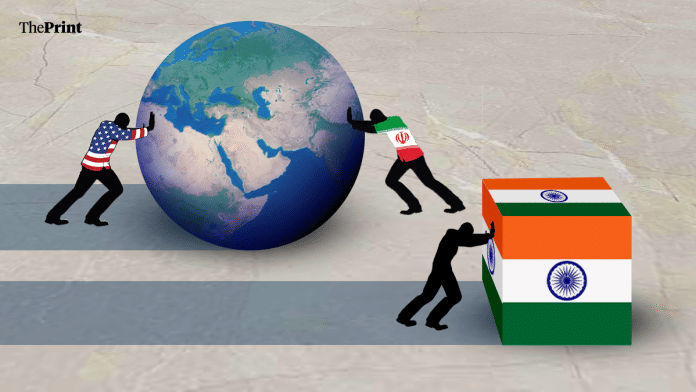

India is an emerging power, almost emerged. It is the world’s most populous country, having overtaken China in 2024. India is considered the world’s third-largest economy in purchasing-power parity, at $17 trillion.
In 2026, the global disorder that is replacing the Westphalia order after World War II is resulting in increasing global uncertainty and anxiety about the future. This causes huge challenges for India.
New strategic paradigms are emerging. India is actively promoting the interests of the developing world, becoming a ‘balancing power’. In a hostile neighbourhood, with two nuclear weapon States on India’s borders, there are few strategic options for India except strategic autonomy.
India’s freedom struggle led to the emergence of the world’s largest democratic, multicultural, multireligious and multi-ethnic state, based on liberty, equality, fraternity, human rights for its citizens and the rule of law.
Emerging out of bi-polarity and in accordance with EU expectations, India should have become an important pole in a multipolar world. Multipolarity was based on the classical European political theory of balance of power. India never supported the theory of ‘balance of power’, so dear to classical European diplomacy of the time.
In a Trumpian world, balance of power has been consigned to the dustbin of history.
What then is India’s strategic autonomy? It is her sovereign capacity to pursue national interests, defence and foreign policy independently without joining formal military alliances or submitting to external coercion.
Strategic autonomy is a pillar of India’s sovereignty. Upholding sovereignty is both a constitutional requirement and a public mandate. India’s foreign policy has, in part, been crafted around economic, strategic and security requirements.
As the world’s fastest growing major economy with a target of reaching developed status within two decades, India is resource hungry. In the face of rising neo-mercantilism practised by the United States, India now pays special attention to unlocking new export markets, securing trade routes and accessing natural resources.
Fractious international relations and proxy wars have raised the spectre of armed and hybrid conflicts. The world is also rearming at the fastest pace since World War II against the backdrop of defence technologies breaching new frontiers. Therefore, for India, building credible, indigenous military deterrence is as important as pioneering breakthrough dual-use technologies.
Strategic autonomy will therefore continue to evolve in scope and scale, and in lockstep with national goals and national security requirements. Calibrated against current and expected changes in the dynamics of international relations and geopolitics, a flexible foreign policy is designed to secure India’s growth and re-emergence as a global economic, continental and maritime power.
Strategic autonomy is a guiding principle of India’s international posture. Should a rising power like India maintain this approach and forge robust partnerships, reformed multilateralism and a new globalisation could emerge.
India’s strategic autonomy is the mechanism by which India pursues its legitimate aspirations based on its national security interests. The disorderly collapse of the existing world order and the interregnum that presently exists carry the risk of widening global conflicts.
While in a prison cell in fascist Italy under Mussolini, philosopher Antonio Gramsci famously declared: “The crisis consists precisely in the fact that the old is dying and the new cannot be born; in this interregnum a great variety of morbid symptoms appear.”
American economist and public policy analyst Jeffrey D Sachs wrote in an article in April 2025: “A century later, we are in another interregnum, and the morbid symptoms are everywhere. The US-led order has ended, but the multipolar world is not yet born. The urgent priority is to give birth to a new multilateral order that can keep the peace and the path to sustainable development.”
It is obvious that the multipolar world will be born when the geopolitical weight of Asia, Africa, and Latin America matches their rising economic weight. This needed shift in geopolitics has been delayed as the US and Europe clings to their past and outdated prerogatives. Meanwhile, the US under Donald Trump bullies Canada, Greenland and others and threatens the rest of the world with unilateral tariffs and sanctions in blatant violation of international law.
Also read: The Vishwaguru delusion, mine vs yours, is ruining our view of the world
Strategic autonomy comes with costs
What are India’s foreign policy options in such a challenging international scenario? Is there a way forward? Is the problem ideological? India’s first Prime Minister, Jawaharlal Nehru, was of the view that India should stay away from ‘alliances’ and ‘arrangements’.
Prime Minister Manmohan Singh took this a step further when he said: “India is too large a country to be boxed into any alliance or regional or subregional arrangements, whether trade, economic or political.”
This thinking has changed under PM Modi. While India, for excellent strategic reasons, may indeed continue to shy away from “alliances,” she has become part of a rapidly increasing number of ‘arrangements’ of differing purpose, cohesiveness, and geographic extension.
Each arrangement comes with obligations that impact India’s foreign policy options. In such a challenging global scenario, with Trump at the helm, India is rethinking its position on some strategic arrangements.
India, as an emerging power, would need to play her role in important regional groupings, including the G20, BRICS, SCO, Quad, and possibly become a member of the expanded G7.
The situation in West Asia, the conflict with Iran, and the emerging defence pacts in the region with Pakistan pose huge strategic challenges for India, given her close relations with Israel and Netanyahu. The latter has embittered public opinion globally against Israel and in particular among Palestinians.
The Palestinian national poet, the widely respected Mahmoud Darwich, wrote in his famous 1964 poem, Identity Card: “You have stolen the orchards of my ancestors
And the land which I cultivated
Along with my children
And you left nothing for us
Except for these rocks …
…
But if I become hungry
The usurper’s flesh will be my food”
It is not clear whether, after elections, a more liberal dispensation would come to power in Tel Aviv and accept a two-State solution. Can reconciliation, leading to autonomous self-governance, become a reality? It looks virtually impossible.
Israel’s present policies pose a difficult strategic conundrum for India.
Challenges arise from the expectations of India’s expanding network of strategic partners. As India’s international profile grows, so too do external expectations regarding its positions on major regional and global issues. Partners increasingly seek not only cooperation but also political alignment on matters affecting their core security interests. This expectation becomes particularly difficult to manage when those partners hold conflicting positions on the same regional crisis.
The Iran conflict demonstrated how difficult it can be for India to satisfy these competing expectations simultaneously. Managing relationships with the United States, Israel, Iran, and key Persian Gulf states requires careful diplomatic calibration, and similar pressures are likely to emerge in future crises.
The result is that strategic autonomy remains achievable, but preserving it may require greater diplomatic effort, more sophisticated balancing strategies, and acceptance of higher political costs than in the past.
The significance of the 2025–2026 developments, therefore, lies less in the immediate choices India made than in the structural trends they revealed. New Delhi successfully navigated the crisis without a major rupture in its relations with any of the principal actors involved. Yet the episode underscored a reality that Indian policymakers are likely to confront with increasing frequency.
Future crises may therefore test India’s strategic autonomy not because New Delhi lacks options, but because each available option is likely to carry greater diplomatic and strategic costs than before.
Looking ahead, the principal challenge for India is unlikely to be whether strategic autonomy should be abandoned. Rather, it will be how to sustain that policy in an environment characterised by intensifying great-power competition, expanding strategic partnerships and growing expectations of political alignment.
The 2025–2026 regional developments suggest that India still possesses significant room for diplomatic manoeuvre. At the same time, they demonstrate that preserving such flexibility is becoming more politically demanding and strategically costly than before.
Over time, India’s strategic autonomy has the potential to reshape global models of partnership, providing a template for what multilateralism can look like in a world in which the centre of economic gravity shifts from the North Atlantic to the Indo-Pacific. By refusing zero-sum alignments, India may catalyse new forms of coalitional diplomacy, especially among middle powers.
Going forward, policymakers will continue to refine this doctrine, balancing autonomy with partnerships and national interest with global responsibility. The challenges are formidable – the complexity of global expectations, a wide range of internal capacity constraints and disruptive geopolitical shifts – but the logic behind strategic autonomy remains robust and central to India’s growth and international stability.
Bhaswati Mukherjee is a retired IFS officer. She has served as India’s ambassador to UNESCO, Paris, and the Netherlands. She tweets @AmbBhaswati1. Views are personal.
(Edited by Prashant Dixit)