




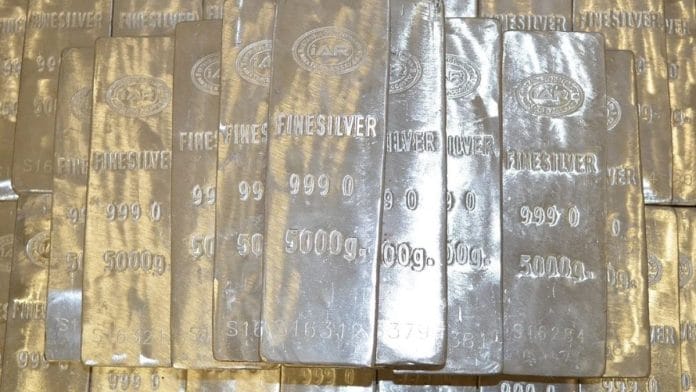

Indians now need a permit to import silver. The permit does not ask whether the metal goes into a bank vault or a solar panel.
On 13 October, the Directorate General of Foreign Trade (DGFT), the commerce ministry office that controls imports, issued ‘Trade Notice No. 30/2026-27’, setting up a faster way to get a silver import permit. Each permit lasts six months and cannot be extended. Applicants must give “a reasoned justification for the quantity and value of imports sought.” The notice sets no limit on how much silver the country will let in. It does not ask what the silver will be used for. A bullion trader and a solar cell maker fill in the same form on the same website.
That gap matters more than the paperwork. Five months after India restricted silver imports to protect the rupee, the permit system still treats silver for a factory and silver for an investor as the same thing.
How the curbs came in
Starting from 13 May, the finance ministry raised the import duty on gold and silver to 15 per cent from 6 per cent. On 16 May, a DGFT notification moved silver bars of 99.9 per cent purity from “free” to “restricted”, meaning a permit is now needed to import them. On 2 June, another notification extended the permit rule to silver powder, grains, and unprocessed silver, even for banks approved to import.
The reason was the size of the bill. India spent $12,050.86 million on silver imports in 2025-26, two and a half times the $4,827.25 million it spent in 2024-25, according to commerce ministry figures released on 15 April. The curbs worked fast. Compared with a year earlier, silver imports fell 86.65 per cent in May, 66.1 per cent in July, and 49.11 per cent in September, the ministry’s monthly trade data show.
Also read: Netanyahu won 53 seats on anti-Arab sentiment. The real unity bloc was Arab parties
Solar factories need the same metal
In the same weeks, the Ministry of New and Renewable Energy (MNRE) made a rule that raises the need for silver. From 1 June, solar projects covered by its Approved List of Models and Manufacturers (ALMM) List-II must use solar cells made in India. MNRE refused to push that date back for everyone. Its 12th update to the list, dated 8 October, covers factories able to make 37,795 MW of cells a year.
Every common silicon solar cell has a thin grid of silver paste printed on it. That grid carries the electricity out of the cell. More Indian cell factories means more silver bought by Indian factories. MNRE’s rule adds to the very demand that DGFT’s rule tries to cut.
Neither ministry publishes numbers that connect the two. MNRE lists cell capacity plant by plant. DGFT lists no permits at all. No government document says how much of India’s silver goes into solar cells, how much into vaults, and how much of each the October fast track will let in.
One permit for two different buyers
The import rules sort silver by purity and shape, not by use. A 99.9 per cent bar bought as an investment and a bar bought to make solar paste carry the same customs code: 71069221. Both need the same permit. A DGFT Policy Circular on 9 October confirmed that a permit holder imports in its own name, up to the quantity on the permit. Neither the circular nor the trade notice puts factories first.
This aims the policy at the wrong target. The problem the government wants to fix is people buying silver as an investment, which sends dollars out of the country. The right tool would make that buying costlier and leave factory inputs alone. India uses two tools on the same buyers instead. The 15 per cent duty already raises the price of every kilogram. The permit then limits quantity on top of that. It hits investors, who buy less when prices rise, and factories, which must buy whatever their production plan needs.
Factories carry the cost. A cell maker does not get to wait for the rupee to recover before buying silver. The duty alone shows the scale. On the 2025-26 import bill of $12,050.86 million, a 15 per cent duty comes to about $1.81 billion. At 6 per cent, it was about $723 million. Every factory pays its share of that rise, whatever the permit system decides. Trade Notice No. 30/2026-27 adds one more step. Silver bought under a permit “shall be procured only through” the India International Bullion Exchange or approved banks and agencies. A factory that once imported directly now pays a middleman.
Permits also create easy profits. When a permit stands between foreign supply and Indian buyers, the holder pockets the gap between the cost of importing and the higher price Indian buyers will pay. Who gets that money depends on who gets the permits. DGFT has published nothing on how many permits it has issued, for how much silver, to whom.
Also read: China is fighting over names in Ladakh. India should notice who else is watching Beijing
A two-track rule
The fix has three parts.
First, automatic permits for factories. Every company on ALMM List-II and every Indian maker of silver paste should get a yearly allowance without applying each time. DGFT already applies an “Actual User” condition to refineries that import raw silver, which means the metal must be used in their own plant and not resold. The 2 June notification kept that condition. The same rule should apply to factories. Each allowance should match the factory’s listed capacity, multiplied by a published figure for silver used per watt of cells.
Second, tight limits on silver bought as an investment. Bars and coins kept as savings are the kind of buying the curbs were meant to slow. The limits should fall on them, and tighten when the rupee comes under pressure.
Third, monthly data. DGFT should publish each month how much silver it has allowed in, how much has arrived, and who holds the permits: banks, approved agencies, traders, or factories. Customs already records every import by its customs code. Publishing the same data by type of holder costs little. It would let markets and Parliament see who gains from the permits.
The strongest objection to such measures is misuse. A factory with an automatic allowance could sell spare silver to traders at a profit. The Actual User condition stops part of this. Linking each allowance to MNRE’s listed capacity stops the rest, because no factory would get more silver than its plants use.
A second objection is about dollars. Every exemption adds to the import bill the curbs were meant to cut. The answer lies in the duty. Trade Notice No. 30/2026-27 already makes applicants declare that they will pay the full customs duty, with no discount. A factory that pays 15 per cent to keep its line running is not the buyer the curbs were meant to stop.
Some questions stay open. Neither ministry publishes how much silver Indian cell factories use. Listed capacity is not the actual output, and not every line runs at full speed. The biggest unknown sits with DGFT: how much silver it has allowed in, and for whom.
India wrote one rule that demands Indian-made solar cells and another that rations silver, within weeks of each other, in two ministries, without matching them. The silver permit asks how much metal an importer wants and why. It does not ask what the metal is for. Until it does, a solar cell maker meeting MNRE’s rule competes for permits with a buyer who wants a bar in a vault.
Sagari Gupta is an independent public policy researcher and writer with over eight years of experience across think tanks and government, including NCAER, the Institute for Human Development, and the Ministry of Consumer Affairs. Views are personal.
(Edited by Prasanna Bachchhav)