




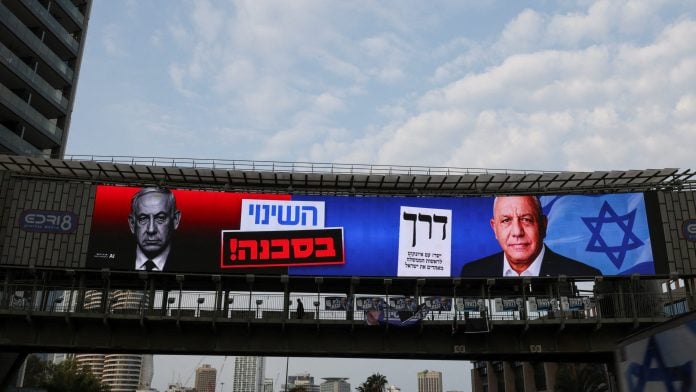

There’s rarely a dull day in Israel’s politics, thanks to its complex electoral arithmetic. This election was termed the most consequential one for the country’s trajectory and for its longest-serving prime minister, Benjamin Netanyahu. Its outcome has thrown up two main takeaways. First, it shows that the anti-Netanyahu bloc’s real test has only just begun. Second, it has held up a mirror to how deeply divided Israel has become after the Hamas-led attacks on 7 October.
The anti-Netanyahu coalition led by Gadi Eisenkot faces some uncomfortable choices if it is to form the government. The birth of the ‘bloc of change’ relied on one premise, as the name suggests: to unseat Netanyahu. In the run-up to the election, Eisenkot ruled out any possibility of a national unity government, and said that he would not sit under Netanyahu, not even under rotation. The leaders of three other parties that are part of this coalition have accused Netanyahu of destroying Israel. If this bloc were to join a unity government with Netanyahu, it would have to swallow much more than its pride, and the one big promise it made to voters.
Everyone’s claiming victory, but no one has won. That is why the Israeli election is ThePrint Newsmaker of the Week.
Litmus test for anti-Netanyahu coalition
There are three ways Eisenkot could form an anti-Netanyahu government and become the next prime minister. He can form a 67-seat coalition by adding the two Arab parties, Ra’am (8 seats) and the Joint List (11 seats). But this is riddled with hurdles. Eisenkot has made four conditions for a party to join his government: recognition of Israel as a Jewish and democratic state, acceptance of its Declaration of Independence, mandatory military or national service for all, and recognition of Hamas as a terrorist organisation that must be dismantled. For the Arab parties, who have not condemned the 7 October attack as a ‘terror act’, agreeing to Eisenkot’s promises seems like an impossible ask. At the same time, three of the four anti-Netanyahu bloc parties had vowed not to sit in the government with Arab parties. And while there are calls across Israel for a Jewish-Arab government, with more protests planned tonight, such a government will have long-term consequences for both the Arab parties and at least three of the four parties in the Jewish bloc—Yashar, B’Yachad, and Yisrael Beytenu.
A minority government, which may be the most practical option from Eisenkot’s point of view, has only a slim chance. This government would hinge on votes from Ra’am and the more conservative Joint List. Ra’am chief Mansour Abbas has said that the chances for such a government to be formed are almost non-existent. Even if it were to take shape, it would be more fragile and would face a formidable opposition. It will be a government dead on arrival.
Theoretically, the Eisenkot-led bloc has another option: seek support of ultra-Orthodox parties Shas and United Torah Judaism. But for a bloc that made ending the exemption from military service for ultra-Orthodox jews one of the main campaign issues, this will again mean going back on a central promise to voters.
For Eisenkot to become Israel’s next prime minister, his coalition will have to give up one of the key aspects of the basic framework of its existence. This also applies to the two Arab parties, despite emerging as the kingmakers in this year’s election.
Also read: Netanyahu didn’t win or lose Israel election. His security doctrine still emerged as the winner
The real unity bloc
The Joint List, comprising Hadash, Balad Ta’al, and Ra’am, led by Abbas, has one similarity with the Eisenkot bloc. They, too, fought on the primary premise of unseating Netanyahu and getting rid of the ultra-Right government in Israel. But that’s where the similarities end. Both Arab parties campaigned on the promise of combating crime and getting investment for Arab communities in Israel. Their outlook on the bigger conflict in Israel, however, differed.
In the months before the election, Abbas sent a message to the Jewish-majority parties that he could join the government. He roped in Yoav Segalovitz, a Jewish former police officer who will soon represent Ra’am. The Joint List, on the other hand, termed Israel’s military campaign in Gaza a ‘genocide’ and likened the ‘West Bank occupation’ to ‘apartheid in South Africa’. Gauging from the support both parties have received, both approaches seem to have worked. Israeli Arab population turned up in large numbers on Tuesday, with almost 80 per cent casting their vote. They secured such a position for both Arab parties that Israel’s mainstream Jewish parties can no longer ignore them. The seats of Arab parties have almost doubled from the 2022 election, and now they may have the last word on what kind of government the country gets. So large were the voting numbers in the Arab-dominated pockets that the Jewish parties had to make frantic pitches to their voters to come out and cast ballots.
Allegations of foreign interference and funding that are being probed by Shin Bet may have raised some questions. But Israel’s 21 per cent Arab population has given a concrete message—they have emerged as the real unity bloc. Netanyahu did manage to secure 53 seats, riding mostly on the anti-Arab wave after the 7 October attacks. However, the 19 seats won by the Arab parties reflect the growing frustration and alienation among Arab citizens that have resulted from the Netanyahu government’s policies.
Janki Dave is Editor (Operations) at ThePrint. Views are personal.
(Edited by Prasanna Bachchhav)