










Is India the “world’s first successful poor democracy”? It is a phrase that initially feels provocative and almost dismissive, but the longer one sits with it, the harder it is to disagree.
India is still poor. Its per capita income remains a fraction of that of advanced democracies. State capacity is uneven. Public goods—healthcare, education, infrastructure—are delivered patchily. And yet, despite these constraints, India has remained a functioning, competitive, mass democracy for more than 75 years.
That combination is not normal.
Most poor countries that experimented with democracy failed to sustain it. Some, like India’s neighbours, collapsed into military rule. Others slid into one-party states or ethnic autocracies. Many discovered that poverty, diversity, and mass politics form an unstable cocktail. India did not. More importantly, the successful democracies of today, including the US, were not poor when they became democracies. India was poor when it became a democracy.
To understand why India remained a democracy and is on the cusp of becoming a successful one, one must return to how precarious the country’s very existence was at birth.
In 1947, India did not inherit a settled nation-state. Roughly two-fifths of the subcontinent’s territory was not directly governed by the British Crown. It consisted of more than 500 princely states, each with its own ruler, political logic, and incentives. Integration was not automatic. It had to be negotiated, coerced, and improvised—often under severe time pressure.
The fear that India might fragment into multiple sovereign entities was real and widely shared. Claude Auchinleck, the last commander-in-chief of the British Army in India, said, “No one can make a nation out of a continent of many nations.” An ex-officer of the Indian Civil Service wrote in 1945 that “the ultimate pattern of India is likely to consist of three or four countries in place of British India, together with a Federation of South Indian States.” Balkanisation was not a metaphor; it was a plausible outcome.
Even the basic instruments of sovereignty were fragmented. Several princely states had their own currencies or monetary arrangements, which the Indian rupee gradually replaced after accession. Hyderabad’s currency, for instance, survived for years and was only fully demonetised in 1959. The Indian state was not born with a unified fiscal, administrative, or coercive capacity. Democracy did not emerge atop a strong nation-state; it helped create one.
That India survived this moment and remained democratic was not inevitable. It was the product of a few foundational institutional choices that, in retrospect, appear extraordinarily farsighted.
The three choices
Universal Suffrage, combined with the continuous holding of free and fair elections
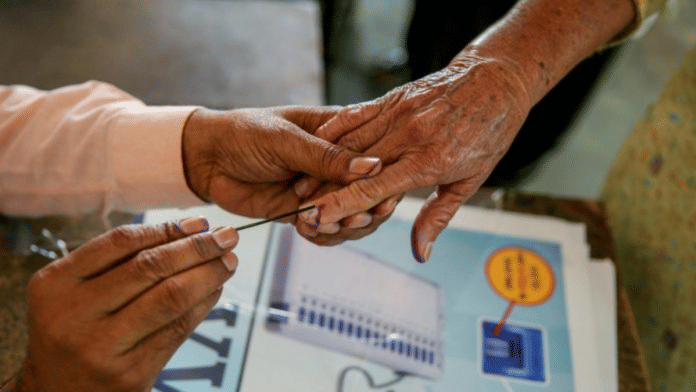
India did not sequence democracy after development; it universalised political rights immediately. In the USA, women and non-whites were not allowed to vote for the longest time. Every adult, regardless of income, literacy, caste, or gender, received an equal vote from the outset in India. The stories of how the country’s first election took place are legendary; 85 per cent of Indian citizens couldn’t read or write, and yet it had a successful national election in 1951-52. Elections became the primary mechanism for resolving conflict, airing grievances, and circulating elites. The ritual of voting, repeated relentlessly, anchored democratic norms even when economic outcomes disappointed.
The refusal to impose a single national lingua franca
India’s refusal to enforce one national language was not accidental; it was stabilising. Language, in many post-colonial societies, became a zero-sum political weapon. In neighbouring countries, especially Sri Lanka, linguistic dominance hardened into exclusion, resentment, and eventually violence. India chose pluralism instead. Federalism, linguistic states, and administrative accommodation defused what could easily have become civil war-level conflicts. Diversity was not eliminated; it was institutionalised.
Affirmative action protected minorities rather than entrenching majorities
India’s reservation system—whatever its implementation flaws—was designed to correct historical exclusion, not preserve demographic dominance. It sought to bring marginalised communities into the democratic mainstream rather than push them outside it. This stands in contrast to cases like South Africa, where political and economic reservation under apartheid entrenched power for a ruling majority-in-practice and left deep institutional scars. India’s approach acknowledged hierarchy and attempted redistribution within democracy, not outside it.
These three choices did not make India rich. But they made India governable.
Also read: Nitin Nabin’s appointment as the BJP President is a selection, not an election
Democracy shaped by poverty
There is a familiar counterargument to this story. Some believe India remains poor because it prioritised political development over economic development and chose universal suffrage, competitive elections, and social accommodation instead of authoritarian efficiency. China, they argue, chose growth first; India chose politics.
The provocative question to them is this: would you rather have a poor country or no country at all?
In a fragmented, diverse, low-capacity society, political consolidation was not a luxury; it was a prerequisite. Without legitimacy, inclusion, and voice, economic policy would have been irrelevant because the state itself would not have survived to implement it. India’s democracy was not a drag on nation-building; it was the scaffolding that held the nation together.
This is the quiet achievement embedded in India’s success. The country did not defeat poverty and then democratise. It democratised first and absorbed poverty within democratic institutions rather than allowing poverty to tear them apart.
But calling India the world’s first successful poor democracy should not be mistaken for unqualified praise.
Poverty leaves fingerprints on democratic quality. When the state struggles to deliver basic public goods, politics often substitutes for governance. Identity mobilisation becomes easier than institutional reform. Short-term redistribution crowds out long-term capacity building. Symbolism displaces systems. Democratic competition survives, but it is distorted by scarcity.
India’s democracy has endured poverty, and it has also been shaped by it.
Also read: Census 2027 is special. It could undo the 1971 freeze on constituencies
Harder question lies ahead
The danger now is complacency. If survival becomes the benchmark, stagnation begins to look like success. A democracy that merely manages conflict rather than expanding opportunity risks exhausting public faith. History suggests that democratic legitimacy is not sustained by procedures alone; it ultimately rests on outcomes.
India has already answered one of the great questions of political development: Can democracy survive without prior wealth? The answer, emphatically, is yes.
The harder question lies ahead: Can democracy generate prosperity at scale faster, fairer, and more sustainably than the alternatives?
The title of this article is best read not as a compliment, but as a challenge. India has passed the test of survival under extraordinary constraints. The next test is transformation: turning democratic resilience into broad-based economic capability.
The power of our demographics is well-known. One of the strengths of India is its ability to innovate in a frugal manner. An example is the success of the country’s space and technology programme. A couple of years ago, India was the first nation to land a spacecraft on the South Pole of the moon; that too at a fraction of what it would cost any other country.
Another driver is digitalisation. A street vendor can get money credited to her bank account without needing electricity or internet connectivity. Nandan Nilekani said that India will be data-rich before it becomes economically rich. Technology will help India leapfrog growth, even as geopolitics seems to change a lot of the institutions it took for granted.
Only when democracy becomes not just a shield against collapse, but a machine for shared prosperity, will the adjective “poor” finally fall away. On this Republic Day, that unfinished journey is worth remembering and worth recommitting to.
Editor’s note: This article is based on a speech delivered by Luis Miranda, then-chairperson of the Centre for Civil Society, on 15 November 2023 at the Atlas Network’s Liberty Forum in New York.
Luis Miranda is the chairperson and co-founder of Indian School of Public Policy.
Yash Kirkire is a public policy graduate from the University of Chicago and currently works at a Fintech startup.
Views are personal.
(Edited by Saptak Datta)
Since poor socialist India is unable to become a rich and developed country, it should celebrate being poor. Democracy helps the country to remain poor through electoral corruption like freebies for votes.