





LNG is the second-largest growth point — after oil — in the Russia-India energy relationship. But while Delhi has steadily and confidently ramped up its oil purchases, gas is a more complicated story. India has been avoiding sanctioned batches of Russian LNG, even though its interest in the Arctic’s resource base is clear. In the summer of 2026, the issue moved back to the centre of the bilateral agenda, against the backdrop of Asia’s rising gas potential and the continuing search for alternative energy sources.
India is already one of the world’s largest LNG importers: by the end of 2025 the country ranked fifth globally by import volume, behind China, Japan, South Korea and France. Current annual imports run at roughly 27–30 million tonnes, handled through seven regasification terminals with a combined capacity of about 48 million tonnes a year. The supplier structure remains fairly conservative and tied to traditional exporters. Qatar accounts for about 41 per cent of the market, the United States for about 19 per cent, the UAE for about 11 per cent, and African states (Nigeria, Angola, Cameroon) for about 10 per cent.
Major projects and buyers
India’s strategic ambitions go well beyond current figures. New Delhi aims to raise gas’ share of its energy mix to 15 per cent by 2030 (from roughly 6 per cent today), and the International Energy Agency projects that the country’s LNG demand could rise to 40-50 million tonnes a year. To meet that target, India plans to expand existing terminal capacity and build new terminals — primarily on the east coast, which would also open up potential supply routes from the east, including via the Trans-Arctic Transport Corridor.
On the Russian side, the flagship of Arctic LNG remains Novatek’s Yamal LNG project — extraction, processing and liquefaction of gas from the South Tambey field on the Yamal Peninsula. The plant’s designed capacity is 17.4 million tonnes a year, making it one of the largest LNG producers in the world.
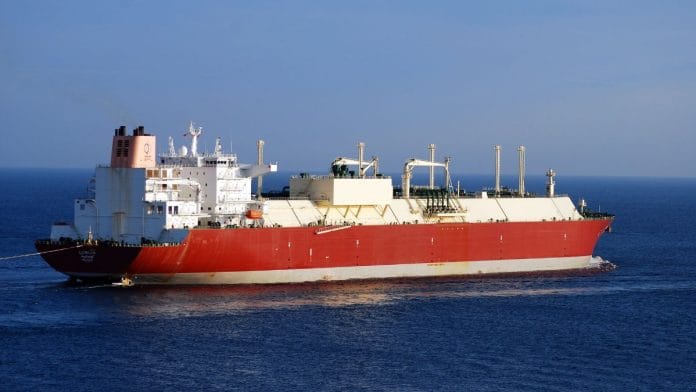
Product is shipped out on Arc7 ice-class “Yamalmax” tankers, moving both west and east along the Northern Sea Route. Shipping routes follow a pronounced seasonal pattern: from November to April, when heavy ice persists in the East Siberian and Chukchi Seas, most LNG moves west, through the European part of the NSR and on into the Atlantic. From June, eastbound shipments build up, peaking in August-September when ice conditions in the eastern Arctic are most favourable.
A landmark moment came in January 2021, when the gas carriers Christophe de Margerie and Nikolay Yevgenov became the first vessels to sail the NSR eastbound independently, without icebreaker escort — proof that year-round navigation is achievable.
Yamal LNG’s delivery footprint keeps expanding despite fierce competition on the global market. In Europe, the bulk of volumes go to France, Belgium and Spain, with smaller amounts to the Netherlands, Portugal and the UK. In the Asia-Pacific, the main buyers are China, Japan and South Korea.
The second major project is Arctic LNG 2 on the Gydan Peninsula, with a combined capacity of around 20 million tonnes a year. Its development has been harder going: under US sanctions, the project has faced delays in both shipping and the construction of its icebreaking tanker fleet, and foreign partners — including France’s Total — have suspended participation. Even so, the first production line came online in late 2023, and in 2025–2026 the first Arc7 ice-class gas carriers built in Russia, at the Zvezda shipyard (lead vessel Alexey Kosygin, followed by Konstantin Posyet), were launched to support Arctic LNG 2 logistics, including shipments to China.
Also read: BRICS can widen India’s Arctic role. Though it can’t become another Arctic Council
A matter under study
Why the caution on India’s side, then? The key condition for scaling up deliveries is the sanctions status of Russia’s various LNG assets. Arctic LNG 2 has been under US sanctions since 2023, and the smaller Gazprom LNG Portovaya plant is also covered by restrictions. That plant was at the centre of a notable incident in spring 2026: an LNG tanker bound for India’s Dahej terminal (Gujarat) was identified by ship-tracking services as carrying gas from the sanctioned project. Indian authorities refused to accept the cargo, and the vessel was left waiting off Singapore with no announced port of discharge.
According to available reports, at a meeting with a Russian deputy energy minister, Indian officials stated plainly that they were not prepared to purchase sanctioned LNG — while talks on possible deliveries of non-sanctioned Russian LNG continue.
It’s important to distinguish between the projects here: Yamal LNG itself is not under blocking sanctions, and India’s GAIL holds a long-term contract with a Gazprom Group trading arm (Gazprom Marketing & Trading Singapore) for roughly 2.9 million tonnes of gas a year.
Yet in the first half of 2026, almost the entire output of the plant — a record for the period, at about 9.89 million tonnes — was bought up by European purchasers rushing to secure fuel ahead of a new EU ban on short-term-contract imports of Russian LNG.
China’s experience — as the largest buyer of Arctic LNG 2 output and a significant recipient of Yamal LNG volumes — points to what it would take to move from intentions to contracts. Asian countries have shown they are willing to work with additional sanctioned projects where the economics make sense and where payment, insurance and tanker arrangements are in place.
For India, which is trying to balance its ties while also positioning itself as a strategic partner of the United States in the Indo-Pacific, that model remains politically sensitive for now.
Arctic LNG remains, for India, still a matter under study: the scale of the resource base and India’s fast-growing economy create real grounds for closer Russia-India ties, but the sanctions architecture built around Russia’s LNG projects continues to hold back the move toward long-term contracts.
Ekaterina Serova is the Head of the Department of International Affairs, PORA Expert Centre. Views are personal.
(Edited by Ratan Priya)