




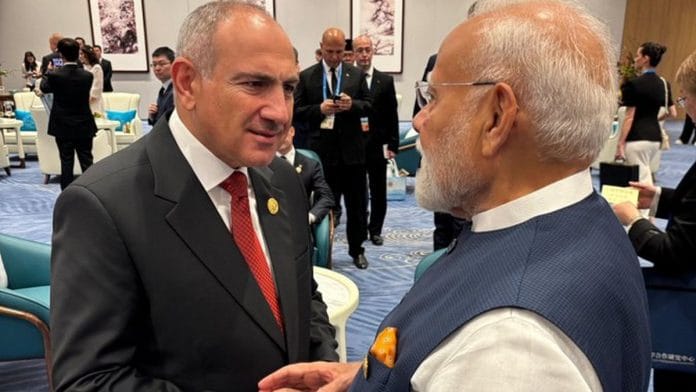

For most Indians, Armenia was once a distant country known through its ancient Christian heritage and a tragic history of genocide and displacement. Yet, over the last few years, Armenia has been discussed steadily in India’s strategic circles. Reason: New Delhi has emerged as Yerevan’s largest defence supplier in recent years, providing everything from Pinaka multi-barrel rocket launchers and Akash air defence systems to radars and anti-tank weaponry. Yerevan, in turn, became the first destination for successful exports of Indian weapon platforms, not just sub-systems — a feat for India’s defence-export aspirations.
India’s growing footprint in Armenia, however, coincided with a period of profound geopolitical transformation in the South Caucasus. The region is no longer defined or controlled by the familiar Russia-centric order that prevailed after the collapse of the Soviet Union. Instead, a new strategic calculus has been emerging — one shaped by the decline of Russian influence, the rise of Turkey, greater European engagement, and burgeoning American investments.
Much of the above owes to the remarkable political experiment unfolding under Armenian Prime Minister Nikol Pashinyan, who has served since 2018. He returned to power days ago with a mandate yearning for geopolitical change. Pashinyan defeated two pro-Russia parties by a comfortable margin but fell short of the mandate required for a constitutional amendment to solidify the peace process with Azerbaijan.
His latest electoral victory, despite military defeat to Azerbaijan, upended the thumb rule of politics and remains crucial not merely for Armenia, but for the future of the Caucasus, and for countries such as India that have invested strategically in the region.
Also Read: The Quad is fading. India must now confront the limits of strategic ambiguity
Unusual political narrative
A journalist by profession, Nikol Pashinyan worked as editor of the Armenian newspaper Haykakan Zhamanak and became a prominent opposition figure in his youth. In 2009, he was imprisoned for his role in protests that followed disputed elections and was sentenced to seven years in prison. His political fortunes, however, continued to rise, and he was elected to parliament for the first time in 2012 and again in 2017.
The defining moment came in 2018 during Armenia’s “Velvet Revolution”, when pro-democracy mass protests against entrenched political elites swept him into power. On 8 May 2018, backed by a popular movement demanding political change, Pashinyan was elected the Prime Minister of Armenia.
Since then, he has become one of the most closely watched leaders in the former Soviet Union — not only because of his domestic reforms but because he represents something rare in the region: a genuinely competitive democratic political figure capable of repeatedly winning elections without Moscow’s endorsement, or, shall I say, despite Kremlin interference.
Statehood and identity
To understand the significance of Pashinyan’s victory, one must first understand Armenia’s complicated post-Soviet journey.
Unlike many Eastern European states, Armenia was not merely a member of the Soviet bloc; it was an integral constituent republic of the Soviet Union itself. The collapse of the USSR in 1991, therefore, created not only a geopolitical vacuum but also a profound identity crisis. This triggered what historian Suren Zolyan calls a “heterogeneous mixture of mythologized ancient history, Soviet and anti-Soviet ideologies”, and a quest for new political symbolism.
The political history of independent Armenia can broadly be divided into four phases. The first period, from 1990 to 1998, was characterised by a rejection of everything Soviet and an attempt to draw legitimacy from the short-lived First Republic of Armenia that existed between 1918 and 1920. Yet there remained a tension between reviving a historical state and creating a new political nation.
This phase was defined by the term of Armenia’s first President, Levon Ter-Petrosyan (the country then had a presidential system), a pragmatic figure who had clashed with Moscow on the status of Karabakh and took an independent view of Armenia’s future.
The next phase, from 1998 to 2018, saw a resurgence of pro-Russia leaders. The rise of Pashinyan in 2018 marked the third phase, while subsequent wars with the larger neighbour Azerbaijan, and their aftermath, ushered the country into the fourth.
Over time, Armenia witnessed the gradual reconciliation of these narratives. Soviet Armenia came to be viewed as an intermediate stage in the broader story of Armenian statehood rather than an aberration. National myths rooted in ancient Armenian civilisation and legendary figures such as Hayk Nahapet were revived, while successive governments sought to define what independent Armenia should represent.
Today, under Pashinyan’s “Fourth Republic”, there emerges a political vision that seeks to move beyond the assumptions that shaped most of Armenia’s post-Soviet identity.
The debate lies at the heart of Armenia’s struggle to adapt to a radically altered regional environment after defeats in wars it could not win.
Winning elections after losing wars
The most striking aspect of Pashinyan’s latest electoral victory is that, by conventional political logic, it should never have happened.
He inherited a country deeply entangled in the decades-old conflict over the mountainous region of Nagorno-Karabakh. Under his leadership, Armenia suffered two major military defeats at the hands of Azerbaijan — in 2020 (when a snap election followed) and again in 2023. The latter effectively ended Armenian control over Nagorno-Karabakh, a territory that generations of Armenians regarded as both historically and emotionally inseparable from their national identity.
In most countries, the loss of territory, particularly one surrounded by historical grievances and national symbolism, would be political suicide. Yet Pashinyan turned the tide.
His Civil Contract party secured 49.8 per cent of the vote and 61 out of 105 parliamentary seats. While this represented a decline from its previous tally of 71 seats in the snap elections of 2021, it still provided a majority and significantly exceeded pre-election expectations. Most importantly, the result came despite widespread assumptions that military defeat would destroy his political legitimacy. Instead, Pashinyan successfully reframed the national conversation.
Rather than promising revenge or territorial recovery, he campaigned on a politically risky proposition: Armenia could not win an endless conflict against a stronger Azerbaijan and therefore needed normalisation, peace, a new strategic direction, and prosperity for future generations.
In doing so, Armenia may have created a new precedent in democratic politics. Pashinyan persuaded the electorate to prioritise future stability over historical grievance — a rare achievement for a region marred by long-standing territorial conflicts and the trauma of defeat.
The Russia question
Since independence, Armenia has remained deeply integrated into Russia’s geopolitical orbit for its security, energy supplies, trade networks, and military planning.
Membership in the Russian-led Eurasian Economic Union brought benefits, including natural gas from Russia at heavily subsidised rates. Moscow has long served as Armenia’s principal security guarantor.
And yet, many Armenians hold the view that Russia failed to uphold its responsibilities when Azerbaijan took over Armenian positions in Nagorno-Karabakh. Pashinyan has long been a critic of Russia’s breach of trust and has capitalised on public sentiment by openly and repeatedly questioning the utility of Armenia’s dependence on Moscow.
Yet he wasn’t the first to seek greater autonomy. Armenia’s first post-independence president, Levon Ter-Petrosyan, whom Pashinyan deeply admired, also advocated a more independent foreign policy. The difference is that subsequent leaders — from Vazgen Sargsyan to Serzh Sargsyan and Karen Karapetyan — belonged to the ‘old guard’ that maintained close ties with Russia and kept Armenia heavily reliant on Moscow for both economic and military security.
What makes the current moment different is not merely Pashinyan’s preference for the West but Russia’s diminished capacity due to Putin’s geopolitical fiasco.
Its prolonged war in Ukraine has weakened Moscow’s ability to project influence across its traditional theatres. The consequences can be seen not only in the Caucasus but also in parts of the Middle East and Central Asia, as well as Latin America.
The shrinking of Russian influence has created political space that Armenia is now attempting to fill through diversification.
New players
The European Union has become increasingly engaged with Armenia, culminating in talks on the accession process and the first Armenia-EU summit last month. Such developments would have been difficult to imagine even five years ago.
The United States has become a significant player. The August 2025 peace deal between Azerbaijani President Ilham Aliyev and Pashinyan, facilitated by Donald Trump, marked the beginning of Washington’s growing engagement in regional diplomacy and connectivity. Subsequent US investments in the TRIPP — Trump Route for International Peace and Prosperity — corridor have pivoted Armenia to a new era.
TRIPP is a 43-kilometre transport route through southern Armenia. It physically links mainland Azerbaijan to its Nakhchivan exclave and provides unimpeded transit towards Turkey, enhancing the Middle Corridor and bypassing both Iran and Russia. Managed by private American, European, and Turkish consortia, it aims to open up critical mineral supply chains from Central Asia and boost regional trade between Armenia and Azerbaijan.
Turkey, meanwhile, has emerged as perhaps the most consequential new variable. Historically viewed through the prism of trauma and distrust, Ankara is now becoming an unavoidable stakeholder in the future of regional connectivity and economic integration. The normalisation process between Armenia and Turkey has moved from being politically taboo to becoming part of mainstream policy discussion.
Also Read: Aggressive outreach isn’t enough to get Norway to invest in India. Its rules are different
What it means for India
New Delhi-Yerevan defence cooperation grew entirely under Pashinyan, but it was also in the specific context of Armenia’s long-standing war. For India, it is time to develop stakes in Armenia’s peace like it had in its war.
A normalised South Caucasus, though still not formally complete, would create opportunities for greater economic connectivity, defence resilience, and diplomatic engagement. Equally important, Armenia’s diversification strategy aligns with India’s recent rapprochement with Azerbaijan, which has had a special relationship with Pakistan.
India’s strategic calculus in the Caucasus is bound to change, but will be more effective if pursued proactively.
Swasti Rao is a Consulting Editor (International and Strategic Affairs) at ThePrint. She tweets @swasrao. Views are personal.
(Edited by Asavari Singh)