



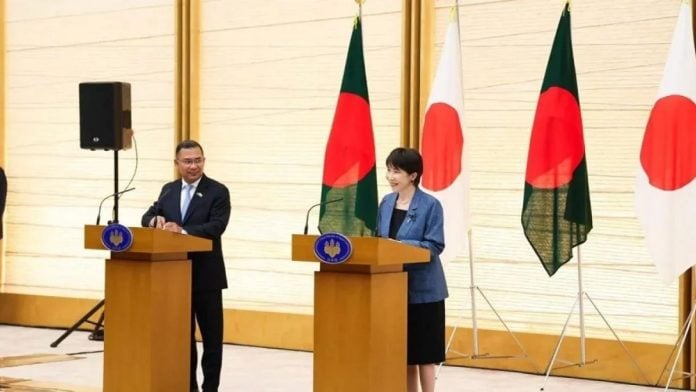
Japan is poised to act as a potential bridge between India and Bangladesh. The timing is key. In the last week of October 2026, Bangladesh Prime Minister Tarique Rahman undertook a four-day visit to Japan, where he held a bilateral summit with his Japanese counterpart, Sanae Takaichi. The joint statement spanned a wide array of dimensions – connectivity, security, economic and energy cooperation, natural disasters, climate change and people-to-people ties, while also touching on international issues.
Given that Tokyo has maintained substantial cross-sectoral ties with both New Delhi and Dhaka, Japan can positively influence connectivity and development in the region, as well as help rebuild trust between India and Bangladesh, given their relationship has deteriorated since August 2024.
Japan would not be acting as a mediator per se between India and Bangladesh. India has long rejected third-party interference in its bilateral affairs. But Tokyo could become a shared partner, offering New Delhi and Dhaka projects to invest in. It could generate confidence in the wider ties between the two countries. Considering the turbulence after Sheikh Hasina’s ouster from Dhaka, and the likely friction awaiting the two neighbours over the Ganges Water Treaty—which expires this December after 30 years—this is a critical moment to seriously evaluate the prospects of an India-Bangladesh-Japan revival.
India-Bangladesh-Japan Revival
After Hasina’s term, the broader breakdown in the India-Bangladesh relationship has created new challenges for bilateral partnerships, especially as some agreements signed under Hasina have come under review. Even as New Delhi and Dhaka are now incrementally rebuilding the relationship, there is fresh space for third-party intermediaries such as Japan, who retain significant good faith in both the capitals.
India and Japan already have a cooperation policy in Sri Lanka, Africa and Myanmar, showing a history of collaboration in emerging economies that they can lean on. A template for India-Bangladesh-Japan already exists, which was tested under Hasina and lost momentum after her downfall. Such triangular cooperation did not rest on a formal institutional design, but rather on dispersed concepts and projects that linked the three.
Take, for instance, the Bay of Bengal-Northeast India-Industrial Value Chain concept proposed during former Japanese Prime Minister Fumio Kishida’s 2023 visit to India, which essentially envisioned establishing a whole economic corridor consisting of three parts – India’s northeast, Bangladesh, and the Bay of Bengal. Another example is the trilateral meeting in India’s Tripura that same year, seen as an effort toward greater triangular cooperation.
This trilateral, even in its informal character, is waiting to be leveraged under Rahman’s Bangladesh Nationalist Party government. But any serious discussion to this end among the three capitals would first require Rahman and Prime Minister Narendra Modi to meet. The Bangladeshi PM has so far declined New Delhi’s invitations to visit India, though a new envoy, Asad Alam Siam, taking charge at Bangladesh’s high commission in Delhi may inject fresh momentum into the bilateral meeting process.
This is where Japan matters. With Tokyo as the public face of regional connectivity projects, new India-linked projects could garner broader support in Bangladesh under Rahman. This is especially given Bangladeshi caution toward India and a polarised environment wherein any high-level visible engagement with Delhi could serve as a political death knell for Rahman, providing his opposition fodder for triggering unrest against him. Even within a trilateral format encompassing India, Dhaka’s demur is apparent.
Immediately after Rahman’s return from Japan exile in London, Bangladesh’s state minister for foreign affairs Humayun Kobir said the joint statement did not refer to a “third country” or the “Bay of Bengal”, and that the Bay of Bengal Industrial Growth Belt (BIG-B) had been discussed purely in terms of Bangladesh-Japan economic ties. He was responding to a question about whether BIG-B could grow into a regional supply chain centered around Matarbari involving Nepal, Bhutan and India’s seven northeastern states. Kobir’s response shows that a trilateral must be built quietly through projects and strong political will rather than grand announcements.
Also read: The difficulties in India’s renewable payment safeguards
Areas of convergence
One outcome of Rahman’s Japan visit deserves particular attention: the BIG-B upgrade into “BIG-B for Shared Prosperity”. This initiative aims to “integrate the development of power, energy, deep-sea port, industrial and ICT infrastructure, build a major nexus for industrial value chains, develop into a trade and supply gateway and generate growth and prosperity”. Arguably, its full viability cannot be realised without Indian participation. The Bay of Bengal is a shared backyard of both New Delhi and Dhaka after all.
Some of these projects are indeed purely bilateral, targeted at local development. Others, such as the development of the Matarbari deep-sea port that Japan is financing, or the creation of an industrial value chain, will only pay off in the long run if large volumes of cargo and investment flow through them. And infrastructure built solely for Bangladesh’s use will risk under-utilisation. For India’s landlocked northeast, Bangladeshi ports offer a shorter route to the sea than Indian territory does. The three stand to gain, with Bangladesh becoming a regional gateway and seeing domestic industrial growth; India securing an outlet for its northeast, and Japan receiving better returns on its investments.
India and Bangladesh are already the two largest recipients of Japanese Official Development Assistance, respectively. In fact, the Japan International Cooperation Agency (JICA) steers key technical projects in Bangladesh and supports connectivity projects in India’s Northeast, making it a reliable stakeholder in both countries. That Japan happens to be the largest, most consistent foreign investor in India’s northeast, whether through JICA or the Japan-dominated Asian Development Bank (ADB), and that New Delhi trusts Tokyo to invest in one of its most sensitive border regions lends further credence to Japan being best placed to lead regional endeavours.
JICA, the Export-Import Bank of India and other lenders have co-financed an environmentally friendly steel plant in Mirsharai, Bangladesh. Moreover, there is synergy between JICA’s projects in Bangladesh and India; notably, JICA itself says that India can accrue benefits from access to the Matarbari port. JICA’s North East Road Network Connectivity Improvement Project seeks to enhance highways and regional roads to ease trade and mobility there, in line with the India-Japan Act East Forum, launched in 2017. This dovetails with JICA’s efforts at improving connectivity within Bangladesh, which could, in theory, make regional integration far easier.
After all, Bangladesh is where India’s Act East Policy and Japan’s Free and Open Indo-Pacific Strategy converge. Japan not only has prior experience stimulating economic growth by connecting several countries through development projects (think of the Japan-backed economic corridors running along the Mekong River Basin Countries), but institutionalising a Japan-India-Bangladesh trilateral would also counter Chinese influence – which happens to be a mutual goal of both Indian and Japanese policymakers.
Some would argue for bringing China into the trilateral, on the logic that it would make India’s participation palatable to Bangladesh’s socio-political milieu, and disarm the National Citizen Party and the Jamaat-e-Islami, who would otherwise criticise Rahman for compromising Dhaka’s sovereignty by engaging with India. But this would run counter to the strategic objectives of both New Delhi and Tokyo. Others have even opined that Chinese projects in Bangladesh should be complemented by Japanese ones. Here, there’s a better argument for Bangladesh: although it is content with Chinese deep pockets, its economy warrants courting many investors, which is where India and Japan can together fill the gap.
Perhaps trilateral backchannels could kickstart discussions now, so that when Bangladesh’s politics stabilise relatively, Tokyo, New Delhi and Dhaka can move the needle.
(Edited by Ratan Priya)