






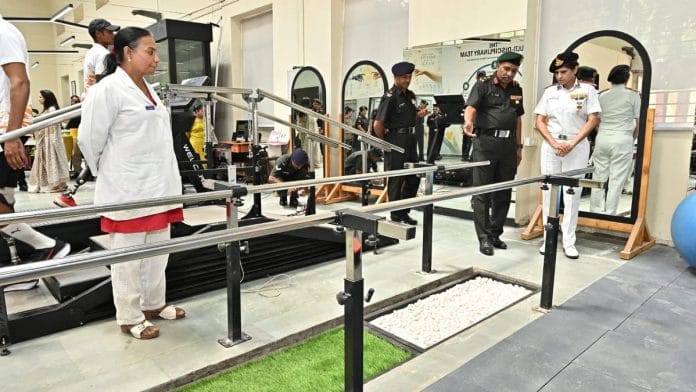


The Artificial Limb Centre in Pune celebrated its 82nd Raising Day this week. I have visited this remarkable institution several times over the years, first while researching my book Soldiering On: The Remarkable Resilience of India’s Disabled Soldiers. Each time, I have returned more inspired, more humbled, and more deeply moved by the extraordinary resilience that lives within its walls.
Established on 19 May 1944, in the final years of the Second World War, the Artificial Limb Centre (ALC) was created to restore mobility, dignity, and livelihood to wounded Indian soldiers returning from battle. Eighty-two years later, over sixty thousand patients have passed through its doors. Its motto, “No Wheelchair, No Crutches”, feels less like a slogan and more like a solemn promise that successive generations of its staff have kept without fanfare and without fail.
The highlight of this year’s celebrations was the inauguration of Saksham, a holistic mobility clinic, dedicated by Surgeon Vice Admiral Arti Sarin, AVSM, VSM, Director General Armed Forces Medical Services (DGAFMS). Also present at the event were Surgeon Vice Admiral Anupam Kapur, DGHS (Armed Forces); Lieutenant General Pankaj P Rao, Director and Commandant of the Armed Forces Medical College; and Surgeon Rear Admiral Rajat Shukla from the office of the DGAFMS.
Brigadier CN Satish, Commandant ALC, showcased a facility where prosthetic care, gait training, counselling, physiotherapy, and post-operative rehabilitation now function seamlessly under one roof. Rehabilitation here is treated not as a string of separate hospital visits, but as a continuous journey back to life.
And that journey extends far beyond the fitting of an artificial limb.
Also Read: Why tax disability pension of soldiers who keep serving? It punishes loyalty
Lives made whole
Walk through ALC’s corridors and one quickly realises this is not merely a prosthetic centre. It is a place where lives are rebuilt in totality: physically, psychologically, socially, and economically.
Prosthetic surgeons, biomechanical engineers, physiotherapists, psychologists, occupational therapists, and medico-social workers work in unison around one central focus: the soldier. They do not see a missing limb but a man whose life must be made whole again.
I saw young men learning to take their first steps on newly fitted limbs with quiet determination — the same determination, I imagine, that once carried them through training and over the line of duty. I saw veterans returning for refits, greeted warmly by staff who remembered them by name.
At the Additive Manufacturing Lab, inaugurated late last year, prosthetists demonstrated how 3D printing technology is transforming rehabilitation, enabling faster and more precise limb production, with the potential to one day reach even remote forward areas through digital scans.
Yet what leaves the deepest impact is not the technology. It is the compassion.
Also Read: 138 degrees and counting—Meet the ex-soldier who’s the world’s most qualified person
A personal sense of debt
At ALC, I realised that “care with compassion” is not institutional rhetoric. It is visible in every interaction, whether it’s the unhurried patience of a physiotherapist, the gentleness of a nursing assistant adjusting a strap, or the way a senior officer allows a young amputee to speak first.
The soldier who enters its gates is not defined by what he has lost, but by what is still possible. Whether a Paralympian returning with medals or a jawan whose only wish is to walk to a temple unaided, each is treated with the same dignity. That equivalence, in a country that too often measures worth by visibility, is itself an act of grace.
Over the decades, ALC has also become a symbol of India’s humanitarian outreach. Patients from Nepal, Bhutan, Bangladesh, and Afghanistan have received treatment here, alongside personnel from the BSF, CRPF, Assam Rifles, and ITBP. Through its association with the Army Paralympic Sports Node, Kirkee, India’s Paralympic athletes have carried the tricolour to international podiums on prostheses developed within these very walls.
For a nation that still owes much to its disabled soldiers, ALC Pune stands as a powerful reminder of what institutional commitment can achieve. Its true strength lies not merely in its infrastructure or medical excellence, but in the philosophy that drives it: that a soldier who has sacrificed a limb for the nation deserves nothing less than the chance to live fully again.
At a personal level, I feel a particular kind of debt toward the ALC. It is the debt of a writer who has been allowed to walk its wards and listen to its stories; the debt of an Army wife who knows what it means when a husband returns from duty altered; and the debt of a citizen who recognises that the longest sentences of service are sometimes written without medals or microphones.
As I walked out of ALC on its 82nd Raising Day, I thought of the thousands of homes across India where husbands, fathers, and sons returned from service irrevocably changed, and of how this institution in Pune helped them return not just mobile, but standing tall.
Ambreen Zaidi is an award-winning military author and activist, honoured by the President of India, for her work on war widows and disabled soldiers. Views are personal.
(Edited by Asavari Singh)