



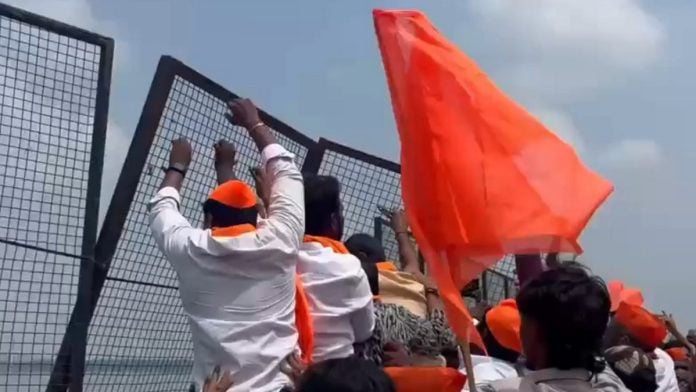
On Monday, members of a Ganesh samiti tore down barricades that had been put up along a stretch of Hussain Sagar lake to stop idol immersions during the Ganpati festival. Earlier too, people had scaled the barricades to immerse idols.
There aren’t many places in Hyderabad that predate the city itself, which is what makes Hussain Sagar a very important site, both in terms of heritage and ecology, that we need to protect. But like many other things in the city, the lake has suffered much damage over the decades, and it is high time that we as citizens also understand the consequences of damaging our water bodies.
The Hussain Sagar lake is also called Tank Bund today, as one of its sides is lined by one of Hyderabad’s main thoroughfares. The Tank Bund stretch has over the last few decades also become the main route where thousands of Ganesh idols are immersed every year.
Despite a ban by the Telangana High Court in 2021 citing environmental concerns, reiterated in 2023, the immersions continued even last year. This year, however, the Greater Hyderabad Municipal Corporation (GHMC) seems to have got its act together and put up banners stating a ban on the immersion of idols from Tank Bund during the ongoing Ganesh or Vinayaka Chaturthi festival.
But of course, on 21 September, the Bhagyanagar Ganesh Utsav Samithi (BGUS) protested and broke open barricades in protest against the ban on idol immersion from Tank Bund. The organisation has been openly defiant of the Telangana High Court’s ruling on the issue, and doesn’t seem to care.
Also Read: Andhra meals are great, but Hyderabad’s food scene badly needed a neo-Telugu reboot
A chance to carry out immersions with care
According to GHMC officials I spoke to, PoP idols can be immersed at certain points in other areas of Hussain Sagar, such as NTR Marg, under government supervision in artificial ponds. Clay idols can in fact be immersed directly into the lake with the help of cranes. This arrangement, if followed, might help protect the lake from further deterioration.
As a Hyderabadi who has grown up watching immersions, I don’t really remember the roads being very hectic during my school years. Of course, there would be traffic jams, especially on roads leading to Hussain Sagar on the final day of the festival, but over the years the situation throughout the 10 days — especially on immersion days — has become much worse.
Honestly, if the BGUS is so intent on doing it, they should at least make sure there are no traffic jams. But that’s just not possible when thousands of people are carrying or facilitating the movement of Lord Ganesha’s idols. Often, the immersion of bigger idols is completed only the next morning due to the heavy traffic and movement.
It is not a great sight. The roads are a mess, traffic is haywire, and the cleaning staff have to pick up far more filth than usual because of the thousands of people who are out. Which is why the ban on immersions from Tank Bund is an important step toward saving one of the city’s oldest lakes.
Immersions carried out with care, as the government has facilitated, should certainly continue, as faith is an important facet of our lives in this country. But it’s also high time that we save one of our most important water bodies and heritage sites.
Also Read: Hyderabadis love Golconda’s tunnel stories. Few care about what’s happening to the fort
Why Hussain Sagar matters
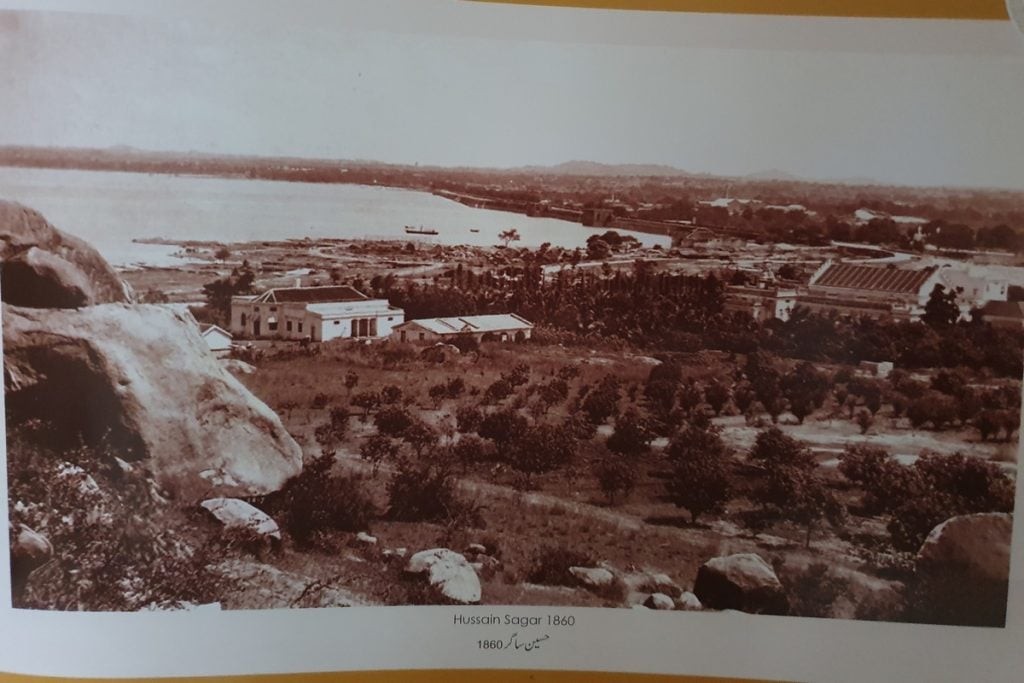
Hussain Sagar was built by a Sufi engineer named Hussain Shah Wali around 1562. He had come here during the reign of Sultan Ibrahim Qutb Shah (1550-80), the third Golconda king, and built the lake as a water source for Golconda Fort, which was the capital before Hyderabad was founded.
It is said that Hussain Shah Wali’s blessings have ensured that the lake never goes dry. Hyderabad was eventually founded in 1591 by Ibrahim’s son Muhammad Quli Qutb Shah, and Hussain Sagar served as a drinking water source from then all the way up to the early 1900s under the Nizams.
It was only after alternative drinking water sources, like Osman Sagar and Himayat Sagar, were built between 1913 and 1925 under the last Nizam, Osman Ali Khan, that Hussain Sagar’s importance as a water source decreased.
From what we know, the lake was once much bigger than it is today. GHMC officials and activists who have been involved in saving the lake told me that its contours are believed to have shrunk by about one-third of their original size because of several encroachments. But encroachment is only one issue. The insane amount of pollution dumped into the lake over decades is another.
According to the Hyderabad Metropolitan Development Authority’s website, five major nalas carrying sewage flow into Hussain Sagar: Balkapur nala, Banjara nala, Yousufguda nala, Kukatpally nala and Picket nala. The total inflow during dry weather is 49 million litres per day (MLD), rising to about 245 MLD during the rainy season.
However, I do recall a conversation with an HMDA official about half a decade ago who said the pumping of nalas into Hussain Sagar had been reduced or stopped to some extent. The unbearable stench that every commuter would once be subjected to has certainly come down over the years.
The other major pollutants going into the lake now are PoP Ganesh idols, and it is time we look at this issue from an environmental standpoint and take care of our heritage.
Yunus Lasania is a Hyderabad-based journalist whose work primarily focuses on politics, history and culture. He tweets @YunusLasania. Views are personal.
(Edited by Asavari Singh)