



Anytime someone compares Indian metro cities, people from Hyderabad now have two major flexes — “We can at least breathe our air, unlike Delhi,” and “Our traffic is still better than Bengaluru’s”. It is true, though. Having been to both Delhi and Bengaluru, I would say, as objectively as I can, that I still prefer my city over both, majorly because the lower pollution means I can breathe here.
Hyderabad has never been as green as Bengaluru, but our city is still more liveable because traffic is comparatively manageable. And the Kasu Brahmananda Reddy (KBR) National Park in Jubilee Hills has, over the years, become one of the biggest places of comfort for thousands of people who go there every morning for some fresh air.
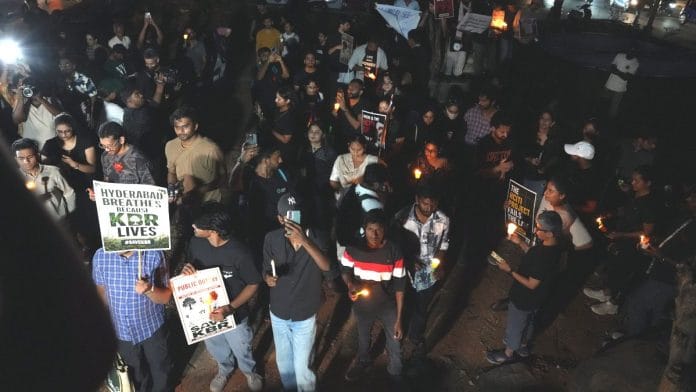
Sadly, that bliss came under threat a few weeks ago, when the Congress government in Telangana decided that it needed to construct new flyovers under the H-CITI project, connecting the Banjara Hills and Jubilee Hills areas to the IT corridor around HITEC City. The result was hundreds of trees on the periphery of KBR Park being uprooted for the flyover project. It left thousands of citizens stunned, and many decided not to let it go.
While the previous Bharat Rashtra Samithi (BRS) government had also planned something similar, it had backed off due to public anger against the project. Since the latest tree felling came to light, protesters have been turning up day after day to hold candlelight demonstrations.
Many of them, in fact, are people who are not from Hyderabad but understand the importance of KBR Park and its greenery. People who have come from cities such as Delhi, which has been reeling under severe pollution, have also decided to raise their voice against the state’s flyover project.
And they have a point. People in Delhi suffer a lot, especially in winter, when pollution reaches alarming levels. Hyderabad, thankfully, has never reached that stage. But there is now a serious concern about the city’s liveability if we keep uprooting trees that play an important role in keeping it cool during hot summers like this one.
In fact, Banjara Hills and Jubilee Hills were, until a few decades ago, almost the end of Hyderabad. Beyond them, there was not much habitation until HITEC City began coming up as the IT hub in the early 2000s. Today, both these areas are sandwiched between the older city and the newer IT hub. Once you leave Banjara Hills or Jubilee Hills and reach the IT sector, the change is very telling. There are barely any trees in sight.
That is honestly the Hyderabad even I don’t recognise. And without tree cover, it is generally hotter to be outside during the day in the scorching heat. Luckily, this week, the Supreme Court stayed tree felling in the eco-sensitive zone around KBR Park. So, for the time being, the activists have won.
It is to be seen whether the state will be able to compensate for the damage that has already been done. Activists claim that nearly 2,000 trees have already been felled and that it will be difficult to replant or relocate them. Honestly, after last year’s Kancha Gachibowli land row over tree felling near the University of Hyderabad, where the Supreme Court took the Telangana government to task, it should have done better. It could have waited a while and asked for public opinion, aside from stakeholders, before carrying this out.
Also Read: Hyderabad only knows Golconda. Telangana’s Hindu temples are either ignored—or demolished
What is the H–CITI project?
H-CITI, short for Hyderabad City Innovative and Transformative Infrastructure, is a massive project with an outlay of over Rs 7,000 crore to overhaul the city’s infrastructure and solve its traffic woes.
Under this, the Telangana government plans to construct seven flyovers and seven underpasses, including multi-level grade separators around KBR Park in the first phase.
The works around KBR Park are estimated to cost Rs 930 crore to Rs 1,090 crore.
Honestly, I do understand the importance of constructing civic infrastructure. There is, however, also the issue of developing public transport. The people protesting against the destruction of trees do have a point when they ask how long we will continue to construct flyovers.
As a commuter, I can tell you that traffic jams in Banjara Hills and Jubilee Hills usually do not exceed 15-30 minutes on any given day unless there is a very serious situation. There are, in fact, worse traffic jams in the HITEC City areas, which already have underpasses and flyovers.
The Raheja Mindspace junction is constantly choked. I’d also like to remind the state government that there is already one important flyover connecting Road No 45 in Jubilee Hills to HITEC City, which is almost always jammed and slow on one side. So perhaps the activists do have a point.
We definitely need more infrastructure, but we also need to keep Hyderabad a breathable and liveable city. After all, we certainly do not want to become as bad as Delhi.
Yunus Lasania is a Hyderabad-based journalist whose work primarily focuses on politics, history and culture. He posts on X @YunusLasania. Views are personal.
(Edited by Asavari Singh)