








When voices combine, power becomes collective. And when that happens, even the mighty realises that they are not quite as invincible as they had begun to believe.
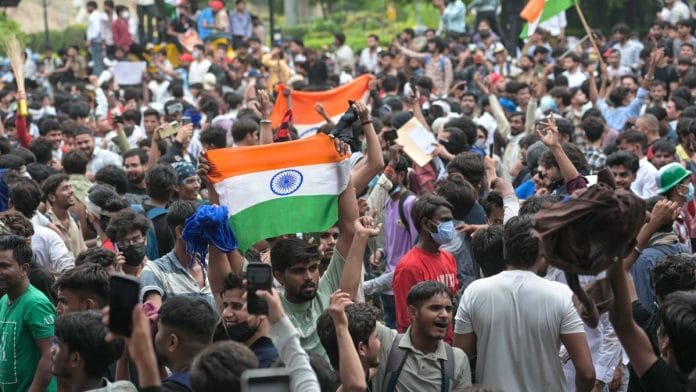
Dharmendra Pradhan’s resignation was unexpected. For 29 days, students had been protesting, and as a result, social activist Sonam Wangchuk went on a hunger strike. But then 20 July happened, and Delhi’s streets filled with a generation the government had perhaps assumed could be contained with barricades, by closing Metro stations and enough police deployment.
They assumed that fear would deter the students.
But something else had been happening simultaneously, on a terrain the BJP understands better than perhaps any other political party in India: social media.
The reverse card
For more than a decade, Prime Minister Narendra Modi and the BJP had mastered the politics of the internet. The photograph, the hashtag, the carefully produced videos, the viral clip, the direct communication that bypassed traditional media—these were not accessories to their politics. They were part of its architecture. But within a month, and more so in the past week, the algorithms began to drift away from them.
In the past two days, the PM himself tried to change the algorithm in his favour. Produced reels hoping to find a connect with Gen Z, but the damage control backfired. Almost as quickly as Modi’s videos appeared, they were being clipped, remixed, memed and turned into punchlines. Another attempt to damage control only became fresh material for content.
The PM was speaking to Gen Z through their language; Gen Z was answering back in its own language.
After all, Gen Z are not young people who grew up writing long Facebook posts or waiting for the evening news bulletin to tell them what had happened that day. They grew up with TikTok, Snapchat, Instagram, YouTube Shorts, edits, remixes and memes. They understand instinctively what previous generations had to learn professionally: how to capture attention in three seconds, how to turn an image into an argument and how to make something travel.
And BJP encountered a political opponent it could neither easily out-produce nor out-meme.
That is what made this movement particularly fascinating to watch. Its political language was not borrowed from an older generation. It did not always arrive as a speech, pamphlet or manifesto. It came as a meme, as a badly drawn placard, as a reel edited to a Bollywood song and as a police chase converted within hours into content designed to make thousands laugh.
And then the internet spilled onto the streets.
From online to offline
The same irreverence I had been watching on my phone appeared at Jantar Mantar. The street fed Instagram; Instagram sent more young people towards the street.
Gen Z has been accused repeatedly of having a short attention span. But this monsoon of 2026, they found a way of turning that very shortness into political ammunition. Thirty seconds were enough for an argument. A meme was enough to puncture pomposity. And ridicule, once decentralised among millions of phones, became almost impossible to police.
That is why Pradhan’s resignation is bigger than the departure of one minister. And it would be simplistic to credit just social media alone. But it would be equally foolish to treat what happened online as merely background noise.
Because this protest demonstrated the feedback loop of the 21st-century dissent: the street created the content, the content enlarged the street, and together they created political pressure.
Perhaps that is the larger story behind Pradhan’s resignation. Not that Instagram brought down a minister. Politics is not that simple. But that a government which had mastered the politics of virality discovered what happens when virality changes sides. For years, social media helped make Narendra Modi politically invincible. This week, a generation raised on that very social media told everybody that even an image of invincibility can be memes, mocked and made to bend.
The algorithm today has shifted. The streets have also stirred. What comes next will be fascinating to watch, because the next political battle will be fought on two fronts—the street and the internet.
Shruti Vyas is a journalist based in New Delhi. She writes on politics, international relations and current affairs. Views are personal.
(Edited by Saptak Datta)
Mr. Karthik Chandran offers sound advice. But I bet he won’t offer this advice to his ‘peaceful’ friends.
As for Ms. Shruti Vyas, the less said the better. Her contempt and disdain for Modi and hatred for Hindutva makes her blind to the actual progress seen all around the country.
Be it physical infrastructure building or improvement of tertiary medical facilities or expansion of elite higher education institutions this government has done a stellar job. Even on inclusive governance the administration has delivered big time with G-RAM-G, Ayushman, Ujjwala and a plethora of other targeted schemes.
Sure, there are flaws and lacunaes – and a lot many of them. But overall, the past 10 years were better than the 10 years of UPA. Any impartial observer would come to that conclusion. Even Mr. Shekhar Gupta grudgingly accepts this – though with a few riders.
Call me both old and old fashioned. I don’t attach too much weightage to what happens on social media. Even less on what the TV channels show. We have Shri Vir Sanghavi’s word that viewers have moved on. 2. The Jantar Mantar protests are highlighting real problems om the ground. Education. Employment. The young – many of them – see a cold, unresponsive system, not enough being done to give them a better future. Once upon a time, that was called Achhe Din.
Hope this is the point the youth turn against the religious bigot.
This man and his rather obese friend has turned our country into a fascist state.
Keep religion inside the house or place of worship. There is no need to wear them on your sleeves or rather your face!
Focus on building institutions and not temples.
Darbaaris trying to prove their Worth through forcibly ramrodded narratives. Why is this dishonest depravity quite often visible in Darbaaris?