






Ninety-one shell firms shared one mobile number.
That was the thread Central GST officers in Meerut uncovered. Within a few months, the investigation led them to 232 such shell firms, goods-less (fake) invoices worth Rs 5,842 crore, and Rs 1,048 crore in ineligible input tax credit (GST fraud) passed on to buyer firms to help them evade tax.
Earlier, the Directorate General of GST Intelligence (DGGI), the premier agency of the Government of India for investigating GST frauds, detected a beneficiary firm in Jaipur that had availed itself of ineligible credit from shell firms operating in Sonipat and Delhi through goods-less, fake invoices. During further investigation, it was found that a Ghaziabad-based resident was engaged in the creation, operation and sale of shell firms (registered with GST and having active GST Numbers—GSTINs) to pass on ineligible ITC for a commission. This individual passed on ineligible credit (GST fraud) of Rs 1,033 crore through 294 shell firms he created and received a commission of 1.25 per cent of the taxable value.
Shell firms and mule accounts as a service
The 1.25 per cent commission is what it takes to create a shell firm and obtain a GSTIN for facilitating fraudulent credit, illustrating the commercial incentive behind the fraud. The rest of the money goes to other people in the fraudulent or partially fraudulent supply chain. This commission paid by buyer firms gets them supply-chain credibility, a ready-to-use GSTIN and bank accounts through forged documents. Call it ‘GSTIN-as-a-service’, with ‘mule-account-as-a-service’ alongside. Identity papers are fraudulently taken from people promised a job, a commission or a loan, and shell firms are registered in their names without their knowledge.
Rent agreements are forged. Mule accounts are opened to route the money. Then come invoices and e-way bills to match: some for trucks that did not run, others that pad a real consignment with invented quantities, which is harder to catch. Local trade is hardest: small or short-haul movements can leave little of a verification trail.
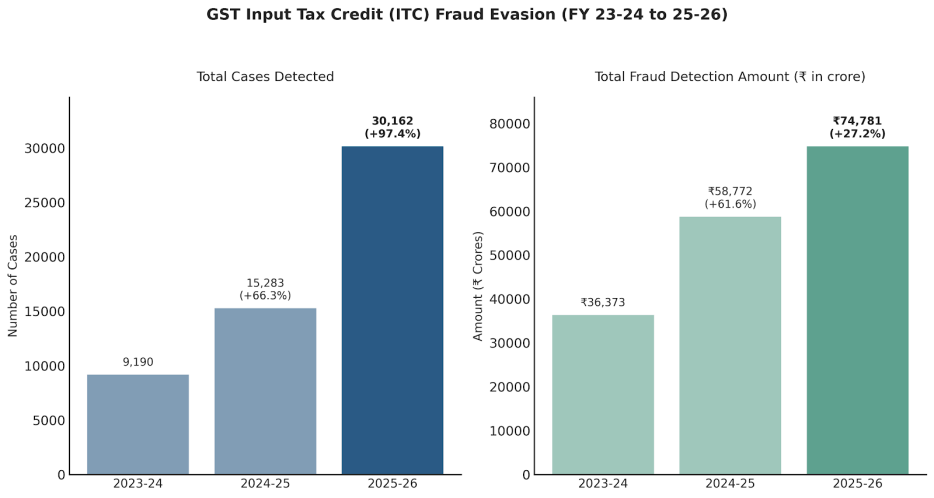
This ecosystem of ‘GSTIN-as-a-service’ with ‘mule-account-as-a-service’, where shell firms pass on fake and ineligible credit at scale, can only be described as ‘fraud-as-a-service’. The number of GST input tax credit (ITC) fraud cases detected in FY 2025-26 almost doubled to 30,162 from 15,283 in FY 2024-25, after rising 66.3 per cent from 9,190 cases in FY 2023-24. Similarly, the fraud amount detected more than doubled from Rs 36,373 crore in FY 2023-24 to Rs 74,781 crore in FY 2025-26, with a cumulative value of Rs 1.7 lakh crore.
As per data on ITC frauds unearthed by central and state GST officers, 42,140 fake firms were detected over the two years 2023-24 and 2024-25. The Union and state governments and GSTN have taken various steps to prevent fake ITC claims, including providing intelligence inputs, detecting fraudulent registration, and flagging suspicious e-way bill activity. Data on ITC frauds detected demonstrate the scale of this ‘fraud-as-a-service’ challenge and the growing reach of enforcement.
Also read: GST reforms show India’s mature federalism and citizen-centric governance
Indian economy, businesses and society pay the cost
Who pays the cost of ITC frauds and ‘fraud-as-a-service’? It is the neighbouring trader, manufacturer and genuine service provider who pays for it. A firm that buys fake credit cuts its tax bill without becoming more efficient, and then can quote below its competitor. The customer sees two “valid invoices” and picks the cheaper option. The American economist George Akerlof has shown that when buyers cannot tell quality apart, the doubtful product crowds out the sound one. The honest competitor firm loses the order, thins its margin, or learns where fake invoices are sold in the market.
Add up enough markets and the state and national economy pays. A value-added tax like GST is built to police itself, since each buyer’s credit is some seller’s declared liability. A fake firm breaks that chain at the first link, and orders and bank loans begin to follow paper turnover instead of productive capacity. It is estimated that better allocation of capital and labour could raise Indian manufacturing productivity. Fake credit pushes this productivity in the opposite direction. The exchequer pays too, in roads and courts left unbuilt and delayed public services.
The last installment falls on society. Central GST Meerut uncovered that the money was routed through money changers. DGGI Bengaluru unearthed shell firms engaged in circular trading to inflate turnover and manipulate stock-exchange prices. DGGI, as part of its commitment to proactively tackle the menace of illegal offshore betting and gaming entities, has revealed through its investigations that these entities operated through ‘mule’ bank accounts to process transactions regardless of the nature of their activity—hawala, cyber fraud, money laundering or organised crime. They legitimise illicit money flows under the guise of “legitimate” everyday commerce, turning the digital public infrastructure meant for economic growth into a conduit for organised crime.
GST-enforcement and facilitation supporting honest businesses
Set against that bill, the argument that GST enforcement is against ease of doing business now appears short-sighted. Though some of the complaints are fair and honest, they blur two things that the law keeps apart. A mismatch in returns, a disputed classification or a late filing: these are civil matters that deserve notice, reasons and quick correction. A shell firm built on a stolen PAN, or a manufacturer or service provider purchasing fake invoices through a ‘fraud-as-a-service’ mechanism, is something else, and above a certain threshold of tax evasion, it is justly an offence liable for prosecution to create deterrence. When GST enforcement against such a trader, manufacturer or service provider who benefits from a fraudulent supply chain is narrated as an inconvenience to trade, the honest businesses, markets and the society they undercut drop out of the story.
It is also important to keep these two lanes apart—ensuring honest mistakes face only civil inquiries while fraudulent acts face criminal action. GST enforcement investigations must be rooted in the realities of legitimate trade and commerce, while looking for the markers of fraud.
When this debate is seen this way, taxpayer facilitation and tax enforcement are two sides of the same coin. Facilitation makes it frictionless for an honest business to establish its legitimacy, while enforcement makes it difficult and risky for a fraudster. A tax administration owes honest businesses both of these protections, because a system that fails to punish fake firms inevitably ends up burdening real ones.
Taxpayer facilitation is making compliance easier. With GST 2.0 reforms, 96 per cent of new small and low-risk applicants are expected to receive GST registration within three days. The next step could be a single verification through geotagged video and one-time password (OTP) authentication across GSTIN, e-Way Bill and bank accounts. This not only benefits honest and small taxpayers but crucially also makes impersonation through borrowed identities harder, similar to the compulsory identity verification mandated by the UK for company directors.
If a fake identity slips through, it still needs a bank account. KYC protocols must therefore track the actual controller behind the account. Warning signs often appear at the bank long before tax returns are filed: a “small trader” receiving and draining crores in a single day, an APMC account used strictly for cash-outs, or loans secured against fake turnover. Currently, the RBI’s MuleHunter.AI and the tax department’s analytics might be tracking the same syndicate network in silos. Establishing a legal, real-time data-sharing channel between them—similar to the European Union’s Eurofisc network and beyond the routine suspicious transaction reports—would allow financial and tax authorities to transform isolated red flags into actionable, cross-agency intelligence and dismantle these syndicates in real time.
The digital tax infrastructure of GST is built exactly for this cross-agency intelligence sharing. e-Way Bills, e-Invoicing and analytical tools connect isolated records, as the Meerut case study has shown in busting shell-firm syndicates. Moving forward, Diagnostic AI can go further, testing whether identity, capacity, goods and money flows tell one consistent story, and highlighting red flags. A system-generated red flag may trigger an evidence-based inquiry. Executed well, this approach can reduce unnecessary interventions, facilitate honest businesses and concurrently check fraudsters.
The true measure of easing of doing business
Tackling the industrialised scale of ‘fraud-as-a-service’ requires more than routine audits. It demands the predictive, AI-integrated enforcement and cross-agency data sharing needed to protect the broader Indian economy and national security. Crucially, through such targeted GST enforcement, tax administration is actively defending the market share, profit margins and competitiveness of genuine enterprises from artificial price-undercutting. To weed out the fake is to protect real entrepreneurs. However, enforcement is only half of the equation.
As part of facilitation, honest businesses should be able to publicly demonstrate their legitimacy. A public compliance rating has largely remained unused. A compliance score that buyers can verify would directly solve Akerlof’s market dilemma, rewarding genuine taxpayers with market trust. There is a proven, highly successful precedent for this in cross-border trade: the World Customs Organization (WCO) enabled Authorised Economic Operator (AEO) framework, which explicitly rewards highly compliant businesses with faster clearances, reduced scrutiny and global recognition.
The syndicate behind those 91 shell firms in Meerut has been dismantled. Yet the legitimate and honest businesses that lost their competitive edge to them never knew the syndicate network existed. Through such enforcement, authorities level the playing field and reward honesty. Today, at a 1.25 per cent commission, a forged business remains cheap. True ease of doing business begins only when the compliance cost for real entrepreneurship is reduced and the expected cost of organised fraud is raised. It serves honest enterprises when fair competition and predictable procedures are protected. Targeted GST enforcement against a ‘fraud-as-a-service’ supply chain is another form of taxpayer facilitation. This defends the trust upon which market systems operate.
Avinash Pandey is a civil servant in the Indian Revenue Service (IRS) with experience in trade, technology and security. Views are personal and do not reflect that of any organisation, agency or the government. His X handle is @avipandey_.
(Edited by Prashant Dixit)