




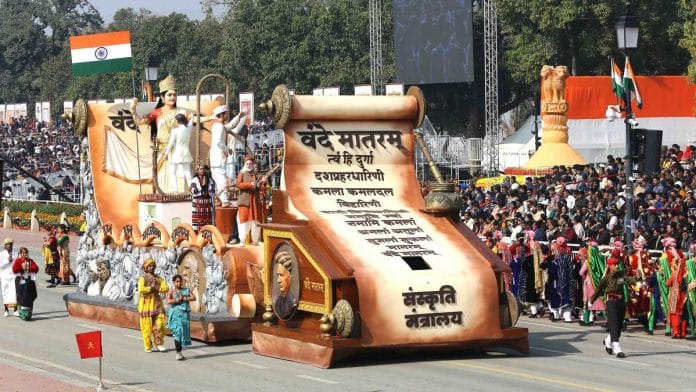

President Droupadi Murmu recently gave assent to the Prevention of Insults to National Honour (Amendment) Bill, 2026, making it an Act. It criminalises an intentional disruption of the singing of the National Anthem Jan Gana Mana and the National song Vande Mataram. It is another matter that the legislation adds only a single term, ‘National Song’, to Section 3 of the existing National Honour Act, 1971 (2005).
However, a curious discrepancy—or a big contradiction—appears as to honouring one while demeaning the other, unintentionally. All thanks to home minister Amit Shah and the home ministry.
The Vande Mataram Bill was introduced last month by the home minister(s). But six months earlier, the home ministry had already issued an ‘Immediate’ permanent order regarding the National Song to all government institutions. All schools and agencies were directed to ensure ‘strict compliance’ with it. What it had is worth pondering.
The order contains a detailed directive only regarding honour for the National Song. Its title itself declares so: “Orders relating to the National Song of India-reg”. Accordingly, the details of it mention the ‘National Song’ about 30 times, whereas the ‘National Anthem’ is mentioned only twice. Even these two mentions seem a forced necessity since it could not be ignored altogether. What meaning does it convey but that the National Anthem is optional? That only the National Song must be fully honoured, and always. What is it if not demeaning one to respect the other?
This becomes even clearer from Clause IV (2) of the order: “When the National Song and the National Anthem are sung or played, National Song will be sung or played first.” This was contrary to the prevailing National Honour Act, 1971 (2005), which stipulated that obstructing the singing of the National Anthem is punishable. To displace the National Anthem—as the order did by asking that the National Song be sung first—was to obstruct its singing. How can a ministry order undo the provision of an existing Act?
After all, the prevailing National Honour Act mentioned only the National Anthem, and called the obstruction of its singing an offence. Relegating it behind the National Song amounted to disrespect.
Indeed, even in section 3 (a) of the newly amended National Honour Act, the National Anthem comes first and the National Song second. Therefore, the home ministry’s 28 January order remains inconsistent with the Act. How does one resolve this contradiction? And what does the indecent situation say about our rulers and ‘lawmakers’, who unnecessarily pit the National Song against the National Anthem?
An ill-conceived, childish exercise
If you’re still not convinced, look at Clause III (5) of the order. It directs that “In all schools, the day’s work may begin with community singing of the National Song.” At the time this order was issued, it ran contrary to the National Honour Act, under which obstructing the singing of the National Anthem was/is punishable. The document said nothing about what should happen in lakhs of schools across the country where, for decades, the day had always begun with the National Anthem. The order only explicitly states that henceforth, the day is to begin with the National Song. Period.
It is, therefore, natural that every school would be singing the National Song since last January—that was the express order. The National Anthem may have been omitted. There is neither any sense in singing both, nor does the order direct that both be sung. Thus, in practice, the order obstructs the National Anthem. Verily an offence under the Act, even today.
One may wonder why this contradictory, ill-conceived, childish exercise? No honour is obtained by ordering. Rather, it instinctively makes one flinch. A critic can legitimately say that the government cares neither for the National Anthem nor the National Song. Rather, it seems interested only in finding a pretext to belittle Opposition leaders, especially the Congress and poor Nehru. The suspicion arises because many ruling leaders over the past year, talking of Vande Mataram, have mainly run a suo motu campaign to denounce the Congress.
Some of these leaders might have been disappointed when the Vande Mataram Bill passed in Parliament without debate. They were looking for the Opposition to say something, to which they could unleash yet another torrent of mud-slinging against Nehru. But the Opposition made itself scarce. The Bill passed without discussion. After all, which Indian would not wish to accord due respect to the National Song?
Also read: POCSO to exam scams, why do we need fast-track courts? Prosecution is India’s weak link
Patriotism or party supremacy?
The sad irony is that our rulers have nothing to say against the class of leaders that has openly opposed Vande Mataram for over 100 years, even issuing fatwas against it (indeed, it was for this reason also that Vande Mataram could not be the National Anthem itself).
No leader of the ruling establishment is seen criticising or trying to persuade and reason with those who actually denounce Vande Mataram as ‘kufr’ and idolatry. Instead, they vilify the Congress, which had been singing the song at its sessions and conferences long before these rulers were even born.
So what exactly was the purpose of the year-long ‘honour Vande Mataram’ exercise? It has had no effect whatsoever upon those who consider the National Song ‘kufr’. Meanwhile, the government unwittingly diminished the dignity of the National Anthem in its fervour for the National Song.
It is regrettable that leaders who have held virtually all power for years should display such a mean tendency. Instead of working together for the country, they are preoccupied with disparaging other parties—even unnecessarily, as in the present case—thereby weakening the national spirit and encouraging partisan acrimony.
They did not realise that, in trying to be more patriotic, their order to all government agencies ended up demeaning the National Anthem. A move not only hasty and improper, but also contrary to an existing law.
This is not patriotism but party supremacy. However well-intentioned it might be, it is harmful to Indian society, education, and culture.
Shankar Sharan is a columnist and professor of political science. He tweets @hesivh. Views are personal.
(Edited by Prasanna Bachchhav)
When we were in school, we used to start the day with National Song and end with National Anthem. I finished schooling in 1985.
May I know what exactly is it that you are smoking?
I would like to have a sample of it too.
Is it from the now famous plant from Yogendra Yadav’s garden – of which DK Singh also got accused of partaking?
Always feel a lump in the throat when the National Anthem is sung or played. Sometimes in unusual ways, by a small girl from the north east, honouring its universal spirit. Nothing else can ever come close. Like Indian Ocean.