






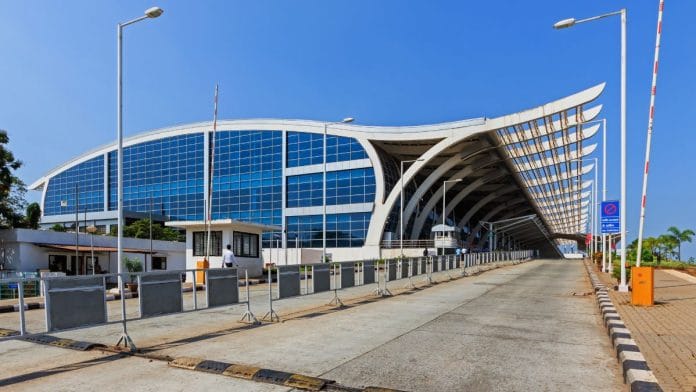



Goa’s grand old airport in Dabolim has survived so much. Portuguese colonial rule and liberation, an Indian military takeover, and six decades of operating in harmony with the Indian Navy. In December 1961, as IAF Canberra bombers targeted its runway, two civilian aircraft slipped off the apron during the night and made it to Karachi. Even the Indian babu aesthetic—best exemplified by the cartoon aquatic-themed carpet and the four heinous clowns stationed past the security area—has only burnished its sheen.
Dabolim, in other words, is no stranger to danger and absurdity. But what it hasn’t seen before—or at least not quite like this—is its survival becoming the focal point of Goan politics. Every political party in the fray is united in announcing that Dabolim is going to continue functioning as a civilian airport. Why, then, do we keep hearing that it might not keep body and soul together past Goa’s next Assembly elections, slated to be held in February 2027?
In some ways, Dabolim’s troubles began the day there was chatter about establishing another airport in Goa. Murmurs that the old airport will be decommissioned as a civilian facility have existed since the early 2000s, when Manohar International Airport (Mopa) was first conceived—so has the resistance to it.
Of late though, the rumbles restarted with the surfacing of correspondence between Mauvin Godinho—Goa’s Minister of Transport and Dabolim MLA—and the ministries of civil aviation, tourism, and defence. The letters, written between 2025 and 2026, have sought continued commercial operations at Dabolim airport. Multiple assurances to that effect from CM Pramod Sawant and Godinho have ensued, but this has lit a fire under the feet of all opposition parties in the state.
Arvind Kejriwal, AAP National Convenor, labelled the plans to convert Dabolim into a defence facility “unacceptable”. Goa Forward Party chief Vijai Sardesai, who was also one of the first to give the murmurs a specific shape, declared, “No Dabolim, no railways, no highways”, stating that all of South Goa would block railway tracks and highways if Dabolim were to be touched.
Into this atmosphere of productive uncertainty arrived a fake tweet, purportedly from South Goa MP Captain Viriato Fernandes, announcing that Dabolim would shut down within 24 hours. Fernandes, a long-time vocal supporter of Dabolim, had to publicly clarify that he had said no such thing, but the fake tweet had done its job. He blamed BJP agents for circulating misinformation.
For its part, the BJP has only further soured the sorpotel. Godinho—who, it bears repetition, is a part of the government—publicly stated that private interests were lobbying with the Navy to reclaim Dabolim’s civilian slots. “From the other side, I hear that GMR, which operates Manohar International Airport at Mopa, is putting tremendous pressure and lobbying with the Navy to take over Dabolim Airport. That is why I requested the Chief Minister to once again meet the Union Defence Minister so that the assurance comes directly from the Centre. Despite repeated assurances from me and the Chief Minister, people continue to live in fear,” he said. The minister doth protest too much?
To understand why the question lands with such force in Goa, it helps to understand what Dabolim actually is and what it has always represented.
Also read: Goa’s new favourite bar isn’t chasing tourists. It’s fiercely local
Goa’s window to the world
The airport was built by the Portuguese government in 1955, and was, since inception, a civilian airport. This is a fact that Father Eremito Rebelo, convenor of the citizen’s collective and NGO, Goans For Dabolim Only, is at pains to emphasise. After Operation Vijay in December 1961, the Indian Navy took over the airfield and commissioned it as INS Hansa. Dabolim then began to function as a civil enclave within a defence facility.
“Dabolim was Goa’s window to the world,” Captain Fernandes told me during an interview. “Other states had not opened up for tourism like Goa had. Foreigners have always come to Goa, so the tourism industry grew.” Now, Fernandes says, at least four to five lakh people—from hotel workers and taxi drivers, motorcycle pilots to “vendors selling ros omelette on the road”—have built their livelihoods around the assumption that Dabolim would keep functioning. It was, and remains, the economic spine of Goa.
Should the worst come to pass, South Goa’s tourist ecosystem will suffer disproportionately. This is not an abstract anxiety: A tourist that lands at Mopa is looking at a two to three-hour commute and a hefty taxi fare (that might even exceed the air fare) before they reach the state’s southern shores.
The argument for a second airport was not, in itself, unreasonable because traffic was increasing. “The problem started in the late 1990s,” Rebelo told me. “But there were three proposals in front of the government: Two different sites for a new airport, and the possibility of upgrading Dabolim by requesting the navy to release land. I don’t know why the government didn’t follow up on the third proposal.” Instead, a new airport came up at Mopa in North Goa’s Pernem taluka, but GFDO continues to assert that “Dabolim cannot be bartered away to compensate for a reckless and ill-conceived private venture.”
Also read: Goa’s Moira now houses a Rs 105 crore villa. New settlers are still trying to fit in
A haunted airport
It’s a sign that Dabolim’s fate is inextricably yoked to that of Mopa. Meanwhile, the Manohar International Airport has had more than its fair share of teething troubles. Built over 2,271 acres of the Barazan plateau, an ecologically sensitive area whose porous laterite rock had, for generations, sustained perennial springs. These fed the down villages and provided year-round drinking water to more than 7,000 residents. The flattening and concretisation of the plateau disrupted these natural recharge zones.
The 2022 monsoons brought flooding on a scale the area had never seen—submerging roads, fields and homes across surrounding villages. Agricultural water from the Tillari Irrigation Project was reportedly diverted to sustain the airport’s operations instead.
For those who had been protesting the airport, the outcome was not entirely unforeseeable. The Supreme Court had set aside the airport’s clearance on observing that the Environmental Impact Assessment had been perfunctory and omitted the presence of reserve forests, wetlands and mangroves. A fresh clearance was issued in 2020, this time with 119 cumulative conditions, 18 of which specifically addressed water management. These conditions too, activists argue, have been observed in a slipshod manner. Yet, the airport won a sustainability award in 2025.
And then there are the ghosts. The spirits of the village headmen who founded the area, and can no longer be appeased through rituals meant to be performed annually at a sacred grove that no longer exists. There are wailing noises at night, which means airport workers don’t want to take on night shifts. And, obviously, there are special appearances from a woman in a red saree on the runway. Although, if you ask Goans, the only malevolent spirits haunting the area are Delhi YouTubers who make videos titled “Evil Haunted Goa Airport”.
Whether or not the airport is haunted is now, almost beside the point.
Since Mopa opened, a flurry of airline departures caused a bit of a stir. Between 2023-24, Qatar Airways, Oman Air, and Air Arabia shifted their operations to Mopa. Yet, as Sardesai told me, “Several airlines are coming back to Dabolim. Mopa is not becoming viable. So the government has to do something extraordinary.”
There is also the familiar charge that Mopa serves the southern reaches of Maharashtra more than Goa. “Mopa is an economic engine, but 75 per cent of the tourists who land there go to Sindhudurg,” Fernandes told me.
Sardesai went a step further and said that even the employees at the airport are drawn from Maharashtra. “Look at the registration numbers of vehicles parked at the airport, so many of them have MH 07 plates, from Sindhdurg district of Maharashtra,” he said. “Pernem locals were promised, but not given these jobs. And now the government is trying everything to make Mopa work, by building a Formula 1 racetrack and trying to bring back Sunburn, an EDM festival! There are many people in Goa who want this airport to run for their own pecuniary reasons.”
Fernandes said that several other forces are at play in the state, including plans to handle more coal, electrification, and double tracking of the southwestern railways. All of these will affect the functioning of the two airports.
Not if Goans have their way, though. “The government feels Goans are ‘susegad’ and will take everything lying down,” Sardesai said. “A state known for tourism is being made a coal hub. AQI is reaching Delhi and Bombay standards. We are agitating because if, in 2027, Dabolim airport is shuttered, what will we do? Wait for another five years to protest?”
It is unlikely that the government will attempt something so drastic, especially during a pre-election year. Dabolim might not entirely shake off a feeling of functioning on borrowed time, but it is far more likely that both the airports will coexist in an uneasy peace. Everyone believes that.
But what happens the year after? The people of Goa—and the ghosts of Mopa—are watching with keen interest.
Karanjeet Kaur is a journalist, former editor of Arré, and a partner at TWO Design. She tweets @Kaju_Katri. Views are personal.
(Edited by Theres Sudeep)