




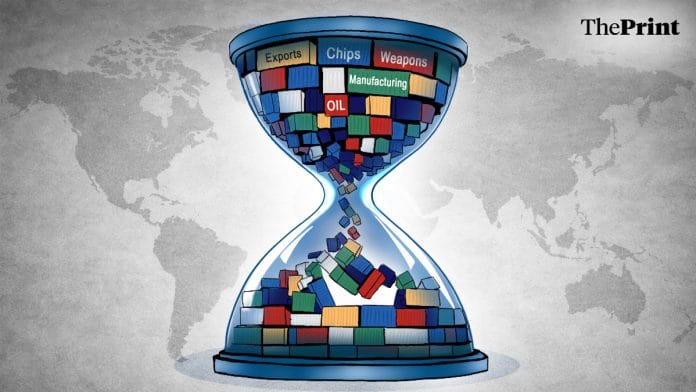

There are four broad forces currently arrayed against Western civilisation, each with distinct ideologies, methods and ultimate goals — but sharing, for now, a common direction of travel. The analytical frame most useful for understanding their combined effect is Samuel Huntington’s thesis that the deepest conflicts of the post-Cold War world would be fought not along political or ideological lines but along cultural and civilisational ones — that the velvet curtain of culture would come to replace the iron curtain of ideology.[7]
Huntington was widely dismissed at the time of writing as alarmist and remained unfashionable in the academic mainstream for decades. Events have been less kind to his critics than to him.
A complementary frame is provided by Sir John Glubb’s study of the rise and fall of empires across four thousand years of recorded history.[9] Glubb observed that great powers follow a remarkably consistent life-cycle of roughly 250 years — from the Age of Pioneers through Commerce, Affluence and Intellect to Decadence — and that the internal symptoms of decline repeat themselves with almost eerie fidelity across civilisations otherwise separated by centuries, geography and culture.
The United States, founded in 1776, is approaching that horizon. Whether this is a coincidence or a pattern is a question the following analysis cannot avoid.
I. Four forces, one direction of travel
The first force is what might best be called the cultural-activist Left, inspired by Gramsci’s insight that political power is secured through cultural hegemony before it is ever exercised through institutions.[1] If Gramsci supplied the strategy, French post-structuralism supplied the solvent. Michel Foucault argued that knowledge and power are inseparable, and that the prison, the school, the clinic and the very categories of sexuality are instruments of discipline as much as of truth.[16] His heirs in the American academy turned this into something cruder: that there is no truth, only power, and that every norm is therefore a form of domination. This force does not announce itself as revolutionary. It works instead by delegitimising the foundational structures of Western society: the nation-state, the family in its traditional form, and the social glue of shared civilisational identity. The obsessive promotion of gender ideology — particularly the erasure of biological sex — is not a marginal preoccupation. It is a battering ram aimed at one of the most elemental units of social organisation: the relationship between men, women and children. Whether every individual activist understands this larger function is irrelevant. The function is served regardless.
The second force is political Islam — not Islam as a faith, which is a more complex and varied matter, but its organised, expansionist political expression. The goal of the dominant strain within this movement is to establish a global Umma, a universal Islamic order that supersedes the nation-state. Like the cultural-activist Left, political Islam is a pan-global, universalist ideology for which national borders are, at best, inconvenient and, at worst, apostasy. Its current organised expression spans the Islamic vanguard states, their armed proxies — Hamas, Hezbollah and the Houthis — and the transnational Muslim Brotherhood network. The most militarily significant of the Islamic vanguard states harbours nuclear ambitions that represent a qualitative escalation of the threat, and the West must treat their prevention as a non-negotiable strategic priority.
One cannot, however, treat this grouping as monolithic. The leading Islamic vanguard state and Saudi Arabia are existential rivals. The Brotherhood and the revolutionary theocratic model of that vanguard state are theologically and politically distinct. The UAE and Saudi Arabia, under their current leadership, show little genuine interest in a global Umma; they are pragmatic, commercially-minded states pursuing national advantage. This nuance matters for strategy: the fault lines within political Islam are real and exploitable. But strategic nuance should not breed complacency. Circumstances change, leadership changes, and the current disposition of the commercial Gulf monarchies is not a permanent structural feature.
The third force is the unelected global class — and it requires more careful analysis than it typically receives, because its project is often mistaken for mere incompetence or idealism gone wrong. It is neither.
The unelected global class consists of financiers, technologists, international institutional figures, senior civil servants, NGO networks and the academic and media establishments that service them. What unites them is not a signed manifesto but a shared formation — the same universities, the same international conferences, the same supranational career paths — that produces convergent instincts without requiring explicit coordination. This is the Gramsci mechanism[1] operating at the elite level: hegemony secured not by force but by the manufacture of a class that cannot conceive of any other way of seeing the world. Alexis de Tocqueville, writing two centuries earlier, had identified the intermediate institutions standing between the individual and the state — family, church, voluntary association, local community — as democracy’s essential load-bearing structures.[11] The unelected global class identified them as obstacles.
The logic of their project is internally coherent, once stated plainly. Global governance by unelected expertise is simply not achievable while people retain strong, competing primary loyalties. A person whose deepest identity is rooted in family, faith, community and nation will resist absorption into a managed global order in ways that a person stripped of all those anchors will not. The project, therefore, required — not as conspiracy but as structural necessity — the progressive weakening of each layer of identity from the most intimate outward: family first, then sexual identity, then religion, then community, then nation, then civilisation itself. This is what connects phenomena that are otherwise puzzling in their simultaneity: the assault on biological sex, the deinstitutionalisation of marriage, aggressive secularism, multiculturalism deployed as erasure rather than addition, mass immigration at a pace designed to prevent integration rather than enable it, and the systematic transfer of sovereignty to supranational bodies beyond democratic recall.
The British case study is instructive because it is unusually well documented. Allister Heath, writing in The Daily Telegraph in April 2026, describes the Blairite project with unusual candour.[10] What was marketed to floating voters as a modernising centrism was, in practice, a utopian programme to socially engineer Britain into a post-national, multicultural society with a permanently enlarged state. The instruments were precisely those the structural logic above would predict: weaponised devolution to fragment national identity; immigration at a scale and pace that prevented integration; the expansion of university education to manufacture a ‘progressive class’ whose career interests aligned with the managerial state; the transfer of powers to Brussels; and the empowerment of quangocrats, activist civil servants and human rights lawyers as a permanent, unelected governing layer insulated from electoral accountability.
What makes Heath’s account analytically significant is his answer to the question posed by the crowning irony of our times: why, after the 20th century had revealed the essential futility and moral bankruptcy of totalitarian socialism, did most Western governments cheerfully re-embrace it?[10] The answer is that socialism was not the point. It was the instrument. The managerial state — vast, complex, staffed by a class with shared interests and mutual recognition — is the natural vehicle for the governance-by-expertise model that the unelected global class requires. Elected politicians, in this framework, are either true believers in the project or willing accomplices, attracted by the personal rewards — institutional prestige, post-office sinecures, international platform — that participation in the network delivers. Either way, the democratic process is retained as a legitimating facade while its substantive content is progressively hollowed out.
The economic complement to Heath’s political analysis has been provided by Ed Conway, who describes Britain’s economic model as the ‘MoneySavingExpert’ economy: an approach that optimised, over several decades, for the lowest possible consumer prices.[14] The instrument was deindustrialisation. Cheap imports, principally from China, sustained household living standards while hollowing out manufacturing capacity, export capability and the supply chains on which genuine economic security depends. Countries that made different choices — notably China and Germany — prioritised manufacturers and exporters over consumers. Britain prioritised the consumer, and called it prosperity. The model worked as long as the world remained integrated, cheap and stable. It is not built for a world where geography, supply chains and energy security have reasserted themselves.
The climate and energy transition agenda has been this class’s most consequential policy instrument. The claim is not that climate concern is manufactured. The claim is twofold. First: the Net Zero framework was imposed on Western societies without the democratic legitimacy that a transformation of this magnitude required. No government put before its electorate an honest reckoning with the costs — the hollowing out of industrial capacity, the structurally elevated energy prices, the export of heavy industry to jurisdictions operating under no equivalent constraints. The public was not persuaded. It was managed. Second: far from burdening China or constraining the West’s adversaries, this agenda disproportionately weakened Western economies while the world’s largest emitters were extended indefinite accommodation. The net effect was not merely elevated energy prices. It was the systematic transfer of industrial and processing capacity — in steel, in aluminium, in critical minerals refining, in semiconductor supply chains — from West to East, dressed in the language of planetary salvation.[2] A civilisation that cannot smelt its own ore or refine its own rare earths does not control its own future. The costs have been most visible in Europe. Germany shut down its nuclear fleet before renewables had matured enough to fill the gap, creating the energy vulnerability that the war in Ukraine then exposed.
The fourth force is China. Its operating ambition has been stated with unusual precision by former British Prime Minister Rishi Sunak: ‘President Xi’s aim is to make the world dependent on China, while China depends on no one.’[12] This is not merely a geopolitical aspiration. It is a civilisational one, rooted in a foundational conviction — far older than the Communist Party — that the existing Western-led order is itself an aberration, a temporary displacement of the natural hierarchy in which China sits at the centre, the Middle Kingdom under heaven, and all other states orbit it in varying degrees of tributary dependence. Within that tradition, autonomy at the frontier was never fully legitimate. The alternative to belonging was not equality. It was discipline.[15] China does not seek a better seat at the Western-designed table. It intends to replace the table entirely.
What makes this ambition more dangerous, not less, is the condition from which it springs. Rome, Britain and the United States entered their hegemonic moments with growing populations, financial depth and psychological confidence. China is attempting its ascent with a shrinking workforce, a heavily indebted financial system, a property overhang and a ruling elite that feels vulnerable to internal doubt. A power rising from strain rather than surplus does not rule gently. It rules defensively. The more insecure the regime feels at home, the more it will seek discipline abroad.[15]
China’s civilisational ambition is what distinguishes it fundamentally from Russia. Russia’s grievance is, at its core, a security grievance: the reversal of what its leadership regards as a historical humiliation, and — critically — the broken assurances of the post-Cold War settlement. The declassified record shows Secretary of State James Baker assuring President Gorbachev in February 1990, at the Kremlin, that a unified Germany in NATO would mean ‘no extension of NATO’s jurisdiction for forces of NATO one inch to the east.’[13] Five rounds of NATO enlargement followed. A state acting from a sense of betrayed security guarantees is not the same animal as a state pursuing civilisational supremacy. Russia wants recognition and a restored strategic perimeter — it wants back in, on terms it can accept. China wants to redesign the building.
Russia possesses an enormous landmass, vast natural resources, formidable intellectual capital and a nuclear arsenal. It is wary of political Islam — for reasons of its own internal demography and historical memory — and its alignment with China is tactical rather than strategic. Russia’s cultural and civilisational affinities lie far closer to the West than to Beijing. These are not natural long-term allies, and the West’s most significant available line of strategic separation runs precisely between them.
II. An alliance without architecture
What binds these four forces together is not a treaty, a shared ideology, or even deliberate coordination in the conventional sense. It is something more interesting and more durable: a convergence of interests around the destruction of the current Western-led order, combined with a growing architecture of operational cooperation that stops well short of a formal alliance but achieves many of the same effects. The actors named in this section are identified by name because the evidentiary record demands it; they correspond to the Islamic vanguard states and the hegemonic challenger described in the analytical sections of this paper.
The distinction between convergent interests and coordinated action is sometimes treated as though it were to dissolve the analytical question. It does not. A group of arsonists who independently decide to set fires in the same building, without ever meeting, still burn the building down. What matters analytically is not whether a signed memorandum exists, but whether the combined effect of actions is mutually reinforcing and whether any party actively facilitates the others. On both counts, the answer is demonstrably yes.
The China-Iran relationship is the most thoroughly documented example. China purchases over 80 per cent of Iran’s crude oil exports, providing the regime with the financial oxygen it needs to survive its own population’s rejection. Since 2021, the cumulative value of these purchases has exceeded $140 billion. Chinese firms — Huawei and ZTE — have built the surveillance infrastructure that allows the Iranian state to identify, track and suppress its dissidents; ZTE signed a $130 million contract in 2010 to overlay a surveillance system onto Iran’s state-managed telephone and internet networks. During the January 2026 massacres, the near-total internet shutdown was executed on infrastructure that Chinese firms constructed for precisely that purpose. The 25-year Comprehensive Strategic Partnership, committing China to $400 billion in investment across Iran’s energy, banking, telecommunications and infrastructure sectors, formalises a relationship that is structural, deliberate and mutually understood. Beijing is not a passive bystander to Iranian repression. It is its technical architect.[3]
The Houthi campaign in the Red Sea offers a further illustration. Between late 2023 and mid-2025, attacks on commercial shipping reduced Red Sea container traffic by 90 per cent, disrupting goods worth roughly one trillion dollars in the first seven months. The United States bore the principal burden of response — deploying carrier strike groups and expending precision munitions at a rate that, by mid-2025, had consumed roughly a quarter of its high-end missile interceptor inventory. Chinese-flagged ships sailed with less interference. Beijing contributed nothing to the multinational protection force, issued no condemnation, and Chinese satellite companies provided the Houthis with targeting intelligence. Every carrier group in the Gulf of Aden was absent from the Western Pacific. This is strategic arbitrage, not coincidence.[3]
The deeper logic of this architecture is material. The chokepoints being contested — the Strait of Hormuz, the Red Sea, the South China Sea — are not incidentally important. They are the arteries through which energy, food and the mineral inputs of modern industry flow. A great power that can threaten those chokepoints at will, while retaining uninterrupted access for its own trade, has converted geopolitical pressure into resource advantage without firing a single shot at its principal rival. Sunak’s formulation captures the strategy precisely: make the world dependent on China, while China depends on no one. The proxy architecture is one instrument of that design.[12] Belt and Road finance is another. It exports China’s domestic model of debt-financed infrastructure: recipient states receive ports, railways and power plants quickly, and China receives leverage, often with strategic assets as collateral. Sri Lanka’s Hambantota port, entangled through debt and eventually leased to a Chinese firm for 99 years, is the best-known case.[15]
The Covid-19 episode deserves particular attention as a case study in coordinated institutional suppression. In October 2019, the Johns Hopkins Center for Health Security convened Event 201 — a high-level simulation of a coronavirus pandemic that produced detailed preparedness recommendations.[4] Weeks later, a coronavirus pandemic began in Wuhan. China suppressed early evidence, silenced whistleblowers, and delayed notification to the WHO. None of Event 201’s recommendations was implemented by China, and European governments declined to act on them. The lab-leak hypothesis was then systematically dismissed across scientific journals, social media platforms and international health institutions simultaneously, despite the absence of a confirmed alternative origin. Multiple institutions with different ostensible interests behaved identically and in the same direction. That is a pattern. Patterns are not proofs. But in geopolitics, patterns are frequently all one has — and all one needs.
This brings us to an important epistemological point. The demand for conventional empirical proof — causal chains, documentary evidence, reproducible data — before acting on strategic intelligence is a peculiarly Western affliction and an increasingly competitive liability. The appropriate standard for strategic analysis is not the peer-reviewed paper but the intelligence assessment: the disciplined weighing of incomplete, fragmentary evidence toward a probabilistic judgment about intent and capability. By that standard, the evidence for anti-Western orchestration is substantial.
III. Fissures that will eventually break the alliance
For all their tactical convergence, the contradictions within this coalition are profound and ultimately unsustainable. The Islamist forces and China share no ideological common ground. The transnational Islamist movement’s universalist theocracy is as antithetical to China’s secular authoritarianism as it is to Western liberalism. The gender ideology promoted by parts of the cultural-activist Left is viscerally incompatible with Islamist social conservatism. Russia is historically and strategically wary of political Islam on its own southern flank. China has no intention of sharing its eventual pre-eminence with an Islamic Umma or with Western global elites, however useful those elites currently are.
These fissures will surface — and may become decisive — once the alliance has achieved its primary shared objective: the serious degradation of Western power and the Western-led order. The West’s strategic task is partly to accelerate those internal contradictions before the coalition completes its work. The most consequential of those contradictions is the one between China and Russia. Russia’s reactive revisionism — rooted in security grievance and the memory of broken assurances — is, in principle, addressable. A serious offer of genuine security accommodation, one that treats Russia as a European power with legitimate interests rather than as a permanent adversary, would test whether the China-Russia alignment is as durable as its architects claim. Squandering that possibility by treating Russia as structurally equivalent to China is a strategic error with compounding costs.
The Jewish state’s position within this picture deserves separate treatment. The cultural-activist Left and political Islam regard it with an intensity of animus that goes beyond ordinary geopolitical antagonism. It is a formidable, technically sophisticated adversary that has proved resilient against forces that vastly outnumber it. China and Russia take a different view: they respect its capability and have begun to calculate how a post-Western regional order might accommodate or co-opt its talent and technology. Their cultivation of anti-Jewish sentiment within the Christian West is therefore a strategic operation — an attempt to weaken a potential Western asset by inflaming divisions within the Western coalition itself.
IV. The West: Advanced in self-destruction
The West is not a passive victim in this story. It is, in significant measure, an active participant in its own weakening. The American journalist Walter Lippmann once observed that ‘if what is right and wrong depends on what each individual feels, then we are outside the bounds of civilization.’[6] By that measure, the condition of large parts of the Western intellectual and media establishment is cause for serious concern. And to understand why, it is worth locating the present moment within the longer historical rhythm that Glubb identified.
Glubb’s account of the Age of Decadence — the terminal phase of the imperial cycle — is distinguished by a cluster of symptoms that recur with remarkable consistency across civilisations: defensiveness replacing enterprise; materialism and frivolity displacing duty and public service; civil dissensions intensifying precisely as external threats grow; an excess of intellectualism producing endless debate but paralysing action; and the weakening of the moral foundations that had originally made greatness possible.[9] Each of these is visible in the contemporary West, and several are directly relevant to the argument this paper is making.
Consider first what Glubb called the Age of Intellect’s characteristic failure: not that thinking itself becomes corrupt, but that it becomes untethered from the will to act. ‘Endless and incessant talking,’ he wrote of declining Athens and Baghdad alike — while ‘public affairs drift from bad to worse’ and ‘the ship drifts on to the rocks.’[9] The Western media and academic establishment’s response to the Iranian theatre — eulogising a theocratic tyrant, agonising over whether calling for genocide constitutes protected speech, performing elaborate moral symmetries between the terrorist and his victim — is precisely this failure: not ignorance but the paralysis of over-sophistication, the inability to render elementary judgment because judgment itself has been delegitimised as unsophisticated.
When the Supreme Leader of the leading Islamic vanguard state died following the American-Israeli military operation, the obituaries published by some of the West’s most prominent news organisations constituted, in miniature, a near-perfect illustration. Here was a man who, across four decades in power, presided over systematic repression of his own population, funded and directed Hamas, Hezbollah and the Houthis, and called openly and repeatedly for the annihilation of the Jewish state and the United States. Yet a leading American newspaper described him as a ‘hardline cleric who made his country a regional power’ — a formulation that, as one commentator noted, is roughly equivalent to describing Hitler as a hardline nationalist.[6] Another major outlet attempted to render him avuncular, dwelling on his easy smile, his fondness for classical poetry and, with exquisite irony, classic Western novels. That a man who devoted his life to the destruction of Western civilisation should be eulogised for his appreciation of its literature apparently struck no one on the editorial staff as a tension worth addressing.
These are not mere lapses in editorial judgment. They are, as Douglas Murray has noted, the kind of moment when a flare goes up, and you see exactly where everyone is standing.[8] What the flare revealed is that significant parts of the Western media establishment have so thoroughly internalised a framework of moral equivalence that they are incapable of rendering elementary moral judgments even about a man whose crimes were documented, admitted and celebrated by his own regime. This is a Gramscian strategy carrying a Foucauldian payload, at its most advanced: not the seizure of the state, but the transformation of the cultural lenses through which the state and its adversaries are perceived. Once every judgment is suspected of being a disguised exercise of power, the refusal to judge comes to look like sophistication.
Glubb also noted what he called defensiveness: the stage at which wealthy nations begin to declare military readiness itself immoral. ‘Military aggressiveness is denounced as primitive and immoral. Civilised peoples are too proud to fight.’ He observed that this device conveniently enables the declining nation to assume an attitude of moral superiority while suppressing the underlying loss of courage.[9] The ‘Hands off Iran’ chant of Western demonstrators — people who had shortly before expressed genuine outrage over the murder of a young woman by the morality police of that same Islamic vanguard state[6] — is a near-textbook example of this mechanism. A movement that claims to speak for the oppressed aligned itself with the oppressor because the oppressor was also an adversary of American power. This is civilisational disorientation.
Perhaps the most ominous of Glubb’s observations concerns what he called civil dissensions: internal political hatreds intensifying precisely as external threats grow most severe. ‘One would have expected that when the survival of the nation became precarious, political factions would drop their rivalry and stand shoulder-to-shoulder.’ The reverse invariably occurs. His example was Byzantium, which spent its final fifty years consumed by civil war while its adversaries prepared the coup de grace.[9] The application to the contemporary United States requires no elaboration. The political polarisation that prevents the country from sustaining a coherent long-term strategy is not merely inconvenient. In Glubb’s terms, it is a symptom of an advanced stage of imperial decline, one that the West’s adversaries understand and actively cultivate.
Universities, media, significant portions of the political class and large parts of the cultural establishment have been substantially penetrated through university funding relationships, think-tank financing, media ownership, NGO networks and the revolving door between international institutions and private finance. The architecture of these influence operations within Western institutions has been documented extensively by Hamilton and Ohlberg.[5] The picture is not of crude, easily identifiable foreign interference but of something more subtle: the quiet colonisation of the institutions through which Western societies form their understanding of the world. Much of this influence requires no instruction at all. Once it is understood that investment, market access, research funding or student fees depend on good relations with Beijing, universities mute criticism, media soften coverage and firms censor themselves. Coercion disperses into anticipation. China, in this sense, is less a colonial conqueror than an engineer of dependence.[15] This is why the absence of documentary orders, so often demanded as proof, settles nothing. The eulogies for a theocratic tyrant are the visible symptom of an infection that runs considerably deeper. And in Glubb’s framework, this infection was always partly self-administered: external actors accelerate and exploit the decay, but the decay itself is endogenous.
President Trump and the MAGA movement represent the most significant organised political resistance to this process within the West. They are fighting a genuinely important battle. They are also fighting it with significant self-inflicted handicaps: personal conflicts of interest, transactional policy-making, indiscriminate anti-immigration sentiment, and a strain of Christian conservatism that has been manipulated into anti-Jewish positions. The absence of a coherent, positive governance agenda — a compelling account of what a restored Western order would actually look like — remains a strategic weakness that energy alone cannot compensate for.
Europe’s situation is, by most measures, considerably worse. In Britain, the full arc of the Blairite project — from its launch as a modernising centrism to what Heath calls its terminus in managed idiocracy[10] — provides a compressed and unusually well-documented case study in how the unelected global class operates through democratic institutions. France and Germany have at various points effectively sided with Islamist positions over those of the Jewish state. The adversarial forces described in this analysis have succeeded far more thoroughly in Europe than in North America in cultivating anti-Jewish sentiment — a reliable indicator of broader civilisational vulnerability. Glubb noted that the heroes of declining nations are always the athlete, the singer and the actor, never the statesman or the soldier.[9] The celebrity culture of contemporary Europe and the United States fits this observation with uncomfortable precision. In this theatre, the United States is fighting largely alone.
V. The dialectic of contest: Why the outcome is open
It would be analytically and strategically mistaken to read this assessment as a forecast of Western defeat. The picture is genuinely complicated, and its complication contains opportunity.
One principle that persistently shapes political contests is the energising effect of underdog status. Movements out of power tend to be sharper, more creative, more motivated and more willing to take risks than incumbents defending existing positions. In the United States today, the Right is the incumbent. The Left, having lost the presidency and found itself institutionally marginalised, will fight back with the ferocity and inventiveness that opposition generates. In Europe, the dynamic is reversed: Right-populist movements are the insurgents, energised by exclusion, producing creative political pressure that the establishment cannot easily contain.
The contest is open for a second reason. Glubb’s framework describes an incumbent in decadence. But the challenger is not at the crest of its own cycle either. China is ageing faster than any society at its income level has ever aged, its growth model faces diminishing returns, and its debt burden constrains its room for manoeuvre.[15] A decadent incumbent faces a strained challenger. Neither side holds all the cards.
Two apparently contradictory trends — the Right advancing in North America while the opposition regroups with renewed energy; nationalist backlash gathering force in Europe while Islamist political influence expands — are not logically contradictory. They are concurrent features of a genuinely open contest. The analytical error lies in the demand for linear resolution. The West retains formidable assets: institutional depth, technological innovation, legal and civic traditions that have not yet been destroyed, and populations in many countries that have not yet consented to the trajectory their institutions have been following. Whether the political will to mobilise those assets can be sustained and focused before the window closes is the defining question.
VI. What this demands
The immediate strategic priority is to prevent China from completing the regional architecture it has been constructing — most urgently in the Middle East, where the leading Islamic vanguard state has served as the central load-bearing pillar of a system designed to attrit Western strategic capacity and foreclose options for a Pacific contingency. The degradation of that architecture is not an end in itself. It is the opening condition for a reorientation of Western strategic bandwidth toward the Pacific, where the defining contest of the coming decades will be decided.
A parallel priority, less visible but equally urgent, is to test and exploit the fault line between China and Russia. Russia’s alignment with China is transactional. It is held together by shared grievance against the West, not by shared civilisational purpose. A credible offer of genuine security accommodation — one that addresses the broken assurances of 1990 rather than dismissing them — would not cost the West its principles. It would test whether Russia’s revisionism is reactive and therefore addressable, or structural and therefore permanent. The answer matters for every calculation that follows.
Beneath the strategic and cultural demands lies a more fundamental one: the recovery of material self-sufficiency. A contest that is, at its foundation, a race for real resources — energy, critical minerals, food, skilled labour — cannot be won by a coalition that has progressively outsourced its resource base in the name of planetary virtue. The China strategy Sunak describes — making the world dependent on China while China depends on no one[12] — has been advanced not only by Chinese investment and Belt and Road infrastructure but also by Western policy choices that voluntarily surrendered industrial capacity and resource-processing capability. Rebuilding that base — in energy independence, in critical-minerals supply chains, in industrial capacity, in the skilled workforce that cannot be printed or permanently imported — is not a second-order priority. It is the foundation on which every other strategic aim rests.
The deeper priority is to restore the internal coherence of the Western coalition — to reverse the penetration of its institutions, to rebuild the intellectual confidence that makes civilisational self-defence psychologically possible, and to develop a positive account of what Western order is worth defending and why. That last task may be the hardest. The forces arrayed against the West have been far more effective at articulating what they oppose than the West has been at articulating what it stands for.
Part of the answer lies in a comparison rather than a claim to virtue. The Western-led order has not been innocent. American power toppled governments, devastated societies and used financial and technological networks to coerce. But domestic pluralism allowed it, imperfectly and often belatedly, to correct itself. A successor order built on surveillance and the suppression of dissent would lack that capacity. Its mistakes would be held longer, imposed wider and defended more rigidly. It would not be a softer form of hegemony. It would be a colder one. Each successive hegemon has reached further into life than the last. Rome governed territory. Britain governed markets. The United States governed systems. The next order, if it is Chinese, will govern behaviour.[15] That is what is at stake.
A civilisation that cannot say with conviction what it stands for — that eulogises its enemies, ties itself in knots over whether calling for genocide constitutes protected speech, and cannot agree that the death of a theocratic tyrant is not cause for mourning — is already in an advanced state of strategic retreat, whatever its material statistics may suggest. Glubb reminds us that decadence is a moral and spiritual disease, not a physical one: ‘the citizens of such a nation will no longer make an effort to save themselves, because they are not convinced that anything in life is worth saving.’[9] The most urgent task, then, is not military or economic. It is the recovery of the conviction that something is worth saving.
The contest is not over. It is, in many respects, only clarifying.
—
References and sources
1. Gramsci, Antonio. Prison Notebooks [Quaderni del carcere]. Written 1929-1935. English translation edited by Joseph A. Buttigieg. Columbia University Press, 1992-2007. The concept of cultural hegemony — the means by which a ruling class secures consent rather than relying solely on coercion — is developed across multiple notebooks, particularly those dealing with intellectuals and the role of civil society.
2. International Energy Agency (IEA). Net Zero by 2050: A Roadmap for the Global Energy Sector. IEA, Paris, May 2021. Available at: https://www.iea.org/reports/net-zero-by-2050. Outlined over 400 milestones for a global transition away from fossil fuels by 2050, and served as the principal policy reference for governments pursuing Net Zero frameworks.
3. Riboua, Zineb. ‘The Iran Strike Is All About China.’ The Free Press, 1 March 2026. Available at: https://www.thefp.com. Details the financial and technological architecture of the China-Iran relationship, including oil purchase volumes, the ZTE surveillance contract, Huawei’s role in Iranian telecommunications infrastructure, the 25-year Comprehensive Strategic Partnership, the Red Sea shipping disruption data, Chinese satellite intelligence support for the Houthis, and the strategic logic of Iranian proxy warfare as a mechanism of American resource attrition.
4. Johns Hopkins Center for Health Security; World Economic Forum; Bill & Melinda Gates Foundation. Event 201: A Global Pandemic Exercise. New York, 18 October 2019. Available at: https://centerforhealthsecurity.org/our-work/tabletop-exercises/event-201-pandemic-tabletop-exercise. Simulated a novel coronavirus pandemic and produced detailed preparedness recommendations that were not subsequently implemented by the states most directly relevant to the outbreak that followed weeks later.
5. Hamilton, Clive and Ohlberg, Mareike. Hidden Hand: Exposing How the Chinese Communist Party is Reshaping the World. Oneworld Publications, London, 2020. Documents the methods by which the Chinese Communist Party has sought to penetrate and influence political institutions, universities, media organisations, think tanks, diaspora communities and business networks across Western democracies.
6. Nageswaran, Vyas. ‘We Have Left Civilization Behind.’ Substack: Vyas Nageswaran, March 2026. Available at: https://vyasnageswaran.substack.com/p/we-have-left-civilization-behind. Opens with Walter Lippmann’s observation that when right and wrong depend on individual feeling, we are outside the bounds of civilisation, applies it to Western media coverage of the death of the Supreme Leader of the Islamic Republic of Iran, invokes Huntington’s Clash of Civilizations thesis, and identifies the ‘Hands off Iran’ phenomenon as evidence of civilisational disorientation on the Western Left.
7. Huntington, Samuel P. The Clash of Civilizations and the Remaking of World Order. Simon & Schuster, New York, 1996. Huntington’s central thesis — that the dominant source of conflict in the post-Cold War world would be cultural and civilisational rather than ideological — provides the overarching analytical frame for this paper. His concept of the ‘velvet curtain of culture’ replacing the iron curtain of ideology is directly applicable to the institutional dynamics described in Section IV.
8. Murray, Douglas. On Democracies and Death Cults. Broadside Books / HarperCollins, 2024. Examines the West’s failure to respond with moral clarity to the October 7 attacks and their aftermath, and provides the observation that certain events function as flares revealing where each actor is standing.
9. Glubb, Sir John (Glubb Pasha). The Fate of Empires and Search for Survival. William Blackwood & Sons, Edinburgh, 1976. Available here. Analyses the life-cycles of eleven empires across 3,000 years of recorded history, finding that great powers follow a consistent sequence — Pioneers, Conquests, Commerce, Affluence, Intellect, Decadence — lasting approximately 250 years. His account of the Age of Decadence — defensiveness, paralysis by intellectualism, intensifying civil dissensions, celebrity culture displacing civic seriousness, and the moral and spiritual nature of decline — provides the structural frame for Section IV.
10. Heath, Allister. ‘Starmer Is Collapsing and Bringing a Broken Political System Down with Him.’ The Daily Telegraph, 22 April 2026. Reproduced and discussed in: Price Value Partners, ‘A Great Deal of Ruin,’ 25 April 2026. Available here. Heath’s analysis of the Blairite project provides the British case study for the unelected global class’s method of operating through democratic institutions — the manufacture of a ‘progressive class’ through university expansion, weaponised devolution, immigration policy as social engineering, and the transformation of triangulation from an electoral tactic into an end in itself.
11. Tocqueville, Alexis de. Democracy in America [De la democratie en Amerique]. Volume II, 1840. The argument that voluntary associations, local self-government and religious institutions are the essential load-bearing structures of democratic society — the intermediary layer standing between the individual and the centralising state — is developed principally in Part II (Chapters 4-7) and Part IV (Chapters 2-6) of Volume II. In Part IV, Tocqueville analyses what he calls soft despotism: the gradual enfeebling of citizens by a paternalistic state that secures their gratifications and watches over their fate, rendering them timid and incapable of self-government. His central warning is that democracy does not perish through violent revolution but through the slow, voluntary surrender of the intermediate institutions that make self-governance possible. The standard English translation is that of Harvey C. Mansfield and Delba Winthrop, University of Chicago Press, 2000.
12. Sunak, Rishi. ‘Without a Coalition to Counter Xi, He Will Succeed.’ The Times, October 2026. Key argument: ‘President Xi’s aim is to make the world dependent on China, while China depends on no one. Without a coalition of countries to counter it, he will succeed.’ Available here (tweet summarising article).
13. Baker, James A. III. Memorandum of Conversation with President Mikhail Gorbachev and Foreign Minister Eduard Shevardnadze. Kremlin, Moscow, 9 February 1990. Declassified and available via the US National Security Archive here. Baker stated: ‘If we maintain a presence in a Germany that is a part of NATO, there would be no extension of NATO’s jurisdiction for forces of NATO one inch to the east.’
14. Conway, Ed. ‘The MoneySavingExpert Economy.’ Substack: Ed Conway, October 2026. Available here. Argues that Britain’s economic model has optimised for the lowest possible consumer prices over several decades, underwritten by cheap imports principally from China, at the cost of manufacturing capacity, export capability and supply-chain resilience. Contrasts Britain’s consumer-first model with the manufacturer- and exporter-first models of China and Germany. Identifies AI’s high energy demands and maritime chokepoints as the central pressures on Western economies in the coming decades.
15. Foucault, Michel. Discipline and Punish: The Birth of the Prison [Surveiller et punir]. Gallimard, Paris, 1975; English translation by Alan Sheridan, Allen Lane, 1977. And The History of Sexuality, Volume 1: An Introduction [La volonte de savoir]. Gallimard, Paris, 1976; English translation by Robert Hurley, Pantheon, 1978. The first presents the prison, school, barracks and hospital as disciplinary institutions that produce docile subjects; the second treats sexuality as a historically constructed apparatus of classification and control. Together they set out the argument that knowledge and power are inseparable, which later scholars, including Judith Butler, Edward Said and the founders of intersectionality theory, extended into a general suspicion of norms, institutions and truth claims.
V Sreedharan is an economic policy researcher. Views are personal.
Editor’s note: This byline is a pseudonym. We know the writer well and only allow pseudonyms when we do so.
(Edited by Prashant Dixit)