






India’s digital public infrastructure has changed how citizens make payments, verify identity, store documents, and access public services. Aadhaar, unified payments interface, DigiLocker, and other platforms have made digital transactions routine for millions. Yet the success of these systems cannot be judged only by their scale. It must also be judged by whether citizens can use them independently, confidently, and safely.
Older citizens provide an important test. Using nationally representative data from the National Sample Survey’s (NSS) Comprehensive Modular Survey on Telecom (CMS:T), 2025, our research (Dey and Paul 2026) finds a sharp age gradient across digital access, capability, and safety. More than half of people aged 60 and above rely exclusively or partly on basic or feature phones, and only around two in five report being able to use the internet through any device. Among those who are online, many use the internet frequently. However, their ability to complete higher-stakes tasks – and to seek redress when something goes wrong – remains much weaker.
This distinction matters because essential services are increasingly organised around digital channels. If a pensioner has a phone but cannot navigate an application, complete authentication, make a payment, or report fraud, formal access has not produced meaningful inclusion. As India’s population ages, the next phase of DPI must move from expanding access to enabling safe and supported use.
The divide begins before age 60
Digital disadvantage does not appear suddenly when a person becomes a “senior citizen”. The CMS:T data show that smartphone access already declines across later-life age groups: from 57.9% among those aged 50-59 to 44.7% among people aged 60-69 and 42% among those aged 70 and above. This is far below the 88.6% recorded among adults aged 18-49.
The data also reveal an important qualification. Among people who have access to a smartphone, reported recent use is very high across age groups, 97% and above, including for the oldest group. This suggests that lack of interest is not the only explanation for lower digital participation among older people. Access to an appropriate device, control over its use, and adequate initial support also matter.
Gender inequalities sit within this age divide. Men report higher smartphone access than women across age groups, while ownership gaps can be substantial. These differences likely reflect wider inequalities in income, education, autonomy, and household control over technology. A programme that trains “the elderly” as a single group may therefore reproduce existing disadvantages unless it explicitly reaches women, rural residents, and people with lower resources.
Also Read: AI model Claude Mythos has alarmed the US. Why India must act now
A phone does not guarantee capability
The second divide concerns what people can do with digital access. Only around two in five people aged 60 and above report that they can use the internet through any device. The gap becomes especially visible for tasks that require several steps, familiarity with interfaces, confidence, and trust.
For example, 53.1% of adults aged 60 and above say they can perform online banking transactions, compared with 71.4% of adults aged 18-49. The difference is larger among men: 57% of older men report this ability compared with 81% of younger men. Older women have lower capability overall – 46%, compared with 59% among younger women. The smaller intergenerational gap among women should not be read as an advantage; it partly reflects women’s lower participation at both ages.
Regression analysis confirms that digital capability declines as age advances, even after accounting for gender, social group, religion, rural or urban residence, household internet access, consumption expenditure, and state differences. Compared with adults aged 50-59, those aged 70 and above have about 65% lower adjusted odds of being able to use the internet and about 52% lower adjusted odds of conducting online banking.
This suggests that a connectivity-first approach is insufficient. Small text, crowded screens, unfamiliar symbols, multiple authentication steps, time-limited one-time passwords, and English-dominant instructions can turn an ordinary transaction into a difficult one. When digital services become the default, these design choices can shift older people from autonomy to dependence on relatives, bank staff, agents, or strangers.
The most serious gap is safety and redress
Access without protection can create a new form of vulnerability. Among older adults who use the internet, nearly nine in 10 report doing so daily. Regular use can support communication and access to information, but it also increases exposure to phishing, fraudulent links, impersonation, misinformation, and identity theft.
The ability to respond is extremely limited. Only 8% of people aged 60 and above report knowing how to complain about cybercrime or report fraud through the cybercrime portal, compared with 24.2% among younger adults. The rate falls to 6% among older women and only 4% among older rural residents (ref: Figure 1).
These numbers point to a “digital safety gap”: use is growing faster than the ability to recognise risk, obtain help, and secure redress. Beyond financial loss, fraud can cause distress, prompt withdrawal from digital activity, and deepen dependence on family members.
Figure 1. Digital inclusion narrows from access to capability and safety among older Indians
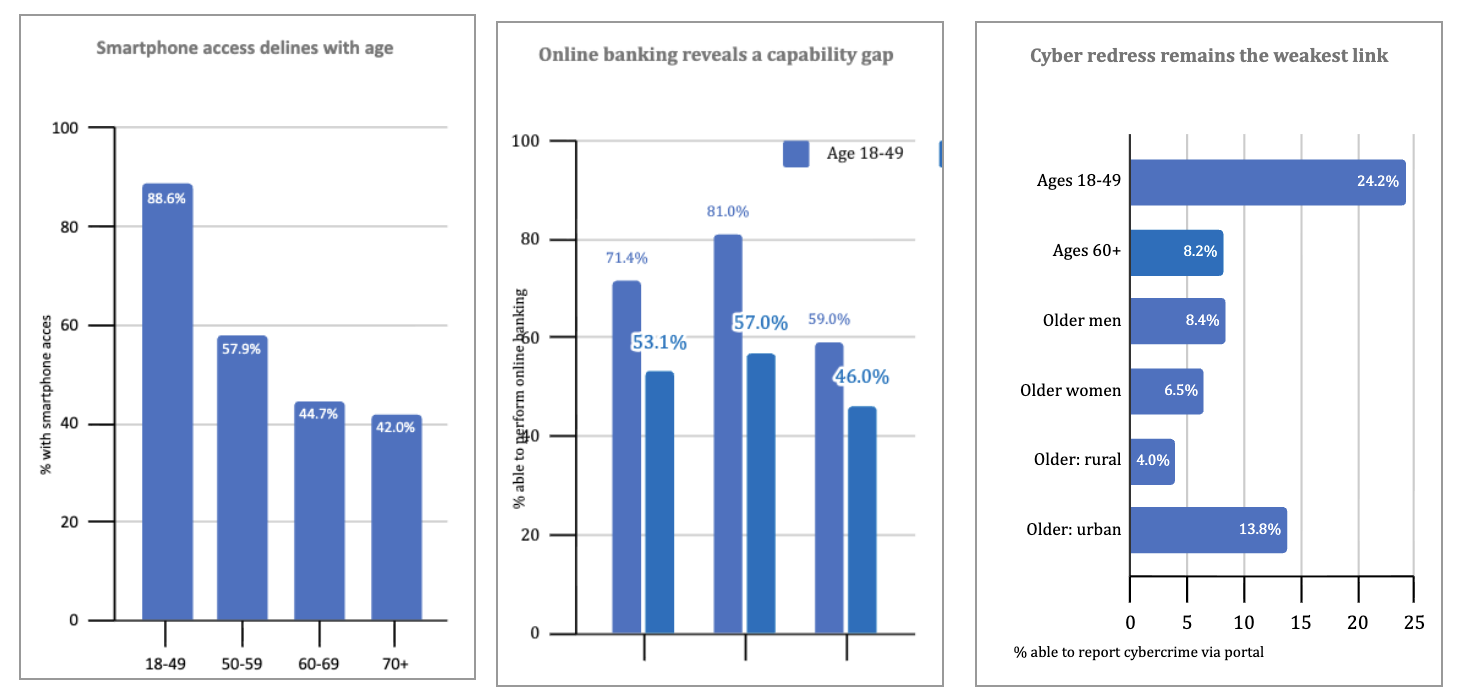
Source: Authors’ calculations based on NSS Comprehensive Modular Survey on Telecom (CMS:T). Figure developed from the findings reported in Dey and Paul (2026).
Notes: (i) Estimates are based on self-reported measures and apply NSS-provided sampling weights. (ii) Smartphone access estimates are based on individuals reporting mobile use in the last three months. (iii) Online banking ability is based on individuals who reported ability to perform transactions via computer or mobile. (iv) Cybercrime reporting ability is based on the proportion reporting ability to complain via the national cybercrime portal.
Also Read: India built the perfect welfare machine and broke the incentive to govern
Economic growth alone will not close the gap
States with higher per capita income tend, on average, to report better internet capability and smartphone ownership among older people. However, the relationship is modest and there is wide variation among states with similar income levels. Mizoram and Goa, for example, perform better on elderly internet capability than their economic position alone would predict, while some better-off states underperform.
Infrastructure and income matter, but so do literacy, local outreach, language, administrative support, and service delivery. National accessibility and safety standards must therefore be combined with state strategies responsive to local barriers.
What an age-responsive DPI should provide
First, accessibility should be built into platforms, not added later. Government and regulated service providers should test important user journeys with people in different older age groups, including those with limited literacy or no prior digital experience. Larger text, clear language, multilingual voice guidance, fewer steps, visible confirmation, longer response times, and alternatives to complex authentication can reduce avoidable exclusion.
Second, assisted access should be treated as a permanent component of digital delivery. Banks, Common Service Centres, post offices, pension offices, health facilities, and local government offices can offer trusted help desks where older users complete tasks without surrendering passwords, PINs, or control of their accounts. Assistance should preserve autonomy rather than substitute another person’s decision-making.
Third, digital literacy must include practice, not one-time awareness. Training should be organised around actual tasks – checking a pension payment, using a digital health service, making a small transaction, identifying a suspicious message, blocking an account, and reporting fraud. Repeated local sessions, peer volunteers, and family-inclusive training may be more useful than generic campaigns.
Fourth, cybercrime reporting must be simpler and more visible. A senior-friendly helpline, assisted complaint filing, multilingual options, and clear escalation pathways should connect the cybercrime system with banks, police, and senior-citizen welfare services. Reporting performance should be monitored by age, gender, and rural-urban location.
Finally, inclusion should be measured beyond enrolment and transactions. DPI monitoring should track whether older people can complete essential tasks independently, how often they require assistance, whether transactions fail, whether grievances are resolved, and whether fear of fraud discourages use. What gets measured will shape what systems are designed to deliver.
India’s digital transformation has created public infrastructure at extraordinary scale. Its next achievement should be to make that infrastructure usable and safe across the life course. For older citizens, the goal is not merely to bring them online. It is to ensure that digital systems protect their agency, dignity, and security.
Sohini Paul is Director, Health Systems and Quality of Life, at LEAD at Krea University, with nearly two decades of research experience spanning health, gender and development.
Sudeshna Dey is Research Manager, Health Systems and Quality of Life, at LEAD at Krea University, with experience in public health research, monitoring and evaluation, and research on gender, adolescent health and environmental epidemiology.
Views are personal.
This article was originally published on the Ideas for India website.