



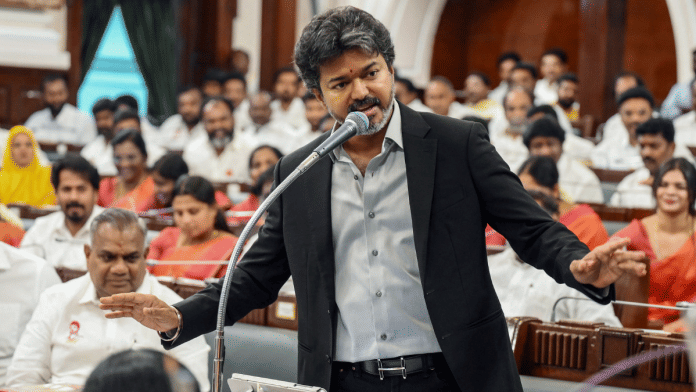

The Tamilaga Vetri Kazhagam-led minority government in Tamil Nadu, headed by Chief Minister Joseph Vijay, has completed four months in office. As the famous Tamil adage goes, “oru paanai sottrukku oru soru padam”, meaning “one grain of rice is enough to test whether the entire pot of rice is cooked”.
So, four months is sufficient time to determine the direction in which Tamil Nadu governance is moving. The same is true of the ‘governance’ decisions and actions taken by the TVK government.
As a test case, let us look at two major executive decisions and one action in the state legislature. The executive decisions relate to the abrupt cancellation of the Parandur International Airport project near Chennai and the hasty decision to build a massive Secretariat building right on Chennai beach. The third pertains to the ugly performance of the Chief Minister in the Tamil Nadu Assembly on 7 September.
The above need to be dealt with in some detail to understand the upstart nature of these decisions and actions.
Also Read: How Vijay’s ‘silent government’ strategy is more than a replay of Tamil Nadu’s movie star CMs
U-turns on ‘nature’ and development
Take the Parandur Greenfield Airport project. Vijay cancelled it because of his earlier commitment to the villagers who lost their rich farming land. Vijay had said, “I am not against development, but I oppose this airport if it comes at the cost of nature.” He pointed out that destroying natural water channels is a key reason why Chennai faces devastating floods year after year. Now in power, he has converted that commitment into state policy, citing the land’s ecological fragility and farmers’ welfare as the main reasons.
This is fine. But within days of the cancellation, his Industries Minister Keerthana announced in the State Assembly that the government was looking into ways to utilise the acquired land for industrial or other purposes. No talk about returning the 5,000-plus acres of land to nature and to the farmers to pursue farming, which is more vital than industries. The hidden agenda seems to be simple — cancel the infrastructure project under some pretext and utilise the farmland for ‘lucrative’ real estate development. And no alternative site has yet been identified for this critical infrastructure project.
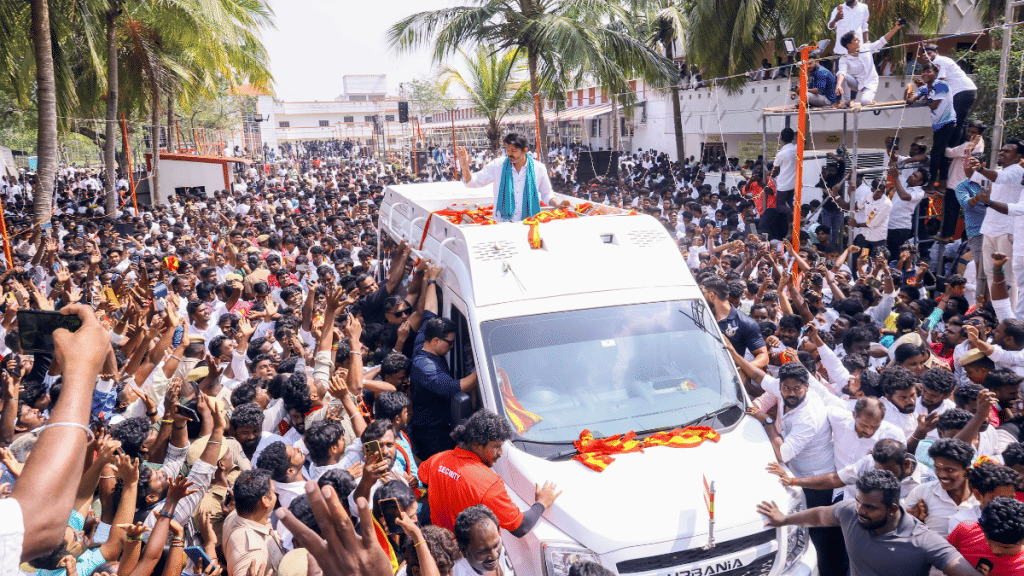
Then there is the decision to construct a massive two-million-square-foot, 15-storey new Secretariat at Pattinapakkam in Chennai. This is absurd to the core and raises serious questions under the Coastal Regulation Zone rules. The 25.55-acre site, which is with the Tamil Nadu Housing Board, is virtually on the waterfront, just a few metres from the high-tide line of the Bay of Bengal. Pattinapakkam is an extension of the famed Marina beach, with its lively and serene atmosphere. It is part of Mylapore, which is crowded and part of old Madras City, where traffic is already at a snarl.
With the threat of rising sea levels, this project would be an ecological disaster for the Chennai coast. For the large number of fisherfolk, it would be an economic and livelihood disaster. The project has drawn strong opposition from fishermen and environmental activists, who have raised concerns over its potential impact on coastal livelihoods, public access to the beach and the area’s vulnerability to climate change.
Ironically, it is said that Vijay took the decision on the advice of his astrologer that the CM’s office should face the sea, which would bring him luck and raise him to be Prime Minister. Incidentally, just across the road from this site is the super-luxury apartment owned by Joseph Vijay.
Cinema in CM chair
Vijay’s performance as Chief Minister in the State Assembly while replying to a debate on demands for grants for the police department, which he heads, was a disgrace.
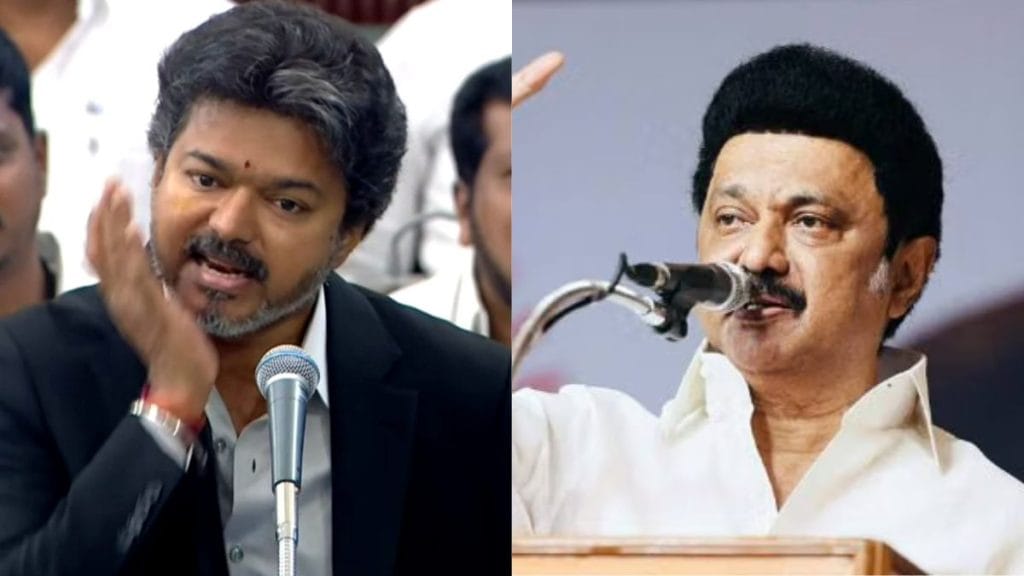
Without answering the valid questions raised by the Leader of the Opposition on the fast-degenerating law and order situation in the state, Vijay went off track and criticised the DMK for its frequent mentions of the Maintenance of Internal Security Act (MISA) from the Emergency era. He insultingly placed the palm of his right hand near his jaw. This was interpreted by many as body-shaming or as mimicking the lasting effect of former Chief Minister MK Stalin’s jaw injury during his imprisonment under MISA. Vijay also brought in irrelevant details from the Sarkaria Commission and the ED’s notice on corruption in the DMK.
The tone and tenor in which he spoke and the body language he exhibited clearly demonstrated that he is a mere cinema actor and not a Chief Minister yet. The fact that he claimed that this was “unintentional” only made things worse.
Welfarism is not governance
As far as the ‘governance’ agenda of the Vijay-led Tamil Nadu government is concerned, it is but a long list of ‘welfare freebies’. This is contained on his personal website. The list, titled ‘TVK Governing Mandate-2026’, has a long ‘Guarantee’ blueprint, of which the following have been implemented: 200 units of free electricity; Singapen Sirappu Athiradi Padai (Lion-women Safety Force); Anti-Drug Task Forces; closure of 717 TASMAC shops; expansion of free bus travel for women (Vettri Payanam); and DA hike for government employees. Many other schemes are stated to be in the pipeline.
These are at best government decisions and schemes and cannot be called governance. This aberration and confusion are taking place because the term ‘governance’ is often mixed up with ‘government’.
At the country or state level, governance is the exercise of political, economic and administrative authority in the management of multifarious affairs. Governance comprises the complex mechanisms, processes and institutions through which citizens and groups articulate their interests, mediate their differences and exercise their legal rights and obligations. Good governance is participatory, transparent and accountable. It would include the government, which is its dominant part, but transcend it by taking in the private sector and civil society.
Governance should be a joint venture
Should governance be ‘cult-centric’, ‘state-centric’ or ‘society-centred’? In a true democracy, cult-centric governance cannot be countenanced, nor can state-centric governance, which makes government all-powerful. In a democracy, as distinct from an autocracy, governance should be ‘society-centred’, wherein participation and role-playing would be as follows:
- Governments represented by the ruling establishments create a conducive political, administrative, legal and living environment. Such governments should be constituted through the process of grassroots democracy.
- The private sector, represented by trade, commerce, agriculture and industry, promotes enterprise and generates jobs and income.
- Civil society, represented by the voluntary sector, facilitates interaction by mobilising groups to participate in economic, social and political activities. It also resolves conflicts.
Such governance is a joint venture. And being a joint venture, governance should adhere to certain functional norms and principles. These include the involvement of stakeholders in the decision-making process; transparency and accountability at all governmental and societal levels; citizens’ participation in the process of social and public welfare, economic growth and development; a balanced relationship between all bodies of government and civil society; social auditing of government programmes and policies; mandatory establishment of ombudsman institutions and their fearless functioning; and an efficient and non-discriminatory judicial system.
Most important of all, there should be enough space for civil society, represented by the voluntary sector, to freely express its views and opinions on the ‘development’ agenda of governments without fear or favour.
Also Read: Vijay cancelled Parandur despite economic costs. That is what keeping a promise looks like
Cult rule in Tamil Nadu
Governance in Tamil Nadu is neither state-centric nor society-centred, but cult-centric. It is built around Joseph Vijay, who is projected as a superhero, protector of the weak, victim of vested interests, saviour of the poor and a moral alternative.
The ‘Anna’ (elder brother) narrative became central to the strategy. This was propagated through reels and memes on social media during the election campaign, which took full advantage of Vijay’s larger-than-life, cinema-centred public image of mass appeal, courage and youthful energy — depicted in fight scenes where he felled dozens of vile villains, and in clips where he devised quick fixes for complicated governance problems.
The same approach is being carried into the government which he now heads. He has consolidated this further by surrounding himself with a galaxy of advisers from the cinema and entertainment industry. Bureaucracy is playing a secondary role, with the Election Commission-appointed Chief Secretary seemingly either abdicating his role or actively participating in the cult-show.
On the positive side, Vijay is stated to have contained administrative corruption in the higher echelons. But on the negative side, he has unleashed political corruption. TVK and Joseph Vijay got elected to the Tamil Nadu State Assembly, winning 108 seats out of 234. They managed to manufacture a working majority of 118 by roping in MLAs belonging to the Indian National Congress, CPM, CPI and VCK (Viduthalai Chiruthaigal Katchi), all of whom had fought the election in alliance with the DMK, the present principal opposition party. Vijay encouraged defections from other opposition parties like the AIADMK, some of whose MLAs are now left in limbo. There are also allegations that by bowing to the wishes of the BJP-led Union government, Vijay has severely compromised Tamil identity.
Tamil Nadu is seeing a rookie entity without any administrative, political or leadership experience or track record capturing power through cinema theatrics, propaganda reels and massive abuse of social media platforms. Its leader has no knowledge of governance, and the only way he can govern is by creating an actor-centred cult ecosystem. This is precisely what Joseph Vijay is doing.
M.G. Devasahayam is a retired IAS officer and chairman of People-First. He also served in the Indian Army. He is the author of Emergency and Neo-Emergency: Who will defend Democracy? Views are personal.
(Edited by Asavari Singh)
Very true, sir. Well written.
As a vijay fan ,I hate this government so much ,your the only news channel which tells the truth thank you for that and keep it up
With the advent of Vijay and his rabble , Tamil Nadu political scene has become a circus – no dignity, no decency. Hang our heads in shame
all these points are agreed and the cult rule around joseph vijay sir is literally making tamilnadu towards a dangerous path and make the politics a dictatorship not a democratic
i don’t know i am saying things right or wrong but in my opinion it feels true to be honest
In “The Plato’s republic” book, Socrates told his students that (I can’t quote his exact sayings, but I’ll convey what he said) The diplomacy will wear down to tyranny. That’s what happening now. The system is collapsing. And there is nothing we can do about it.
Haha, , hey old man – quitc pls, can’t understand why this so called intellectual doesn’t speak a this on last five years ,
What an idiotic article! The author didn’t even know the exact acreage acquired but had the audacity to write about it. If we dig further into Devasahayam, this moron is clearly a DMK stooge.
A modern day King Canute. One can visualise him gesticulating, in full theatrical form, as an incoming spring high tide surges into the new Secretariat. The basement would flood in seconds.
This is a contested feature of land acquisition. Land is acquired – often against the owners’s wishes, although financial compensation is now much more generous than in the past – for a specific public purpose. If that purpose, construction of a world class airport for Chennai is abandoned, even more galling if the state profiteers from it, diverting it to general real estate, the owners of those priceless five thousand acres should go all the way up to the Supreme Court to get it back. Return the compensation they have received, with interest if the Ciurt decrees it.
Take a very faint interest in Tamil Nadu politics, also Bengal politics, both of which have lost tall regional leaders, but this is also my sense. A great pity, since Tamil Nadu id a successful economy, a well governed state, with a solid higher bureaucracy. Perhaps the CM, with no prior governance experience, could assemble a team of well regarded civil servants, to guide and assist him. Popularity is as fickle in politics as it is in the film industry. Something Rajesh Khanna discovered after delivering the greatest set of hits.