






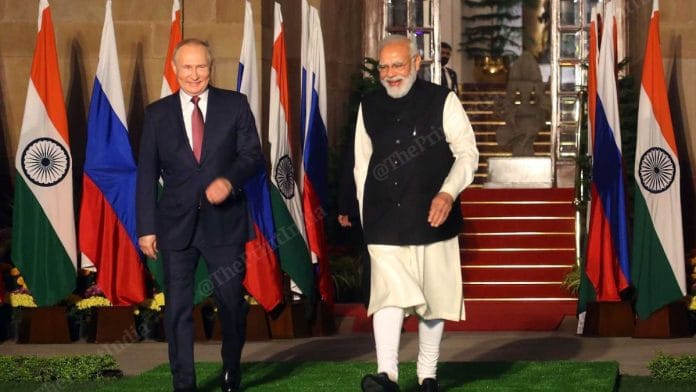



President Vladimir Putin has recently concluded a whirlwind trip to Bharat. This just-in and just-out two day visit has created ripples, not just in the global geopolitical arena, but within the boundaries of our own nation as well.
The easy camaraderie between PM Modi and President Putin has always drawn attention and has become a symbol of national independence.
The Russian leader has been facing diplomatic sanctions from the so-called Global North because of the Russia-Ukraine war, which began in 2022 post the breach of Minsk agreement, and we are battling Trump’s Tariffs; negotiations on which have made little headway. Parallelly, our LoP and the Congress President were both left off the guest list for the State Reception at the Presidential house, causing much drama. Adding to it was the invitation extended to Opposition MP and Chair of the Parliamentary Standing Committee for external affairs, Shashi Tharoor.
PM Modi “broke protocol” to greet Putin on the tarmac when he disembarked from his Ilyushin 96 Soviet-manufactured jet. He welcomed the Russian President on to Bhartiya soil with a tight hug; a “jadoo ki jhappi” from an old friend.
After all, Modi and Putin share an equation which dates back over 25 years, since then CM Modi accompanied then PM Vajpayee to Moscow in 2001. This year, 2025, also commemorates the 25th anniversary of the Declaration on Strategic Partnership between India and Russia, which was established during Putin’s first state visit to India in 2000.
The ‘carpooling’ tradition of PM Modi and President Putin, a Tianjin redux from the SCO summit in China earlier this year, continued in New Delhi as they rode together in a Toyota Fortuner. The easy camaraderie of the Russian President and the Indian PM mimicked the special nature of this long standing and time-tested relationship, which is characterised by mutual trust, respect for each other’s core national interests, strategic convergence and each other’s culture.
Also read: Hugs, car rides, but no deals—Modi-Putin meet exposes weaknesses of both countries
Walking a tightrope
As a duly elected leader of the world’s largest democracy, PM Modi has to ensure that he safeguards the interest of 1.4 billion people. Food, fertiliser and fuel are the needs of the most populated country of the world, which has only 2.4 per cent of the earth’s land mass. And in order to manage the country’s interests Modi has to engage with President Putin. Once in the fragile five, India is now part of fab five, the largest growing economies in the world. Energy sufficiency thus becomes critical and Russia is able to support these needs through fossil and nuclear fuel. Making strategic choices and sovereign decision making in the new world order is the new geopolitical mantra.
India must also balance on a diplomatic tightrope. India is “friends” with the US, while the US is close to Pakistan. India must also balance its equation with Russia, and with Europe. Russia is also close to China, which in turn is a friend of Pakistan.
A joint statement released on 5 December reads “India-Russia ties have remained resilient in the backdrop of the prevailing complex, challenging and uncertain geopolitical situation. Both sides have strived to forge a contemporary, balanced, mutually beneficial, sustainable and long-term partnership.”
India has chosen to retain a diplomatically neutral outlook on the war in Europe. Ensuring that the channels of communication with Ukraine remain open, India has not compromised its own sovereignty and interests to pander to a war that does not belong to it. The channels of communication remain open as India speaks the language of peace and bridges the gap between warring nations.
Russia also remains committed to fuelling India’s energy requirements for the ‘Make in India’ vision. Putin proclaimed that “Russia is a reliable supplier of oil, gas, coal and everything that is required for the development of India’s energy”. He also commended us on our “independent and self sufficient” foreign policy. Many experts have said that India’s purchase of Russian crude oil has kept global oil prices from skyrocketing. As traditional markets for Russian crude in Europe and the West dry up, it’s mutually beneficial for India to purchase fuel from Russia.
As we move toward our Viksit Bharat goals, we need to maneuver our goals and meet challenges of energy deficiencies. Sovereign decision making helps the interests of India, and we must learn to respect any country’s independent goals.
Also read: Putin’s India visit a lesson for Europe on how to maintain foreign ties when Trump is against it
Make in India push
Modi and Putin also touched upon trade. The target is to elevate India-Russian trade to $100 billion from $68.7 billion, by adopting the Programme for the Development of Strategic Areas of India-Russian Economic Cooperation. Trade balance is heavily biased towards Russia.
The idea is to move beyond traditional commodities and toward manufacturing, automobiles, pharmaceuticals and also export of Indian potatoes, pomegranates and processed foods. Negotiations towards FTAs will make Indian goods more competitive in Eurasian markets of Russia, Belarus, Kyrgyzstan, Armenia and Kazakhstan, thus potentially opening up new markets for Indian goods.
A critical mineral cooperation is being aimed for, which recognises the importance of critical minerals and rare earths, and identifies the recycling technologies for these as advanced manufacturing for emerging technologies. An innovation and technology collaboration is being strengthened under a “Roadmap for Science, Technology & Innovation Cooperation”. Opportunities for start-ups, SMEs through joint R&D, knowledge exchange and capacity building are being explored. “It was noted with satisfaction that both sides are actively exploring new avenues for cooperation while further strengthening cooperation in the traditional areas,” read the joint statement.
The Russian-made S-400 missile systems played a very crucial role during Operation Sindoor and were the launching pad for the Brahmos missile. India is exploring the purchase of the S-500 missile systems to meet its security requirements. In a boost to “Make in India”, Modi and Putin have agreed to set up joint ventures to manufacture spare parts for Russian made military equipment. Further, defence minister Rajnath Singh and his Russian counterpart also discussed the purchase of military equipment and expanding defense cooperation.
President Putin’s visit is indeed historic and has resulted in a reiteration of bilateral ties. Modi has also leveraged his personal equation with the Russian leader to ensure that the visit was a success at various levels, diplomatic, strategic and from a Make in India perspective. During the visit, the leaders underscored that, “as major powers with shared responsibilities, this important relationship continues to be an anchor of global peace and stability that should be ensured upon the basis of equal and indivisible security.”
The conclusion of Putin’s visit coincided with the inauguration of Nikas Safronov’s exhibition at the Lalit Kala Academy, which I was privileged to attend. Safronov is a renowned Russian artist whose works depict a deep understanding of India’s rich cultural heritage. His work includes visions of the deities and is inspired by India’s religious imagery including inspiration from depictions of Lord Shiva and Brahma.
Art is a talent that knows no bounds, a creation born from the soul, where artists pour their heart and emotions into their work. Today, I had the incredible opportunity to meet Nikas Safronov, National Artist of Russia. It was truly inspiring to experience his art. Do visit the… pic.twitter.com/aRRmrFLwaq
— Meenakashi Lekhi (@M_Lekhi) December 7, 2025
Nearly 100 works by the Russian Artist are on display, including works in his signature ‘Dream Vision’ style, which ostensibly depict the half-blurred impressions of pre-conscious dreams. I urge you not to miss this cultural treat which is on display till 21 December.
Meenakashi Lekhi is a BJP leader, lawyer and social activist. Her X handle is @M_Lekhi. Views are personal.
(Edited by Theres Sudeep)