









The world has long moved past 2025, yet China and Pakistan remain mired in celebrating a “victory” that, by most credible accounts, never truly occurred. It has now been repackaged as a marketing tool for Chinese fighter jets. Beneath the choreographed fanfare lies a familiar and enduring obsession: India. For decades, India has been the unspoken centrepiece of China–Pakistan defence theatrics, a fixation that refuses to fade.
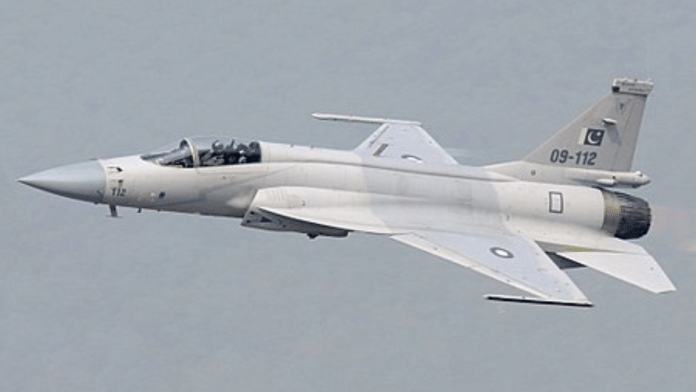
Last year’s India-Pakistan confrontation has been ingeniously repurposed on the Chinese internet, transforming the jointly developed JF-17 Thunder, a lightweight, multirole combat aircraft, into a glossy commercial narrative. Chinese state media and online commentary are amplifying Pakistan’s version of events, a pattern that was also evident during Operation Sindoor in May last year.
Headlines such as “Countries rushing to buy Chinese fighters from Pakistan” and “Pakistan’s prestige has skyrocketed” are circulated widely, while the hashtag ‘JF-17 Thunder’ has become a hard currency in the international market and is being aggressively pushed on Weibo.
Chinese internet and the manufacturing of credibility
Chinese commentators have exaggerated Pakistan’s role, portraying it as a strategic actor rather than a geopolitical pawn, based on its military-industrial ties with China. The JF-17 is the primary prop in this narrative. In curated accounts of the May 2025 clash, a JF-17 Thunder Block III is claimed to have locked onto an Indian Rafale, fired a PL-15E, and disrupted India’s S-400. Priced at $25–30 million, one-eighth the cost of a Rafale, it is presented as combat-tested, affordable, and politically unconstrained. On Weibo, a post hyped it as the “AK-47 of fighter jets”, recast from a weak platform into a supposed global success and export solution for smaller air forces, claims that reflect exaggeration more than reality.
This narrative is framed as serving multiple interests: Pakistan gains foreign exchange, China expands its market, buyers secure cost-effective capability, and financiers such as Saudi Arabia consolidate influence. Pakistan’s rise, from “doing the dirty work” for the West to a “senior distributor” for China’s defence industry, is held up as proof that a smaller state can leverage geography and partnerships to reshape its global role.
A commentator attributed the supposed surge in demand for Chinese arms to three factors: Pakistan’s self-declared May 2025 victory, rising geopolitical uncertainty, and China’s price advantage.
Yet India remains at the core of these discussions. A Chinese commentator contrasted Pakistan’s largely imagined rise from a buyer to a co-developer and exporter with India’s procurement-heavy model, portraying reliance on expensive foreign systems as stifling domestic innovation. China benefits strategically where every export routed through Pakistan secures orders for Chinese engines, avionics, radars, and missiles while shielding Beijing from direct geopolitical exposure. The narrative frames Pakistan’s planning as yielding dividends, while India is depicted as paying steep “tuition” without building real capability, a line consistent with years of Chinese discourse emphasising Beijing’s unwavering support for Islamabad to counter India.
Rebranding limitation as logic
Another line of commentary reframes limitation as strategy. Debates over the JF-17’s “generation”, a Chinese aerospace commentator notes, miss the point. According to his view, the aircraft is not meant to rival high-end Western fighters but to fill the gap between costly modern jets and ageing legacy platforms. Its appeal lies in affordability, sustainability, and minimal political strings.
From this perspective, the India–Pakistan clash did not alter the Thunder’s role but it merely accelerated interest and smoothed negotiations with countries that were previously hesitant. Within the China–Pakistan export framework, which diffuses political risk and reduces friction, the JF-17 Block III is presented as a practical compromise for states balancing cost, capability, and autonomy.
China provides technology and oversight, while Pakistan manages sales, selectively offering the aircraft to friendly states and linking transfers to diplomatic alignment. Proponents in China argue that the Thunder’s success demonstrates how developing countries can compete in advanced military technology, diversify a market long dominated by the United States, Russia, and Europe, and gain both foreign exchange and strategic leverage.
Some Chinese commentary, however, tempers the enthusiasm. Pakistan’s $13 billion defence export target is widely acknowledged as aspirational. Heavy dependence on China for engines and avionics, combined with limited industrial capacity, ensures that Beijing remains the primary beneficiary. Even so, defence exports are seen as offering Pakistan short-term economic relief and geopolitical leverage, though whether such “military-driven prosperity” can address structural economic challenges remains doubtful.
Also read: Pakistan se azaadi. Grow up India, stop giving it prime real estate in your psyche
The reality
Taken together, these narratives reveal China’s growing desperation to secure a larger share of the global arms market, a push intensified as systems such as BrahMos gain regional traction and buyers. Pakistan functions as the conduit through which Beijing markets “combat-tested” and politically manageable alternatives to Western platforms. Yet it remains unclear whether this carefully curated image resonates beyond a tightly controlled echo chamber.
In reality, Pakistan’s autonomy is largely illusory, and the Thunder’s battlefield reputation is inflated without credible evidence. While the aircraft may appeal to cost-conscious buyers, claims of decisive impact or market transformation remain unsubstantiated. Geopolitical considerations do not automatically tilt in favour of Chinese systems, and price competitiveness cannot conceal long-term operational and strategic limitations.
Pakistan has not escaped its pawn status. It may no longer serve Western interests, but it has firmly assumed the role of a Chinese proxy. Its JF-17 “success” narrative reflects Beijing’s ambitions far more than any genuine expansion of Islamabad’s autonomy or influence.
Sana Hashmi is a fellow at the Taiwan-Asia Exchange Foundation. She tweets @sanahashmi1. Views are personal.
(Edited by Aamaan Alam Khan)
Is anybody buying Chinese logic?