




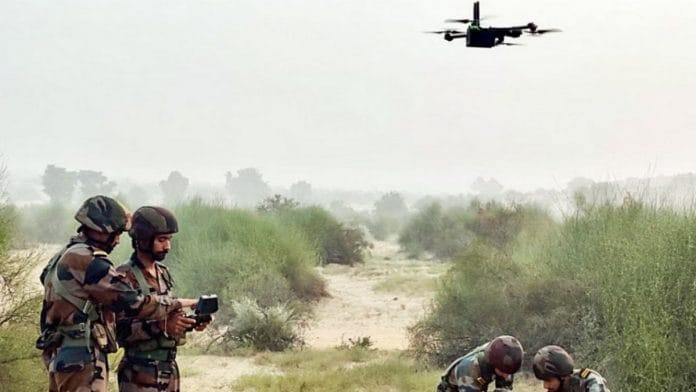

The drone revolution has entered a new phase. Three major developments in September-October, along with a host of minor ones in recent times, offer important lessons on drone warfare for India.
First, Ukraine’s Operation Vivaldi has demonstrated that offensive manoeuvre remains possible even on a battlefield saturated with drones. Second, US Defence Secretary Pete Hegseth has announced a four-star Autonomous Warfare Command (AutoWarCom) and a separate initiative, Project Meridian, to rethink future warfare with the participation of technology entrepreneurs, including Elon Musk and Palmer Luckey. Ukraine’s battlefield command and control and drone operations were seriously impacted by technological restrictions placed by SpaceX’s military-grade Starshield satellite communications service, exposing the vulnerability of military operations to decisions made by foreign technology providers.
Unmanned Ground Vehicles (UGVs) for fighting and logistics are no longer a novelty. Last week, Ukraine demonstrated the evacuation of a wounded soldier by a heavy-lift drone. On 23 October at NDTV’s World Summit, General David Petraeus (Retd), a ringside observer of the Ukraine War, said that drones have brought about the most profound changes in warfare. In the near future, he added, these changes would get magnified with the emergence of autonomous systems. Militaries require institutional change or transformation and not merely modernisation.
These are not isolated developments. Together, they point to a fundamental transformation in how armed forces must think, organise, equip, train, fight, and sustain themselves. For India, the uncomfortable question is whether we are preparing for this transformation or merely modernising with another force multiplier in the form of drones.
Operation Vivaldi: Manoeuvre is not dead
Operation Vivaldi is perhaps the most consequential recent demonstration of the relationship between drones and conventional warfare.
In its counter-offensive in the Donbas, Ukraine claims to have recaptured 277 square kilometres and 16 settlements, blunting a Russian effort to threaten its defensive strongholds. The operation reportedly involved months of preparation and sustained fighting under persistent Russian drone surveillance and attack. Ukrainian casualty claims and the full extent of battlefield gains require caution, but the reported territorial advances have also been acknowledged in independent battlefield assessments.
The significance is not simply that Ukraine used drones successfully. Both sides have employed drones extensively for reconnaissance, target acquisition, strike and counter-drone operations. The important lesson is that drones have not made offensive operations impossible. They have made them substantially more difficult, demanding, and dependent on careful preparation.
Since 2023, persistent drones, electronic warfare, mines, and rapid sensor-to-shooter cycles have made offensive action in Ukraine slower, more visible, and more costly. With the exception of Ukraine’s Kursk offensive in August 2024—the test bed for Operation Vivaldi, albeit in a drone environment of much lesser intensity—the front resembled the trenches of the First World War. The battlefield has become transparent to a degree that would have been unimaginable a decade ago. Small drones can detect movement, identify firing positions, direct artillery and attack vehicles, and individual soldiers. A force attempting to concentrate for an assault risks being detected and engaged before it reaches its objective.
The answer, however, is not to abandon manoeuvre or conclude that existing combined arms are obsolete. It is to change how they operate. At the tactical level, the drones became the predominant arm (wing/form?) of combined arms. The emerging pattern was to contact and shape the Russian drone reconnaissance-strike system in depth, establish local counter-UAS and electronic-warfare protection bubbles, use unmanned ground systems for the most exposed tasks, and keep the manned force within the period for which those functions could be sustained. In a nutshell, persistent networked robotic overwatch (drones and counter-UAS) has to be maintained over the manoeuvre force. Drones can destroy targets, disrupt logistics, and impose unacceptable costs. They cannot independently hold territory, control populations, or deliver a political outcome.
The most important lesson for the Indian Army is that drones must not be treated as an add-on weapon system/force multiplier, but must be integrated as a key part of the Army’s combined arms. Establishment of drone superiority is the sine qua non for future offensive manoeuvre or even managing kinetic confrontations along the Line of Control or the Line of Actual Control.
Also read: India’s tri-service logistics push must learn from how Ukrainian drones humbled NATO forces
America creates an Autonomous Warfare Command
On 30 September, Hegseth announced the proposed Autonomous Warfare Command, a four-star functional combatant command intended to scale autonomous and robotic capabilities across the US joint force. It is planned to become operational by October 2027, and its remit is expected to include drones, artificial intelligence (AI), and command-and-control systems. The Pentagon has proposed a $74 billion budget for drone and counter-drone technology.
The announcement was accompanied by Project Meridian, a separate initiative involving Musk, Anduril founder Luckey, and former US House Speaker Newt Gingrich. The group has been tasked with examining future battlefields and recommending technologies and solutions for rapid development, testing, and fielding.
The significance lies less in the creation of another headquarters than in the recognition that autonomous warfare requires institutional ownership.
Conventional defence procurement is built around long acquisition cycles, detailed specifications, trials, and relatively small numbers of expensive platforms. The drone battlefield, on the other hand, demands rapid experimentation, inexpensive mass production, continuous software upgrades, adaptation to electronic warfare, and the ability to replace systems destroyed in combat.
A drone that is effective today may become vulnerable tomorrow. Frequencies are jammed, navigation signals disrupted, control links intercepted, and software countermeasures rapidly developed. The answer is not to wait for the next General Staff Qualitative Requirement or GSQR-driven procurement cycle. It is to learn from battlefield feedback and modify equipment and tactics continuously.
The US initiative also recognises that the military cannot develop every relevant technology internally. It must draw on commercial innovation, software expertise, AI, robotics, and industrial production. The challenge is to translate these capabilities into reliable military systems without allowing commercial priorities to dictate operational requirements.
India must absorb this institutional lesson. We have capable public-sector establishments, private defence companies, startups, academic institutions, and a large technology workforce. Yet, these capabilities do not automatically combine into an effective military innovation ecosystem. The missing link is an empowered organisation that connects all stakeholders—the Services, operational formations, research institutions, industry, and procurement authorities—and remains accountable for delivering battlefield capability.
Starshield: The danger of technological dependence
The most strategically significant development may be the restriction of Ukraine’s access to Starshield. The distinction between external technology and sovereign military capability has suddenly become much more than an academic debate.
Modern drone warfare increasingly depends on communications networks connecting sensors, operators, commanders, and weapons. Satellite connectivity can extend control beyond the line of sight and help sustain operations over large areas. But if access depends on a private provider, foreign government, or external policy decision, an adversary’s technological vulnerability may become a political vulnerability.
The lesson for India is that critical military functions must never depend on a single external provider without credible alternatives.
India needs secure, resilient military communications, indigenous satellite and terrestrial networks, interoperable terminals, alternative navigation systems, and the ability to operate when connectivity is degraded or denied. Drone systems must also be designed to retain useful functionality when satellite navigation or remote control becomes unavailable, within appropriate safety and operational constraints. Redundancy is not wasteful duplication when the alternative is losing the ability to fight.
Also read: Theatre commands aren’t the answer to India’s military problem. Joint planning is
Lessons for India
The ‘Defence Forces Vision 2047’ provides the larger framework for India’s military transformation, including the proposed tri-service Drone Force. The challenge is to translate this vision into an operational capability rather than another long-term aspiration.
First, establish a tri-service Unmanned Systems Forces Command under the CDS. Going beyond a conventional drone force, this should integrate aerial, ground, surface, and underwater unmanned systems, robotics, and AI. It must develop strategic and operational-level capabilities while providing an umbrella for tactical operations by the three Services and Theatre Commands. The principle should be centralised capability development, joint operational coordination, and decentralised tactical employment. The command must have dedicated forces, funding, and clear accountability.
Second, reform procurement and build industrial mass. The conventional acquisition cycle cannot keep pace with rapidly evolving drone technology. India needs accelerated procurement, competitive field trials, modular designs, and continuous upgrades based on battlefield feedback. Indigenous production must extend beyond assembly to critical components, software, communications, and navigation systems. Equally, unmanned forces must be designed to operate in degraded communications environments, with redundant networks and alternatives to satellite navigation.
Third, institutionalise battlefield adaptation. Lessons from Ukraine must translate rapidly into doctrine, training, force structures, and equipment. Every formation must be able to employ drones, counter enemy unmanned systems, and sustain operations under persistent surveillance and electronic warfare. The unmanned systems ‘arm’ must become an integral part of combined arms and not become a technological substitute for combined-arms warfare.
‘Vision 2047’ must therefore be backed by political ownership, measurable milestones, and periodic audits. The proposed Unmanned Systems Forces Command should be a central instrument of this transformation, with progress assessed against operational capability rather than the number of systems acquired.
The real test of Vision 2047
The drone is only one component of a larger combat ecosystem. Success on today’s battlefield depends on integrating autonomous systems with conventional forces, producing affordable mass, ensuring technological resilience, and adapting faster than the adversary.
India’s ‘Armed Forces Vision 2047’ must move beyond aspirations to organisational and operational change. A properly empowered Unmanned Systems Forces Command could provide the institutional impetus, provided it is not reduced to another headquarters or allowed to fragment combined-arms warfare.
The ultimate test is not how many drones India acquires by 2047, but whether, in the next five years, its armed forces can demonstrate the ability to fight, manoeuvre, and sustain operations against a technologically capable adversary in a battlefield dominated by persistent surveillance, autonomous systems, and electronic warfare.
Lt Gen H S Panag PVSM, AVSM (R) served in the Indian Army for 40 years. He was GOC in C Northern Command and Central Command. Post-retirement, he was Member of Armed Forces Tribunal. Views are personal.
(Edited by Prasanna Bachchhav)