









We remember so many across India who stood by us—emotionally, physically, materially—in West Bengal, Tripura, other parts of the North-East, and beyond. We remember so much of support and succour provided to the young Mukti Bahini Force Commanders in India,” said Riaz Hamidullah, Bangladesh High Commissioner to India, at their Independence Day and National Day reception celebrated on 26 March.
The audience applauded, and what seemed to be the strongest historical connection—ignored during former Chief Advisor Muhammad Yunus’s 18-month regime—seemed to have returned.
The acknowledgement of the shared history and valour of the two sides in fighting the Pakistani forces in the 1971 War of Independence came a day after Prime Minister Tarique Rahman, in his message on 25 March, marking Genocide Day, called out Pakistan, adding, “In the history of freedom-loving Bangladesh, 25 March 1971 remains one of the most disgraceful and brutal days. On that dark night, the Pakistani occupation forces carried out one of the most heinous genocides in history against the unarmed people of Bangladesh.”
Two messages, one reading: Dhaka has pressed the reset button in ties with Delhi, which were damaged and looked beyond repair during Yunus’s tenure in the interim government.
Yunus touched on sensitive and threatening aspects of bilateral ties, including the issue of opening to Pakistan, referring to India’s Northeast region without prefixing India, and the question of the extradition of exiled leader Sheikh Hasina. Not too difficult to guess that Yunus was not an elected leader, driven by an agenda of hyphenating India with Hasina, and who blurred the line between personal and diplomatic endeavour.
Now, since Rahman entered office, his efforts towards de-Yunusification of the foreign policy have two key messages for India—sensitivity and engagement. And, India needs to open up.
Bangladesh FM’s forthcoming visit
In a major diplomatic re-connect, the newly appointed Foreign Minister of Bangladesh, Kahlilur Rahman, is expected to land in India in April. This will be the first high-level outreach since Rahman took office in February. At the top of the agenda would be to build confidence measures that may have been at the lowest, followed by discussing renewing the Ganga Waters Treaty—a 30-year bilateral agreement signed in December 1996—which is scheduled to expire in December this year.
The third item on the agenda could well be the issue of visa issuance for Bangladeshi visitors to India, which, in Dhaka’s view, remains quiet. Dhaka affirms that while it has ‘opened up’ and is fully engaging with India, the corresponding signal from Delhi is perceived as ‘insufficient’. This gap signals how Bangladeshis interpret India’s stance on visas and broader openness.
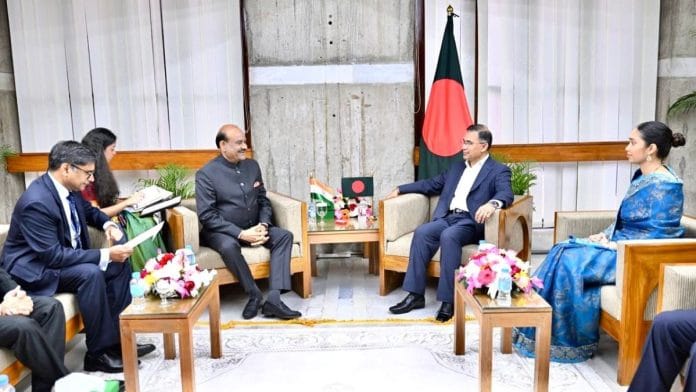
Also, since the visit of Speaker of the Lok Sabha, Om Birla, to Dhaka to attend the oath-taking ceremony of Rahman, visa services were reportedly ‘quietly opened’ on a bright sunny day. However, a public announcement was missing, meaning not many in Bangladesh were aware of the change, raising questions about why Delhi is keeping it low-key.
For Dhaka, visas for Bangladeshis are now a political and psychological signal, not just a consular procedure, and Bangladesh wants immediate warmth and openness on visas first. If India were concerned about the brewing negativity towards Delhi in Bangladesh, Bangladesh would remain concerned about an unwelcoming reception in India—a direct result of Yunus’s hyper-nationalistic and narrow foreign policy.
As two societies with common cultures and a shared colonial heritage, visas are a major entry ticket for Bangladeshis not just to connect with relatives on the other side, but also to avail advanced medical services, educational opportunities, etc. The visiting minister might well raise the visa issue.
Also read: Delhi is keeping Dhaka’s security concerns in mind. Tarique Rahman should remember this
What can help?
First, shedding the notion of hopelessness in the bilateral ties. Dhaka has been sensitive to India’s concerns under PM Rahman’s watch, and if Delhi opens up, it might help. While political goodwill and people’s warmth would take time to bear fruit, the economic channels must be activated through trade, investment, and wider economic integration.
Second, there are diplomatic dilemmas on both sides: Dhaka renews its demand for Hasina’s extradition, and Delhi repeats her presence as a ‘guest’. The two sides need to have learned to ignore the chatter around it, but how far Dhaka goes with the extradition demand would still matter to the relationship, because Rahman’s Bangladesh Nationalist Party (BNP) will face that question politically in parliament.
Third, BNP should be seen in its newer avatar, not the same as it was in the past. It’s not just the leadership that has changed in BNP; its openness to Delhi has also been sensitive and receptive. And for all good reasons, this is the first time India has a welcoming BNP ready to work with Delhi, as opposed to the past.
Isn’t it good news? Just a few weeks ago, BNP, while congratulating Nepal’s newly elected Prime Minister Balen Shah, tweeted a congratulatory message featuring Nepal’s controversial map, which was quickly deleted after going viral in India, and then posted a new poster featuring Nepal’s flag. This may be a digital loop, but the intent is clearly reflected.
To conclude, despite too many moving parts in the relationship, the forthcoming visit of the Bangladeshi Foreign Minister would help shape the bilateral ties, with a major possibility of Delhi engaging.
Rishi Gupta is a commentator on global strategic affairs. Views are personal.
(Edited by Saptak Datta)