




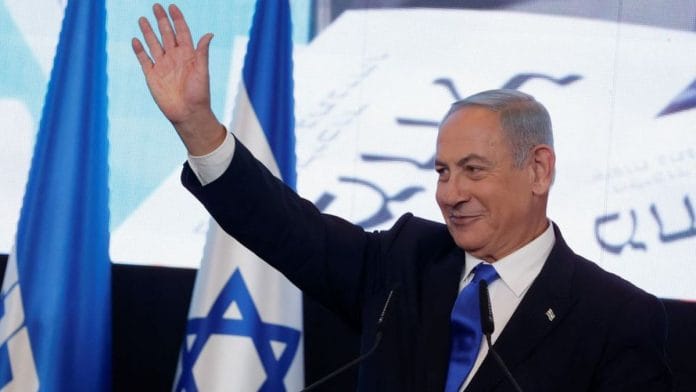

Benjamin Netanyahu’s Likud party has encapsulated the stakes of the upcoming election in a stark three-word slogan: “Yamin o Falastin (Right or Palestine)”. Israel’s Right has long sought to tar its opponents with the brush of Palestinian sympathy, but this time it has played its strongest hand on the issue. The message to voters is deliberately uncompromising, framing the contest as a binary choice between returning the Right-wing incumbent to office or allowing an opposition-led coalition to pave the way for a sovereign Palestinian state.
That statehood should feature so prominently in the campaign marks a striking reversal in Israeli political calculations. For more than a decade, mainstream candidates largely ignored the Palestinian question; even those who privately suspected the issue would eventually resurface were convinced it held no traction with an indifferent electorate, dismissing it as a redundant topic that no longer warranted airtime during a national campaign. Today, however, the fallout from the 7 October massacre and the ensuing multi-front conflicts give Netanyahu hope. He believes that the deep concern among most Israeli Jews regarding a Palestinian state can be leveraged to force the issue back to the very centre of national discourse.
Despite Donald Trump’s overt backing of the Prime Minister’s candidacy, the expectation that Netanyahu faces defeat in Israel’s general election on Tuesday, 27 October, has become the prevailing consensus among pollsters, save for a single outlier.
Capitalising on this consensus, opposition parties have deftly sidestepped the Palestinian issue, directing their campaigns instead at the Prime Minister’s core vulnerabilities. Naftali Bennett, a former prime minister now leading an opposition faction, has pledged that any post-election administration will be “free of idiots.”
Such combative rhetoric plays well with Right-leaning voters who have grown thoroughly disillusioned with Netanyahu’s recent habit of appointing ministers on the basis of personal fealty rather than merit, accelerating a broader decay in the quality of the civil service.
Conscription and corruption
Another line of attack centres on military conscription and the rolling back of special privileges enjoyed by the ultra-Orthodox. Some 80 per cent of Israel’s citizens are Jewish, of whom roughly a fifth are ultra-Orthodox, or Haredim. Arab citizens remain exempt from mandatory service; Jewish men and women, by contrast, face compulsory enlistment followed by reserve duty until the age of 40. The long-standing blanket exemption for the Haredim failed to pass muster in the Supreme Court during Netanyahu’s last term, ground down by the legal reality that it rested on custom rather than explicit legislation. The Prime Minister’s subsequent, unsuccessful attempt to codify the exemption cost him dearly among traditional Right-wing voters.
At the same time, the armed forces’ operational requirements have mushroomed. With Israel currently occupying more than half of the Gaza Strip alongside buffer zones in Syria and Lebanon, the military establishment is pressing ministers to enforce universal conscription across the entire Jewish population, carving out exemptions for no one.
Another issue fueling optimism within the opposition is the emergence of allegations that senior aides in Prime Minister Benjamin Netanyahu’s office received substantial payments from Qatar to carry out public-relations work aimed at improving Doha’s image in Israel, even following the 7 October attacks. This effort reportedly included promoting Qatar as the preferred mediator in hostage and ceasefire negotiations, while simultaneously seeking to undermine Egypt’s standing.
This allegedly involved passing classified information — concerning potential Egyptian violations of the peace treaty — to Qatar, which was subsequently circulated within the Israeli media. Qatar has long hosted Hamas’ political leadership and provided extensive funding, which Israeli intelligence assessments have linked, in part, to the group’s military capabilities. Opposition leaders in Israel believe that the suspicious connection between the Prime Minister’s Office and a principal financial backer of Hamas’s war machine is unlikely to enhance Netanyahu’s electoral prospects.
Heading into this week’s poll, the opposition is banking heavily on a sweeping wave of anti-incumbency sentiment to carry it into power. Netanyahu, for his part, is wagering that the horror of the 7 October atrocities has stripped centre-left voters of their long-held illusions, persuading them that dialogue with the Palestinians is irredeemably broken and leaving them little choice but to back the parties of the governing coalition.
A result leaving Netanyahu’s bloc with 50-54 seats out of 120 would amount to a clear defeat for the incumbent, yet it would not automatically deliver victory to the opposition, which would still need to navigate the same coalition arithmetic and the high political cost of any reliance on Arab parties.
The opposition parties’ leading contender is Gadi Eisenkot, a former army chief of staff whose background leaves the Netanyahu campaign with precious few angles of attack.
These elections are also a contest between Israel’s most seasoned political operator and a relative novice whose principal claim to leadership rests on his tenure as Chief of Staff of the IDF. Indeed, even within the opposition he seeks to lead, at least three senior figures can lay claim to substantially greater political experience, having demonstrated over years in public life an ability to navigate the pressures, compromises and unforgiving demands of electoral politics.
Eisenkot’s status as a political novice, following a lifetime in uniform, provides Netanyahu with fewer openings than might be expected. Paint him as a soft-headed Leftist and the charge fails to stick. Eisenkot is best known as the architect of the “Dahiya doctrine”, a strategy formulated following the 2006 war in Lebanon that prescribes the application of overwhelming force against civilian and economic infrastructure exploited by non-state adversaries. By dealing a swift, devastating blow to dual-use targets, the doctrine aims to forestall protracted wars of attrition through immediate deterrence.
Beyond his credentials as a security hawk, Eisenkot carries the weight of personal sacrifice, having lost a son in action during recent combat in Gaza. For many Israelis, the contrast with the Prime Minister could hardly be starker: while Netanyahu’s elder son resided comfortably abroad during the war, Eisenkot’s children, who possessed the influence to secure safe postings, elected instead to put themselves directly in harm’s way.
The social chasm extends to their roots. If translated into Indian political parlance, Netanyahu — the American-educated son of a European-born professor, possessing fluent English and elite polish — is the quintessential “upper-caste” candidate. Eisenkot, by contrast, hails from a working-class North African immigrant family and speaks only functional English; he represents the OBC, grounding his appeal in an unpretentious, authentic outsider status that resonates with at least a slice of Netanyahu’s own coalition voters.
Also read: The Jewish expat wildcard: How flying voters could end Netanyahu’s decade of power
A political gamble
The structure of Israel’s electoral system poses a formidable challenge for both front-runners. The country operates under a highly centralised, single-constituency model of proportional representation, within which no single party has ever commanded a majority of the 120 seats in the Knesset. The campaign calculus familiar to India’s “first-past-the-post” system is simply inapplicable here.
Under the Israeli mechanism, any party crossing the national threshold secures parliamentary representation almost precisely proportional to its share of the popular vote. It is within these mechanics that the tactical dilemmas emerge.
Arab voters, numbering roughly 13 lakh, account for about 17 per cent of the electorate. Following the war in Gaza and Netanyahu’s decision in 2022 to appoint a national security minister openly hostile to Arab citizens, turnout in the sector is projected to rise by ten percentage points. A mere 15 per cent of Arab voters back Jewish Zionist parties, with the remainder supporting two sectoral Arab factions. For Netanyahu, the central problem is how to drive up turnout in peripheral Jewish strongholds to dilute the impact of the Arab vote. For Eisenkot, the test lies in whether he can fold Arab parties into a future administration, or rely on them as a parliamentary “safety net”, without forfeiting credibility among his own core supporters.
When pressed directly on whether they regard Hamas as a terrorist organisation, leaders and candidates from the main Arab factions have routinely offered evasive or qualified answers. Such reticence complicates still further any prospective partnership with the Jewish opposition.
Israel remains deeply traumatised by the events of 7 October 2023. Even prior to that day, few Israelis harboured illusions about their standing among Palestinians in Gaza or the West Bank. Yet the murder of over a thousand civilians in the kibbutzim and at the Nova music festival, coupled with sexual violence, the abduction of children and the elderly, and the sight of Gazan crowds celebrating as Hamas fighters returned with captives, inflicted a profound psychological shock. The atrocity also placed unprecedented strain on the political partnership between Israel’s Zionist centre-left and Arab parties, an alignment that had only begun to take shape half a decade earlier.
For outsiders seeking to comprehend the texture of this enduring national grief, popular culture sometimes provides a clearer mirror than political commentary. The latest season of Fauda, the acclaimed drama series, offers a particularly sharp insight into the Israeli experience of trauma, laying bare how recent horrors continue to reverberate through the country’s collective psyche.
Almost all pollsters agree that if the Jewish opposition parties cross the psychological threshold of forging a Jewish-Arab political partnership, Netanyahu will be consigned to the opposition benches for four long years. Furthermore, were he to be convicted during that tenure in the corruption trials now hanging over him, his departure from Israeli public life would, in all likelihood, be permanent. Yet taking such a step is no light matter; against the backdrop of Israel’s traumatic new reality, it constitutes a monumental political gamble for the country’s centre-left.
Lev Aran is a former coordinator of the Israel-India Parliamentary Friendship League and an Israel-based freelance columnist and journalist. He tweets @LevAranlookeast. Views are personal.
(Edited by Aamaan Alam Khan)