






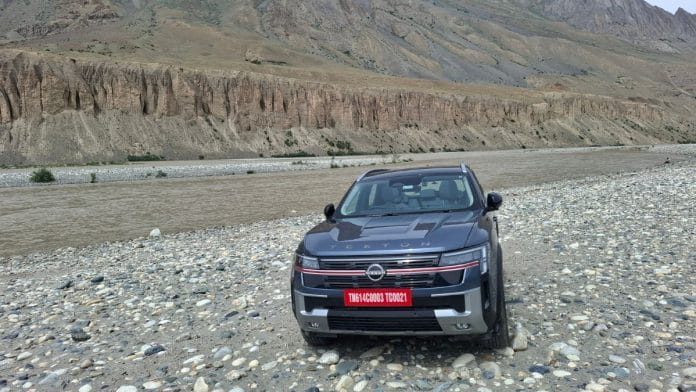


Driving the new Nissan Tekton across western Ladakh reminded me once again that the Border Roads Organisation deserves more appreciation than it gets. I have been very fortunate to drive on several sections of amazing tarmac all across our northern and eastern mountainous border regions, and these guys do a wonderful job of building and maintaining roads despite some incredibly difficult conditions, let alone the altitude.
On this drive, I drove down the newly constructed section of road between Nimmu and Padam in western Ladakh, past the plains of the spectacular Gonbo Rangjom mountain. Then I moved onto the Zanskar valley. You fall short of superlatives to describe the roads and drive. Although I must admit seeing the twisted layers of what was an ancient seabed now towering over 10,000 feet above sea-level does give an instant lesson in plate tectonics.
And thus, it is kind of appropriate that the vehicle I was driving was named the Nissan Tekton.
Nissan India should also be given a huge shout-out here. A convoy of 60 Tektons drove more than 700 kilometres between Chandigarh and Leh. And this was no joyride; it was a proper road test drive. Not over a couple of hours down a straight highway in Rajasthan or the Bengaluru-Hyderabad highway.
Because when you pass through around 16,600 feet at Shinkula Top on such a drive and through the twisty sections of the Zanskar hugging the river where a small mistake can send you hurtling into the silt-laden waters, all while watching carefully for rockfalls, it is no joke. You get to experience a vehicle, warts and all. And it does take considerable bravery to do such a drive.
However, the average Tekton owner will never have to endure such conditions, and will in all likelihood be stuck in bad urban traffic jams. But they will be pleased to note that the vehicle can manage the high Himalayas. There are some niggles, but on the whole the Tekton was pretty darn good.
A standout product from Nissan
One reason for such an exotic journey, I guess, was not only for Nissan India to make a statement that they’re taking the Indian market seriously but also to make the vehicle stand out. Because it is, in essence, a re-skinned Renault Duster. Nissan has added their own touches to the vehicle—the headlight design mimics that of the famous Nissan Patrol, the company’s large offroader. Some other small touches on the exterior do distinguish it a little as well.
And there are some details on the interior that try the same. In terms of onboard technology, particularly with displays and ADAS, they’re identical, albeit with different colours and fonts. Ergo, in terms of design, technology and performance, this is a story of twins who have parted their hair on opposite sides.
So what about that performance?
I was driving the T280 specification of the vehicle, which denotes the torque output of the vehicle, and features the 1.3-litre turbo-petrol engine with 163PS of power. I drove the variant with the six-speed dual-clutch automatic transmission.
In the city and the lower reaches of the hills, this engine and transmission combination is fabulous. As we moved higher, though, it did struggle a bit. However, we were incredibly high up in the mountains. Speeding through the plains of Gonbo Rangjom, it was still 14,500 feet. I felt the need to take the occasional hit of canned oxygen.
The main issue was with the transmission, actually, which clearly (and rightly) was tuned for urban fuel efficiency. It upshifted too quickly, and even when I used the paddle shifters, it switched back to automatic mode before I wanted it to. I later discovered that there was a way of keeping it in permanent manual mode. And that was really useful on the small stretches of roads under construction or damaged by landslides.
Also read: Small workshop to global supplier—how this Indian auto parts maker built a manufacturing empire
Tekton’s fight in CSUV segment
Of course, the transmission did not know how high we were and changed gears at a preset range of engine speed. But engines, just like human beings, are slightly less powerful at altitude. Actually a fair bit less powerful.
But in terms of ride and handling, the Tekton was superb. Mountain roads are by their very definition quite twisty. And the real test of any vehicle is how well it changes direction rapidly. The Tekton did that brilliantly without throwing me around, albeit the fact was that I was alone in the vehicle.
All in all, the Tekton is a fantastic addition to the extremely crowded CSUV segment. But how the vehicle will perform in the market is anyone’s guess. Nissan India has been like a lost child in the woods for the past few years. But that is clearly changing now, because an unserious company would not organise such a complicated drive.
But the market is supreme, and that requires investment in sales and service. And there is an adage in sales, “joh dikhti hai, voh bikti hai.” Sixty cars rushing down. The Zanskar Valley must have convinced a few potential buyers.
(Edited by Saptak Datta)