









The Federation of Automotive Dealer Associations recently released retail automotive sales figures for the past financial year. After a few years of near-stagnant growth, the passenger vehicle market climbed an impressive 13 per cent in the financial year 2025-2026, and sales touched a shade more than 4.7 million units. Two-Wheelers grew even faster at 13.4 per cent with 21.4 million units sold.
The numbers from the Federation of Automotive Dealer Associations (FADA) tend to be a fairly accurate indicator of sales at the retail level, as they use vehicle registration data from the Ministry of Road Transportation and Highways (MoRTH) VAHAN portal and a few Regional Transport Offices (RTOs), which are not part of the portal as yet.
What was interesting to note was that sales of electric vehicles (EVs) were ramping up. In three-wheelers, electrification is now entrenched; 60 per cent of three-wheelers sold are now electric. The operating cost advantages of EVs, especially as small commercial vehicles, are unbeatable, and companies like Bengaluru-based Exponent Energy, which have developed rapid 15-minute charging solutions, are now offering conversion of existing CNG/LPG three-wheelers to electrics.
But the overall annual percentage for electric two-wheelers as a proportion of sales grew from 6.09 per cent in FY25 to 6.54 per cent in FY26. And while the growth of electrics among passenger vehicles was tremendous, as a percentage of sales, it grew from just 2.61 per cent to 4.25 per cent of sales from FY25 to FY26.
Demand for EVs
To look at EV sales through the lens of the whole year does not give the full picture. For example, Tata Motors’ Passenger Electric Mobility’s Chief Commercial Officer Vivek Srivatsa said that the adoption of EVs among the taxi segment had come down. The GST rate cut for passenger cars late last year had driven taxi owner-operators back to CNG vehicles. Of course, the situation was not helped by the failure of large electric taxi operator BluSmart earlier in the year.
That said, sales of EVs have shot up in the past couple of months. In March, for example, sales of electric passenger vehicles touched an all-time high of 22,490 units of the total 4,40,144 passenger vehicles sold, thus crossing the important 5 per cent mark for the first time. Even for two-wheelers, the percentage of electrics sold was a rounding error below 10 per cent.
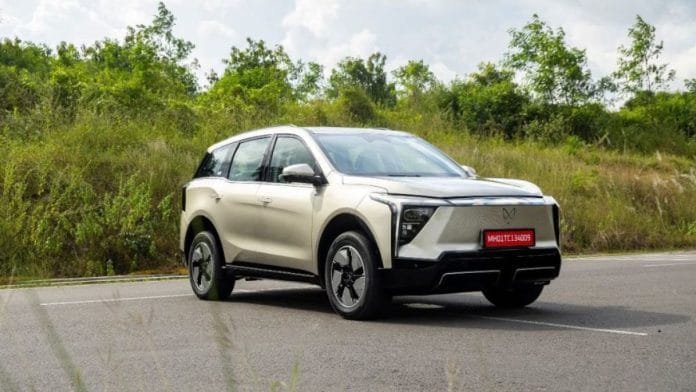
Massive growth for Mahindra, whose XEV9S became India’s top-selling EV model with 3,254 units sold, as well as Maruti-Suzuki’s eVITARA, helping the carmaker into the fourth spot among electric carmakers with 941 units sold. For luxury carmaker BMW India, the numbers were impressive, with one in four of the 4,567 vehicles they sold between January and March being electric.
There are a few reasons for this growth. While taxes play a role, as March is the last month of the government accounting year, and vehicles bought in the name of the company gain depreciation benefits, which are even higher for EVs. But this does not explain the sustained demand for electrics.
Maruti-Suzuki’s Senior Executive Officer, Sales and Marketing, Partho Banerjee, said that despite the carmaker having a restricted supply of the eVITARA to just 2,000 units till the middle of 2026, they will sell the vehicle everywhere there is a Nexa showroom. And that is a similar story across carmakers, initially restricting EV sales to only larger cities, which had less to do with charging infrastructure and more with service support, as EVs require service staff to be trained in handling dangerous high-voltage systems.
Maruti-Suzuki gains here as almost all the service centres can handle high-voltage repairs thanks to their experience with hybrids. More choice in the market has also given fence-sitters more confidence, and that will be reflected in the two-wheeler market. Notably, Royal Enfield’s Flying Flea goes on sale soon.
Also read: VinFast MPV7 can be price warrior against Kia, Ertiga. It’s the features list that’s worrying
The Strait of Hormuz impact
Let us now come to the elephant in the room that is driving EV sales of late, and his name is US President Donald Trump. The situation in Iran has not escaped the Indian car buyers or the current owners. Almost everyone is either impacted or knows of someone impacted by restricted LPG supplies. In eastern and southern India, where CNG pipelines are sparse, autorickshaws, in particular, run on Auto-LPG, and huge queues are the order of the day. Prices of CNG have been increased in areas where private operators run franchises.
The government has cut excise duties on petrol and diesel to control losses at public-sector oil marketing companies and private players who sell petrol and diesel—Jio-BP and Nayara—have increased fuel prices dramatically. Basically, even if the ceasefire holds and the Straits of Hormuz opens up again, almost everyone in India expects petrol, diesel and CNG prices to go up. Not a few rupees but an increase in double-digit numbers is expected, especially if the rise in Aviation fuel prices is any indication.
Petrol already costs more than Rs 100 in major cities like Chennai, Hyderabad and Mumbai, and a 10-15 per cent price hike could see standard E20 petrol in some cities touch Rs 120 a litre. Diesel prices will also rise substantially.
At those prices, even extremely efficient petrol vehicles like the Maruti-Suzuki Victoris will have a running cost of Rs 8-10 a kilometre. The eVITARA from the same manufacturer, if you charge it at residential rates, will cost a rupee a kilometre to operate or Rs 2.50 if you charge at public fast-charging stations. The operating cost difference, or ‘delta’, is huge. Drive 800-1,000 kilometres every month, and you will be saving a lakh a year.
But something I tell people who ask me for car advice is that you are purchasing a vehicle in the now. The now doesn’t just mean fuel prices; it also means your current usage patterns and rules on the ground. Folks who bought a BS-4 diesel vehicle in 2019 now find that they can’t use it when GRAP norms are implemented in NCR and other metropolitan areas. Your commuting distances could change dramatically.
But the fact is that no matter how you cut it, unless you are driving your car just a couple of hundred kilometres every month and fuel efficiency does not matter, an electric or hybrid vehicle makes sense. And the Delhi government’s draft EV policy announced on Saturday realises this, but Karnataka, on the other hand, has withdrawn benefits for EVs.
That said, I do not believe demand-side interventions can keep sustaining EV sales forever; it will be the sheer economics of owning and running an EV.
Kushan Mitra is an automotive journalist based in New Delhi. He tweets @kushanmitra. Views are personal.
(Edited by Saptak Datta)