




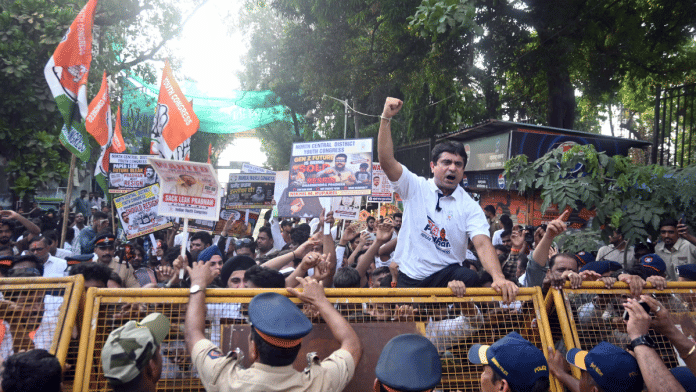

The massive call to gather at Mumbai’s historic Shivaji Park on the eve of Gandhi Jayanti for the ‘Jail Bharo Andolan’, spearheaded by the Cockroach Janta Party, is not a mere transient flashpoint. As a youth of India, I am guided by the spirit of the Constitution, whose principled base lies in Dr Ambedkar’s idea of constitutional morality. I see this announcement as the tangible manifestation of a crisis of trust currently simmering among my fellow youth in India.
When the nation’s young people come out onto the streets to voice their deep anxieties about the erosion of autonomy of foundational bodies, it points to the decline and decay of the democratic principles that form the basis of constitutional morality. In the current case, these anxieties range from the perceived erosion of statutory independence within the Election Commission of India (ECI) to widespread systemic failures in national examination frameworks.
The global history of political theory has some interesting lessons to offer. Time and again, it has been shown that street-level mobilisations are a temporary shield. At most, they can expose a wound, but they lack the legislative and administrative tools to heal it or even initiate the process of healing.
For youth eager to reshape the nation, this raw, anti-establishment energy of contemporary dissent must undergo a critical yet constructive, permanent evolution. To halt this institutional decay, sporadic public outrage must mature into the long-term labour of formal party-building and governance.
The catalyst for the current unrest underscores how critical a rigorous institutional response has become. The CJP’s announced agitation is rooted in a severe institutional fracture. Investigations by The Indian Express revealed that two Election Commissioners, Sukhbir Singh Sandhu and Vivek Joshi, formally objected 14 times over 10 months to decisions regarding the special intensive revision of electoral rolls, which allegedly led to the deletion of millions of voters.
This discord at the highest tier of the ECI, a constitutional body, highlights the perils of relying only on reactive mechanisms. When the very arbiters of the nation’s democratic process are divided over the integrity of regulation, the standard method of civic pressure is not sufficient to effect change in the bureaucracy. It requires something more: a permanent internal counterweight, but one rooted in the spirit of constitutional democracy.
Also Read: Why Manusmriti can’t be defended by cherry-picking its punishments for men
Mass movements need an ideological spine
The vulnerability of contemporary digital movements in this age of AI and post-truth is that they operate in an intellectual vacuum. They are fantastic at diagnosing failures, as everyone will agree. But they are functionally weak at prescribing alternatives that can effect a structural overhaul.
Recently, Ambedkarite artist and author Siddhesh Gautam captured my doubts about these limitations in an interview with ThePrint. Speaking about digital media and its strategies for mobilisation, he stated that while mass public demonstrations represent a “nice way of dissenting”, any protest remains fundamentally incomplete without deep, continuous ideological deliberation and commitment to an agreed principled base.
He also noted that a temporary media surge can never measure the true success of a people’s movement. Echoing Dr Ambedkar, he stated that “it comes when you make leaders for the future”.
I fully agree with Gautam, especially when he says that “ideological clarity” forms the core of a movement and gives it its spine. Without this spine, mass mobilisations risk becoming mere events—short-lived spectacles. In the long run, they cause more damage than they help nurture the spirit of democracy and its institutions.
Political sociologist Sidney Tarrow has extensively documented the phenomenon of spectacular events. He has argued that decentralised, disruptive networks that rely solely on shared outrage often dissolve into internal factionalism or public apathy once the initial zeal of moral indignation subsides.
For India today, “ideology” is not a mere academic luxury. It is the pressing need of the hour. It is the grammar needed to effect a lasting institutional alternative to disenchantment with the status quo.
Lessons from Gandhi and Ambedkar
The leap to organisational longevity can be found in India’s freedom struggle, specifically in the template of Mahatma Gandhi.
Gandhi’s sudden suspension of the Non-Cooperation Movement in 1922 caused the national movement to face a severe crisis, mainly by undermining the momentum of participants and negatively affecting their morale. But Gandhi, the master strategist and politician, knew the limitations of these spontaneous passions. He understood that while they were potent, they could not dismantle a deeply entrenched, highly bureaucratised imperial structure.
And so came his infamous pivot toward the “Constructive Programme”, a patient, decade-long commitment to grassroots organisation, social reform and village-level civic discipline. Gandhi also understood a fundamental truth of power: effective resistance requires durable yet mundane machinery that can survive long periods of political lull. Modern youth movements must adopt this Gandhian template and make the transition from a viral online meme to established booth-level grassroots machinery. This seems to be the way to convert volatile media attention into permanent legislative and executive influence.
There is also a need to understand how modern constitutional democracies fundamentally protect themselves. For real, systemic change to occur, an internal institutional counterweight is required to defend democratic norms from within the state apparatus itself.
This principle informs the life and legacy of Dr BR Ambedkar. His political and social struggles showed that the most durable victories against deep-seated discrimination and institutional decay occur when the marginalised enter the formal corridors of power and participate in the democratic process to draft, defend and execute the law.
Ambedkar warned against a blind reliance on extra-constitutional methods, especially after the adoption and enactment of the Constitution of India, when structured legislative and legal channels are available.
Reversing institutional decay demands a protracted mastery of legal infrastructure, policy formation and painstaking, day-to-day organisational work. As a student of democracy and politics, I feel that there is a need for a mature, unified national party platform to sustain change. To protect the Constitution, one needs the institutional levers necessary to enforce it.
The work of Daron Acemoglu and James A Robinson on institutional economics also demonstrates that the sustainability of freedom, economic prosperity and statutory accountability depends on robust, inclusive institutions. It does not depend on the piety of rulers or the sporadic, external demands of the masses. They further argue that when citizens channel their creative energies into building inclusive political and economic institutions, they tend to create a self-reinforcing loop of democratic accountability.
Movements that fail to institutionalise leave society’s gatekeeping mechanisms highly vulnerable to capture by narrow yet extractive elites. As French political philosopher Alexis de Tocqueville observed in his analysis of democratic governance, the art of association lies in the willingness to build stable, structured and long-lasting political capital through political groups. These are the safeguards that can tackle despotism and remedy democratic instability.
Also Read: Why ‘Reservation Hatao’ agitation at Jantar Mantar is a direct assault on women
From protesters to political stakeholders
The current moment of widespread youth dissent in India must be understood as a profound turning point in the grammar of protest in an era of ongoing institutional decay. My worry, as well as my fear, as a fellow youth, is that this explosive, anti-establishment energy must not be allowed to evaporate into a mere historical footnote or viral digital memory.
It must be channelled consciously into a forward-looking roadmap that prioritises institutional party-building over short-term spectacle. By interweaving the ideological rigour championed by contemporary critics like Siddhesh Gautam with the meticulous grassroots organisational discipline of Mahatma Gandhi’s Constructive Programme and, more importantly, the unyielding constitutionalism of Dr BR Ambedkar, the youth can transition from external protesters to internal stakeholders.
The view that joining, building and sustaining formal political parties is a compromise with the system has to be countered. In fact, it is the ultimate act of democratic reclamation. Only by entering the permanent institutional architecture of formal governance can India’s youth safeguard their future, restore statutory independence and rebuild an enduring republic based on the ethos, pathos and logos of constitutional morality.
Nikhil Sanjay-Rekha Adsule is a lawyer, an alumnus of TISS, Creighton Peden Scholar, USA, and a Senior Scholar at IIT-Delhi. He tweets @Surajya_Raje_. Views are personal.
(Edited by Asavari Singh)