






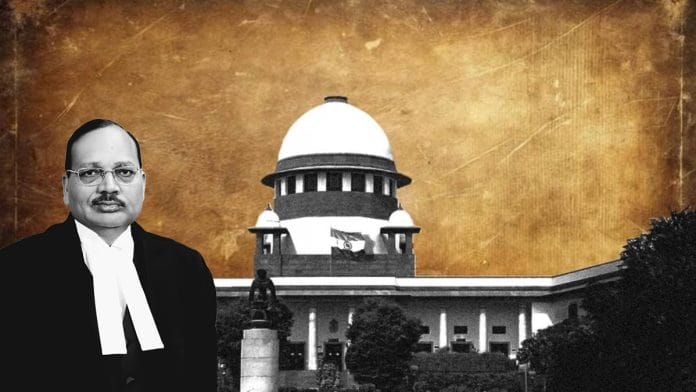



Chief Justice of India Surya Kant sounded deeply perturbed last week as he observed: “Whenever elections come, this court becomes a political battleground.”
Two Communist parties were among the petitioners who had approached the Supreme Court seeking action against Assam Chief Minister Himanta Biswa Sarma for his ‘hate’ speeches and videos. The Chief Justice of India, heading a three-membebr bench, took exception to the fact that the petitioners had come directly to the Supreme Court.
“The entire effort is to undermine, demoralise the high courts, which is not acceptable to us,” he said. The judges weren’t impressed by Senior Advocate Abhishek Singhvi’s reference to 17 previous instances when the apex court had entertained petitions under Article 32 that gives individuals the right to approach the Supreme Court for the enforcement of fundamental rights.
The CJI was equally probing while hearing another litigation concerning alleged ‘hate speeches’ by BJP CMs and leaders. “Come with an impartial and neutral petition…Ultimately, there must be restraint in speeches from all sides…You haven’t cited a single example from the other side,” said the CJI.
Senior Advocate Kapil Sibal finally agreed to file a revised petition after deleting the names.
Supreme Court as political arena
With around 90,000 pending cases and only 33 judges, CJI Surya Kant has good reasons to worry about politicians taking their political battles to the Supreme Court. It’s mostly the Opposition parties. Only a couple of weeks back, West Bengal Chief Minister Mamata Banerjee showed up at the Supreme Court as a petitioner and spoke against the Special Intensive Revision (SIR) exercise of the Election Commission. Her cameo appearance got rave reviews back home—in poll-bound West Bengal.
CJI Surya Kant is, therefore, right. The Supreme Court does become a political battleground whenever there are elections—or political disputes, big or small. There is no escaping, though. Judges, by the very nature of their job, can end up, however unwittingly, changing the contours of the political landscape and creating or destroying the fortune of many politicians and political parties.
Remember the big Maharashtra political crisis of 2022, when Eknath Shinde, along with 16 MLAs, had rebelled against Shiv Sena chief Uddhav Thackeray. It was the Supreme Court vacation bench of Justice Surya Kant and Justice JB Pardiwala whose two interim orders led to the fall of the Maha Vikas Aghadi (MVA) government. Governor Bhagat Singh Koshyari had called for the floor test on 30 June. On June 27, the vacation bench gave an interim relief to rebel MLAs, giving them time till 12 July to reply to disqualification notices, which they were supposed to do by that evening only.
It meant that the rebel Sena MLAs could not be disqualified till 12 July, thus they could vote during the floor test on 30 June. On June 29, the bench met after the court hours and rejected the Thackeray-led Sena’s plea to stay the floor test. Chief Minister Uddhav Thackeray chose to resign before that, as the MVA didn’t have the numbers. The rest is history. A year later, in May 2023, a constitution bench led by then CJI DY Chandrachud concluded that Governor Koshyari’s decision to call for a floor test was illegal. The court said that Thackeray could not be reinstated as the CM because he had resigned before the floor test.
CJI Kant’s pain about the Supreme Court being made a political battleground by parties is understandable. There is not much he or fellow judges can do about it. Thackeray might have reasons to feel wronged by the vacation bench’s interim orders. That changed Maharashtra’s political landscape and has led to his party getting pushed to the political margins today. He should, however, appreciate the fact that the SC constitution bench had the time to properly examine the matter while the vacation bench was hard-pressed in the middle of a political storm.
Also read: Modi govt’s increasing reluctance to share information—Pakistan link in Delhi blast to PM CARES
Election season and contentious cases
Our judges are aware that political parties can turn their orders or even oral observations into poll campaign fodder. The judiciary can resent this tendency of the political class, but can’t help it. Four states—Tamil Nadu, Kerala, West Bengal, and Assam—and the union territory of Puducherry are set to go to polls in March-April. The piling up of pending cases also means that the Supreme Court sometimes can’t decide on time-sensitive cases.
For instance, in November 2025, a writ petition was filed in the Supreme Court challenging the Election Commission’s decision not to undertake special intensive revision (SIR) in Assam, as it had done in Bihar and 12 other states. Instead, the ECI opted for a special revision in Assam, arguing that the state has a separate provision under India’s citizenship laws and the Supreme Court-monitored citizenship identification process was about to conclude.
It was not clear what Chief Election Commissioner (CEC) Gyanesh Kumar meant by the court-monitored process. He was probably referring to the National Register of Citizens (NRC) in Assam. A clutch of petitions demanding its reverification and implementation has been pending with the Supreme Court. The CEC’s explanation, however, didn’t hold water. Given the repeated assertions by Union Home Minister Amit Shah and CM Himanta Sarma about infiltrators in Assam, it was only incumbent on the ECI to conduct SIR of electoral rolls in the state to weed out those infiltrators if they figure on the voters’ list.
Without that, the integrity of the voters’ list is bound to be questioned. Anyway, a CJI-led bench disposed of the November 2025 plea seeking SIR in Assam, terming it as “infructuous” because the ECI had completed the special revision and published the final electoral rolls early this month.
Last week, a CJI-led bench again came down heavily on the growing ‘freebie’ culture in states while hearing a petition emanating from the DMK-led government’s proposal to provide free electricity in poll-bound Tamil Nadu. CJI Kant asked why the scheme had been announced at the last minute, just ahead of the elections. The court, however, clarified that its remarks were directed at the freebie culture in all states, not just Tamil Nadu. CM Stalin may not find it very reassuring, though.
In another ruling last week, a CJI-led bench set a two-week window—from 7 to 22 April—for the Supreme Court to complete hearings on a batch of petitions in the controversial Sabarimala women’s entry case. Supporting the SC’s verdict allowing women of all ages entry into the shrine had cost the Pinarayi Vijayan-led government dearly in the 2019 Lok Sabha election. In 2021, Kerala went to the polls for the Assembly elections on 6 April. CM Pinarayi Vijayan must therefore be an anxious man today. What if his government has to take a stand in the Supreme Court on women’s entry into the Sabarimala shrine before the day of voting this year?
In another decision last week, a CJI-led bench scheduled a four-day final hearing, from 5 May, on petitions challenging the validity of the Citizenship Amendment Act. It is likely to rekindle the debate over the contentious CAA, particularly in poll-bound West Bengal and Assam.
A series of pronouncements by CJI Surya Kant-led benches last week—from Sabarimala to CAA and freebies—are set to resonate in the coming Assembly elections. That’s despite the CJI’s strong views about the Supreme Court becoming a political battleground for parties.
Meanwhile, Chief Election Commissioner Gyanesh Kumar must be watching these developments very closely, especially the dates set by the apex court to hear petitions in long-pending contentious cases.
DK Singh is Political Editor at ThePrint. He tweets @dksingh73. Views are personal.
(Edited by Ratan Priya)